Skip to content
  English
  Russian
  Turkish
  Spanish
  French
  German
  Japanese
Every stage of medicine production depends on correct and trusted data. Even a small mistake can affect product safety and patient health, so protecting information is very important. Data integrity in the pharmaceutical industry helps maintain honest records and supports safe manufacturing. In this article, we discuss its role and importance.
What is Data Integrity in the Pharmaceutical Industry?
Data integrity in the pharmaceutical industry means keeping all data complete, correct, and unchanged from the time it is created. It covers every record made during the research, manufacturing, and testing of medicines. This includes paper documents, electronic files, lab results, and machine readings.
Video source: https://www.youtube.com/watch?v=NfIWk6xA40A
For example, when a new drug is made, the temperature and pressure data recorded by machines during production must be accurate and safely stored. Machine training at the site helps workers learn how to record and handle such data accurately.
Data integrity also means that every entry can be traced back to the person who created it and the time it was made. Whether information is written or electronic, it should be straightforward, original, and easy to read whenever needed. When these practices and strategies for data integrity are followed, companies can ensure their data remains complete and trustworthy.
Importance of Data Integrity in Pharmaceutics
Data integrity is central to how medicines are developed, tested, and produced. Without correct and complete data, no process in a pharmaceutical company can be trusted or repeated safely. The importance of data integrity cannot be stressed enough, as it affects everything from patient health to company reputation:
Protecting Patient Safety
Data integrity in the pharmaceutical industry helps keep patients safe by making sure all test and production data is accurate. When data is recorded and followed correctly under SOP in the pharmaceutical industry, unsafe products can be caught early. This prevents harmful drugs from reaching people.
Maintaining Product Quality
Strong and correct data keeps product quality the same in every batch. Accurate records help workers spot mistakes during mixing, testing, or packaging. The act of precise record keeping makes sure that each medicine meets the same standard of safety and effectiveness.
Meeting Regulatory Requirements
Government agencies need clean and complete records before approving any medicine. Data will be correct and easy to trace, which shows that the company follows proper rules. This helps pass inspections smoothly and allows the company to make and sell its products.
Building Trust and Transparency
Data integrity in the pharmaceutical industry helps create honesty between companies, regulators, and patients. When all results are recorded clearly, anyone can check how medicines were made. The open process builds trust and strengthens a company’s good name.
Reducing Financial and Legal Risks
Correct and honest data helps companies avoid heavy losses, product recalls, and legal action. With all the steps being recorded clearly, mistakes are easier to spot and fix. Doing this saves time, money, and protects the company from severe penalties or damage to its name.
Supporting Audits and Inspections
Organized and accurate data support better audits by giving a clear picture of company activities. Auditors can easily trace how medicines were produced and tested, reducing delays or doubts. It also reflects the company’s commitment to honest work and safe manufacturing practices.
Regulatory Framework and Global Guidelines
Rules and guidelines about data integrity in the pharmaceutical industry are made to keep medicine-making safe and authentic. They tell companies how to record, store, and check data at every stage. These global rules help all countries follow the same standards and keep patients protected in every part of the world.
Regulatory Framework and Global Guidelines
Different international agencies set clear rules to make sure medicine companies follow safe practices.
The rules cover how data is created, handled, and saved in the pharmaceutical production line. They also require that all information stay complete and unchanged, from testing materials to packing the final medicine.
European Union GMP Annex 11 and Annex 15
The European Union gives detailed instructions through Annex 11 and Annex 15 of Good Manufacturing Practice (GMP). Annex 11 focuses on computer and electronic systems to keep data safe, while Annex 15 explains how to test and qualify equipment.
Together, they make sure digital and physical records stay correct and traceable, fulfilling data integrity in the pharmaceutical industry.
WHO and PIC/S Guidance Documents
The World Health Organization (WHO) with the Pharmaceutical Inspection Co-operation Scheme (PIC/S) provides guidance used by many countries. They help companies build a strong culture of honesty and proper recordkeeping. These documents also explain how inspections should be done and how staff should handle data responsibly.
Common Data Integrity Issues
Many problems can affect how data is handled during medicine development and testing. These data integrity issues in the pharmaceutical industry mostly happen because of human error or poor recordkeeping. Finding and fixing them early is important to keep the data accurate and complete.
Human Errors and Poor Documentation
Simple mistakes like forgetting to record test results or writing them later can cause big problems. Missing or unclear information makes it hard to prove that a process was done correctly. Careful training and real-time recording help reduce such errors.
Data Manipulation
Changing, hiding, or re-entering data to make results look better is a serious issue. It damages trust and can lead to unsafe medicines reaching the market. Companies must check records to stop this kind of behavior and to keep data integrity in the pharmaceutical industry.
Incomplete or Lost Records
Sometimes, important files or reports go missing due to bad storage or computer failures. This makes it impossible to confirm how a product was made or tested. Safe backups and organized systems help prevent this problem.
Principles of Pharma Data Integrity
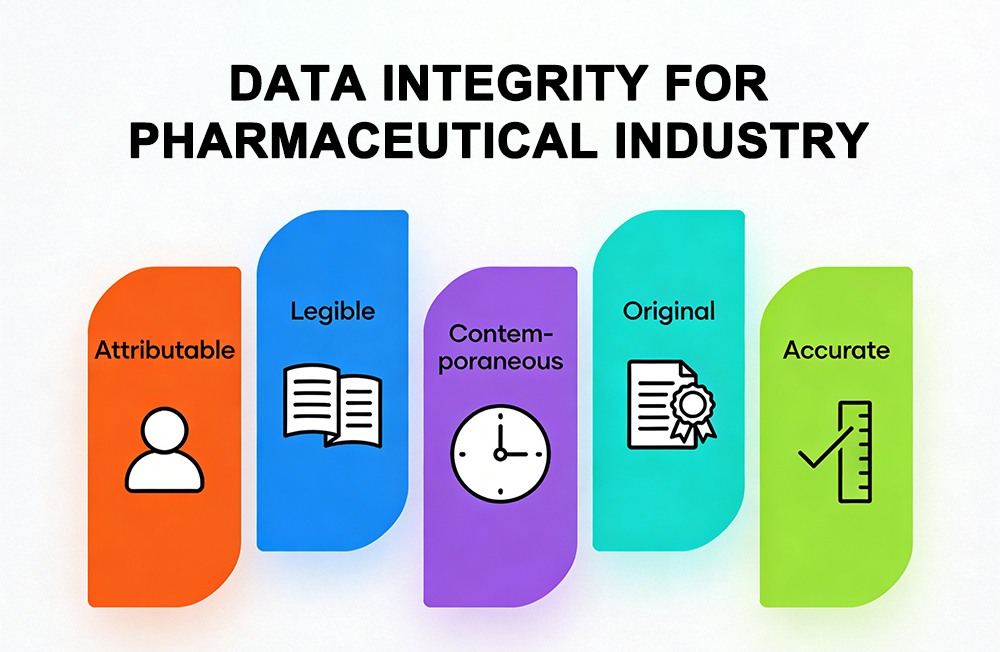
The basic rules of keeping data safe and correct are called the principles of data integrity in the pharmaceutical industry. These principles make sure that every piece of information collected during medical research, testing, and production is true and complete. They guide how records should be created, checked, and stored in daily work.
Main Principles:
- Attributable: Each entry should show who did the work and when it was done.
- Legible:All records must be straightforward and easy to read at any time.
- Contemporaneous: Data should be written or saved at the same time the work is done.
- Original: The first record or a verified copy should always be kept safely.
- Accurate: All information must be correct and free from errors.
- Complete: Every part of the process should be recorded, with nothing missing.
These principles work together to keep information trustworthy from the start of production to the final medicine. By following them, companies can prove that every result is true, every step is recorded, and nothing is hidden or changed. This builds confidence in the safety and quality of medicines made for patients.
FAQs
What are the four types of data integrity?
There are four types of data integrity: physical, logical, entity, and referential integrity. Physical integrity protects data from damage, while logical integrity ensures the information remains correct. Entity and referential integrity keep data consistent and properly linked within databases.
What is Alcoa+++ in pharma?
ALCOA+++ stands for Attributable, Legible, Contemporaneous, Original, Accurate, Complete, Consistent, Enduring, and Available. It is a guideline in the pharmaceutical industry which makes sure that all data is trustworthy and properly recorded.
How do you validate data in pharma?
Data validation in pharmaceuticals means checking that information is accurate, complete, and trustworthy. It involves system audits, review of raw data, and verification of electronic entries.
Conclusion
Keeping data accurate and complete is an important part of medicine making. It helps protect patients, maintain product quality, and follow global standards. Good data practices also build trust and show responsibility in every part of the process.
If you are in need of machinery for packaging equipment, we offer a huge range of options. Our collection includes capsule strip packaging machines and many other types of pharmaceutical machinery. We also provide services that you can request at any time to support your production needs. Contact us today for information on our machinery and services.