Skip to content
  English
  Russian
  Turkish
  Spanish
  French
  German
  Japanese


Need a Cutsom Quote
Or More information About this product? Contact our sales stuff today!
Key Features
Technical Data
Machine Details
Application
FAQ
Reviews No reviews yet
Videos
Output: 150-450 kg/hour.
Soft candy production steps: Dissolve raw materials → Cook → Convey → Filter → Store→ Mix → Deposit → Cool → Demold → Convey → Dry → Mix sugars → Choose → Pack end product.
An HMI and PLC control production.
Suitable for temperatures of 20-25℃.
| Item | Model | SE-150 | SE-300 | SE-450 |
| Output | 150kgs/h | 300kgs/h | 450kgs/h | |
| Sugar block weight | 5g | 5g | 5g | |
| Pouring times | 30~45n/min | 30~45n/min | 30~45n/min | |
| Steam | Consumption | 100kgs/h | 200kgs/h | 300kgs/h |
| Pressure | 0.2~0.6Mpa | 0.2~0.6Mpa | 0.2~0.6Mpa | |
| Compressed air | Consumption | 0.2m/min | 0.4m3/min | 0.6m3/min |
| Pressure | 0.4-0.6Mpa | 0.4-0.6Mpa | 0.4-0.6Mpa | |
| Environmental requirements | Temperature | 20~25℃ | 20~25℃ | 20~25℃ |
| Humidity | 55% | 55% | 55% | |
| Total power | 18kw/380V | 12kw/380V | 15kw/380V | |
| Production line total length | 13.5m | 14m | 15m | |


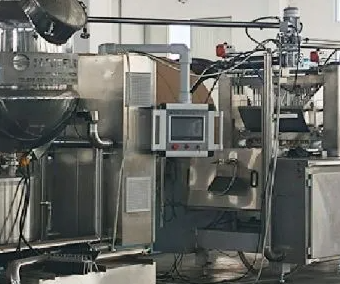

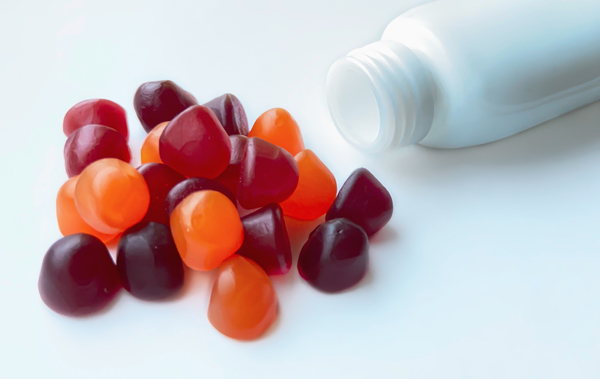


Mixing & Cooking: Ingredients (water, sugar, glucose syrup, gelatin, starch, acids, flavors, colors) are precisely weighed and cooked in a dissolving and cooking station.
Depositing: The hot, liquid candy mass is pumped into a depositor, which precisely fills starch or silicone molds with the desired shape.
Cooling & Setting: The filled molds travel through a cooling tunnel, where the candy sets and solidifies.
Drying & Curing (for Starch Molds): If starch molds are used, the trays are stacked in a drying room for 24-48 hours to remove excess moisture and achieve the correct texture.
Demolding & Cleaning: The set gummies are removed from the molds. Starch is shaken off and recycled; silicone molds are simply released.
Polishing & Oiling: Gummies are tumbled in a polishing drum with a food-grade coating oil (like beeswax or carnauba wax) to prevent sticking and add shine.
Inspection & Packaging: Gummies are inspected (manually or by vision systems) and then packaged into bags, boxes, or other containers.
Gelatin-Based Gummies: The classic, chewy texture.
Starch-Based Gummies: Often used for firmer candies like jelly beans, but can be formulated for gummies.
Pectin-Based Gummies: A vegetarian/vegan alternative with a firmer, fruitier bite.
Agar-Based Gummies: Another vegan option, with a different, more brittle texture.
Custom Shapes & Sizes: By changing the molds, you can produce bears, worms, rings, bottles, and any custom shape you can imagine.
Starch Moguls: Trays are filled with compressed corn starch, and impressions are made by a mold board. Ideal for high-volume production of simple shapes. Requires a drying room and a starch recycling system. Lower mold cost but higher space and energy requirements.
Silicone Molds: Reusable, flexible molds, often on a continuous belt. Better for complex, detailed shapes and faster setting times (no long drying needed). Higher initial mold cost but more efficient for medium-scale production.
This varies greatly by output capacity (e.g., 100 kg/hr vs. 1000 kg/hr). Generally, you will need:
Space: A clean, hygienic facility with separate areas for raw material storage, production, drying (if applicable), packaging, and finished goods. A small line may fit in 150 sq. meters, while large ones require 500+ sq. meters.
Utilities: Stable 3-phase electrical power, clean water supply, drainage, and compressed air. For starch lines, significant steam or gas may be needed for the drying room.
This is usually a temperature issue.
Mass Too Cold: Ensure the hopper, pipes, and depositor head are heated to the correct temperature (typically between 80-95°C / 176-203°F, depending on the recipe).
Recipe Issue: High gelatin content or incorrect acid/sugar balance can cause premature setting.
For Starch Molds: The starch may be too dry or too moist. Check moisture content (typically 6-8%). The mold impression might not have been dusted properly.
For Silicone Molds: The molds may be worn out or damaged. Ensure you are using a food-grade mold release agent if recommended. The recipe might be too sticky (high sugar content).
Air Bubbles: The mass was not de-aerated properly after mixing. Ensure your cooking/mixing system has a vacuum function to remove air.
Tails (Stringing): The depositor nozzles are lifting away too slowly, pulling strands of candy. Adjust the "cut-off" timing and speed of the depositor head. The viscosity of the mass might be too high (check temperature and recipe).
Flush the system with a neutral, hot base mass (e.g., just sugar, glucose, and gelatin).
Disassemble and clean the hopper, pumps, pipes, and depositor heads thoroughly with hot water.
Wipe down all surfaces. Always run a small batch of the new recipe as a "purge" before full production.
Common causes include:
Incorrect Water Activity (aw): The final moisture content is too high. Review the drying/curing process and recipe.
Microbial Contamination: Poor hygiene in the production area. Implement stricter sanitation protocols (CIP systems, deep cleaning).
Poor Packaging: The packaging material does not provide an adequate barrier against moisture and oxygen.
Texture is primarily controlled by the gelling agent.
Softer: Increase the ratio of syrup to sugar; use a lower Bloom strength gelatin; increase moisture content.
Firmer: Increase the amount of gelling agent (gelatin, pectin, starch); use a higher Bloom strength gelatin; reduce moisture content.
Color Fading: Exposure to direct light or high heat during storage. Use heat-stable and light-stable colors. Some natural colors are inherently less stable.
Off-Flavors: Can be caused by:
Flavor Scalding: Adding volatile flavors when the mass is too hot.
Oxidation: Old or improperly stored ingredients.
Cross-Contamination: Inadequate cleaning between batches.
This happens when sucrose molecules re-crystallize. It is prevented by:
Using enough "doctors" (inhibitors): Glucose syrup, corn syrup, or invert sugar interfere with sucrose crystallization. Ensure your recipe has the correct ratio of sugar to glucose syrup.
Proper Cooking: Ensure the mass is cooked to the correct temperature and dissolved completely.
Replace gelatin with a plant-based gelling agent.
Pectin: Most common; provides a firm, clean bite. Requires specific pH and sugar content to set properly.
Agar-Agar: Sets firmly and can tolerate higher temperatures but has a more brittle texture.
Starch: Creates a different, often more gelatin-like texture but can be less clear.
Carrageenan: Often used in combination with other gelling agents.
- Start of Day: Check all heating/cooling systems. Ensure lubricants are filled (food-grade only!). Do a test run.
During Production: Listen for unusual noises. Visually inspect for leaks.
End of Day (Most Critical): Perform a full Clean-in-Place (CIP) or disassembly cleaning. Flush all systems with water. Sanitize contact surfaces. Clear starch and debris from moving parts.
- Mechanical Alignment: Check for loose bolts or worn parts on the depositor carriage.
- Sensor Calibration: The sensors that detect the mold positions may be dirty or out of calibration.
- Programming: Verify the depositing program in the PLC (Programmable Logic Controller) matches the mold layout and machine speed.
Customer Reviews
No reviews yet. Be the first to review this product!