English
  Russian
  Turkish
  Spanish
  French
  German
  Japanese
Study shows that 50% of all active pharmaceutical ingredients (APIs) exhibit poor water solubility. It leads to dosage forms with limited bioavailability and reduced therapeutic efficiency. This challenge has driven the need for innovative technology to enhance drug absorption.
In this aspect, hot melt extrusion formulation serves as an effective approach. Using this efficient system, you can produce more consistent drug quality. Let’s discuss the main process comprehensively!
What is Hot Melt Extrusion Formulation?
Hot melt extrusion formulation (HME) is a continuous drug manufacturing process. In this technique, a drug and a polymer are mixed under controlled conditions. Developers set a precise temperature and pressure to form a uniform dispersion.
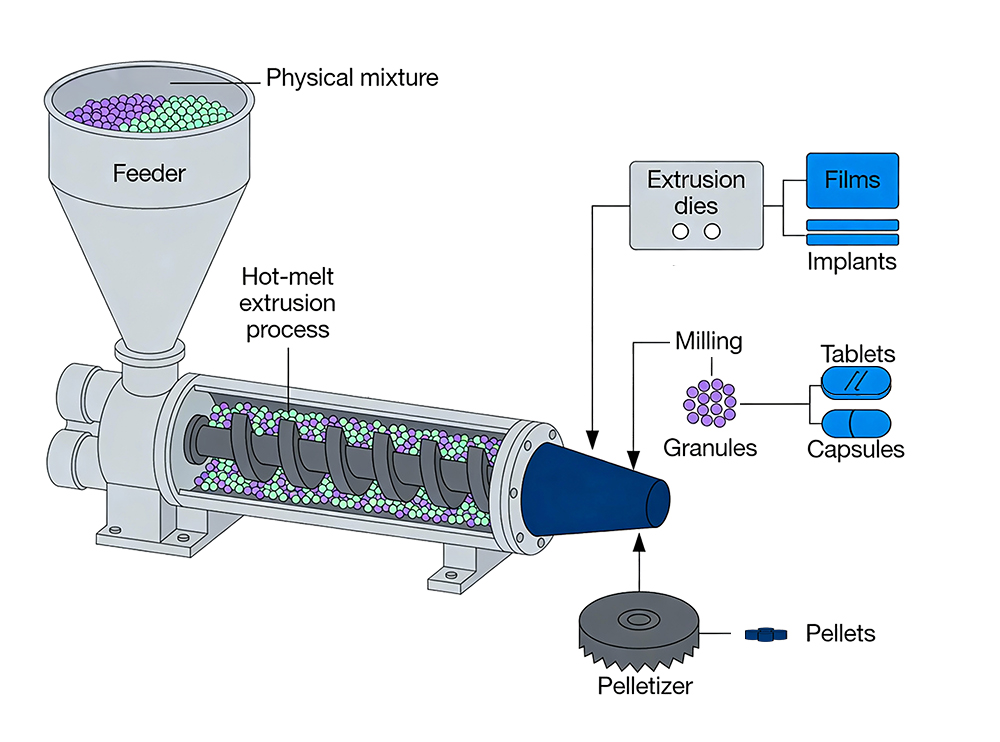
Instead of traditional methods, this technology eliminates the need for solvents. It makes it a more sustainable choice for medicinal preparations. ResearchGate shows that HME is highly prioritized for its solvent-free and eco-friendly approach.
Process of Hot Melt Extrusion Formulation
The process involves melting the polymer and incorporating the API into it using mechanical force. This molten mixture is then forced through an extruder die. It results in forming a homogeneous product. Once cooled, the extrudate is shaped into the desired dosage. It includes tablets, pellets, or films. Here is a step-by-step guide:
1. Feeding
A pre-blended mixture of the drug and excipients is first fed into the extruder through a hopper. This step ensures that all ingredients enter the system at a controlled rate. Proper feeding helps maintain uniform composition.
2. Heating and Mixing
Inside the extruder, the blend is exposed to controlled heating and shear forces. The polymer melts and disperses the drug uniformly. It results in a uniform mixture.
3. Extrusion
The molten material is then forced through a die. It creates an extrudate with the desired shape and dimensions.
4. Cooling and Milling
The extrudate is cooled and milled into appropriate sizes. This step ensures further processing into solid dosage forms.
Equipment Used in HME Process
The success of hot melt extrusion formulation largely depends on the use of specialized equipment. Key machinery includes:
Feeders
Feeders are precision devices used to supply the mixture into the extruder. They regulate the feeding rate to maintain a steady material flow.
Twin-Screw Extruder (TSE)
The core component in the HME process is a twin-screw extruder. It consists of two intermeshing screws that rotate within a heated barrel.
This mechanism provides efficient mixing through different temperature zones. It ensures a uniform drug dispersion within the polymer matrix. The National Library of Medicine reveals that TSE offers efficient blending and granulation.
Heating System
To control the temperature in the extruder, a heating system is required. It ensures that the polymer melts uniformly without degrading the drug. Thus, this setup maintains optimal processing conditions throughout the formulation.
Die Assembly
The core function of die is to curate the shapes of the product. By adjusting the die design, manufacturers can produce the desired dosage form. For example, a round die is deployed for producing a circular tablet.
Cooling Conveyor
After the die assembly, the extrudate is usually hot. To solidify the product, a cooling conveyor is efficient. Proper cooling preserves the product’s structure and prevents deformation.
Pelletizer or Cutter
The pelletizer is used to cut the cooled extrudate into uniform pellets or granules. These are later processed into tablets or capsules.
Downstream Processing Equipment
Downstream processing equipment includes blenders, tablet presses, and coating machines. These are used to enhance the finish of the final pharmaceutical product.
| Equipment | Description | Function |
| Feeders | Delivers the mixture into extruder | Regulate a steady flow for uniform composition |
| Twin-Screw Extruder | Main unit with two rotating screws | Mixes, melts, and disperses materials evenly. |
| Heating System | Regulate heat along the extruder barrel | Helps in melting polymers without degrading the drug. |
| Die Assembly | Shaping tool at the end of the extruder | Convert the molten mixture into desired shape |
| Cooling Conveyor | A system used after extrusion. | Cools and solidifies the extrudate to maintain shape. |
| Pelletizer / Cutter | Mechanical cutter used after cooling. | Cut the extrudate into uniform pellets or granules. |
| Downstream Equipment | Includes blenders, tablet presses, and coaters. | Converts pellets into final dosage forms |
Applications of Hot Melt Extrusion Formulation
HME technology has vast applications in pharmaceuticals. Here’s an overview:
Solid Dispersions:
One of the most common uses of hot melt extrusion formulation is in the development of solid dispersions. This technology helps in converting low-soluble drugs into an amorphous form. It increases the dissolution rate, making the drug more effective in the body.
Controlled and Sustained Release Systems
The process allows precise control over drug release rates. It reduces the need for frequent dosing and increases the therapeutic action.
Taste Masking
Hot melt extrusion formulation is also useful for masking the unpleasant taste of certain drugs. By embedding the API within a polymer matrix, the bitter taste is effectively blocked.
Solvent-Free Processing Applications
HME technology eradicates the need for solvents. It is highly suitable for drugs that are unstable or sensitive to moisture and solvents. This feature makes it a safer approach compared to traditional techniques.
FAQS
What Types of Drugs are Suitable for Hot Melt Extrusion Formulation?
This technique is ideal for poorly soluble drugs. Also, heat-sensitive formulations can be processed under the HME method.
Is Hot Melt Extrusion a Solvent-Free Process?
Yes. HME eliminates the need for solvents. It makes it suitable for moisture-sensitive drugs.
What is the Future of Hot Melt Extrusion Technology?
The future is highly promising. Integration with continuous manufacturing is expanding its potential for producing quality drugs.
Conclusion
Hot melt extrusion formulation is a transformative approach in drug manufacturing. It offers a more effective drug delivery system. However, the quality of the product depends on the equipment used. For producing reliable dosage forms, consider Finetech Pharma machinery. We offer an extensive collection of medicinal equipment to cover your needs. So, utilize your top-notch products to streamline drug production!
References:
Hot-melt extrusion in the pharmaceutical industry
Hot Melt Extrusion Formulation & Manufacturing.
Improving API Solubility Using Hot Melt Extrusion Formulation With Polyvinyl Alcohol.
Copyright Notice:
You may not reproduce, modify, publish, display, transmit, or in any way exploit any content on this website, or use such content to construct any kind of database without prior express written approval by Finetech Group. For permission to use the content, please contact: info@pharmamachinecn.com
Disclaimer:
The information contained in this article is for general information purposes only. The Company does not guarantee the accuracy, relevance timeliness or completeness of any information, and the Company assumes no responsibility for errors or omission in the content of this article.