Skip to content
  English
  Russian
  Turkish
  Spanish
  French
  German
  Japanese
Every medicine we use goes through many careful steps before reaching us. But sometimes, problems still appear and must be handled properly. The CAPA in the pharmaceutical industry helps find the cause, correct it, and make sure it does not happen again. In this article, we discuss how this process keeps medicines safe and trusted worldwide.
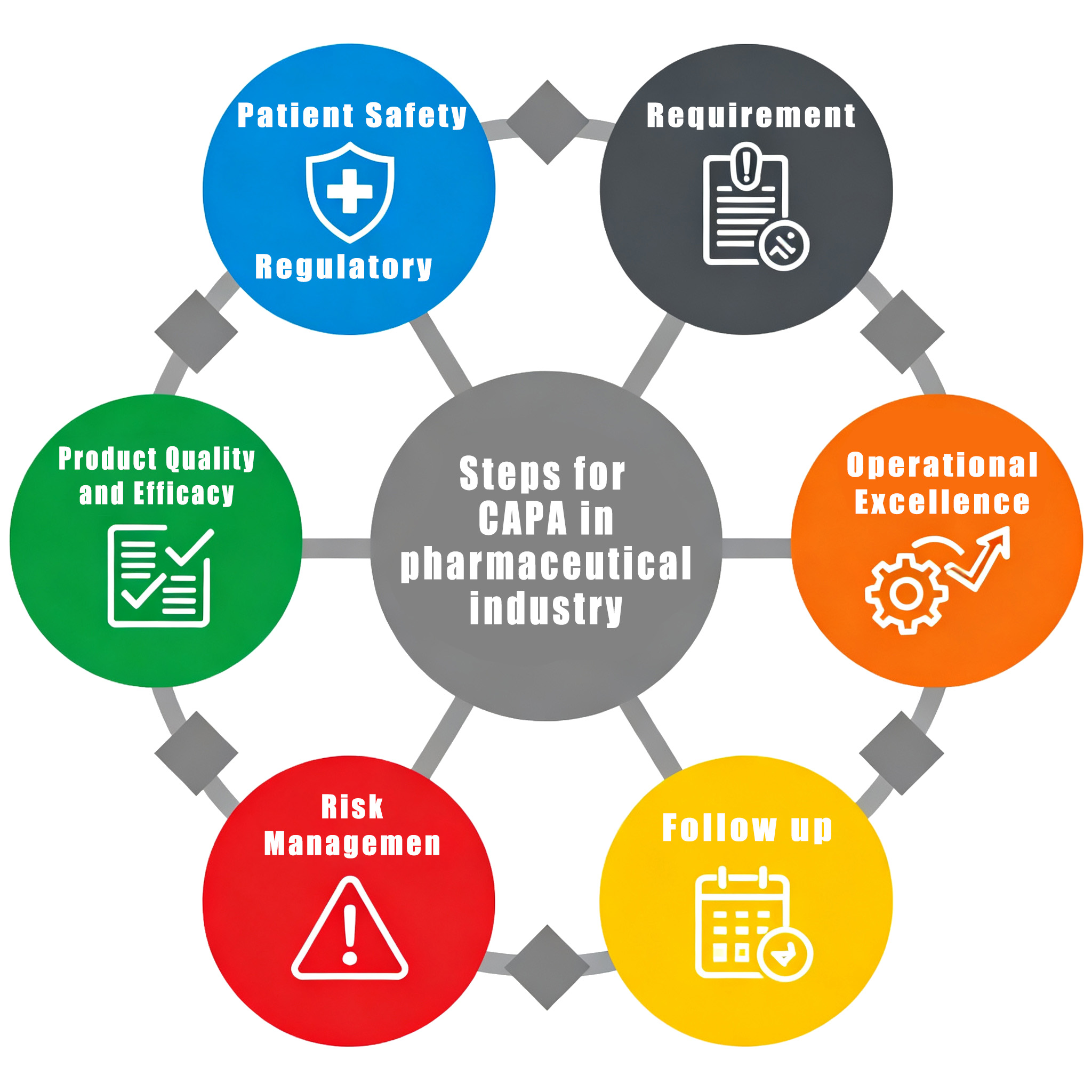
CAPA in the Pharmaceutical Industry
CAPA, short for Corrective and Preventive Action, is a structured quality system that is used to find the root cause of problems, correct them, and prevent them from happening again. It helps pharmaceutical companies learn from their mistakes and improve their processes.
For example, if a batch of tablets fails a quality test, the company investigates the reason, corrects the mistake, and changes the process to prevent it in future batches.
Importance of CAPA in Pharmaceutical Industry
The CAPA in the pharmaceutical industry keeps medicines safe, protects patients’ health, and maintains product quality. It protects patients by reducing risks, supports companies in meeting strict global standards, and strengthens confidence in pharmaceutical products.
Components of CAPA in the Pharmaceutical Industry
The CAPA in the pharmaceutical industry is made up of two main parts: Corrective Actions and Preventive Actions. Both are equally important for improving quality and maintaining safety in medicine production.
Corrective Actions
Corrective actions are taken after a problem has already occurred. The focus here is on finding the root cause and correcting it to prevent recurrence.
For example, if packaging machinery causes labeling errors or damages blister packs, a CAPA investigation looks into the reason, such as machine misalignment or poor maintenance. The issue is then fixed by installing top pharma packaging machinery, and the process is monitored to make sure it does not happen again.
Preventive Actions
Preventive actions are taken before a problem occurs. They focus on identifying possible risks and making improvements early.
For example, if any minor irregularities are noticed during the capsule filling machine process, preventive steps like equipment calibration or staff retraining are introduced.
Together, these components make the CAPA in the pharmaceutical industry a strong system for improving quality and keeping medicines safe for patients.
What is the CAPA Process in the Pharmaceutical Industry
The CAPA process in the pharmaceutical industry is a step-by-step method that helps companies find problems, fix them, and make sure they do not happen again. It focuses on improving product quality, patient safety, and meeting global rules like GMP.
Every step in this process helps the company learn from mistakes and build a stronger and safer system for medicine production.
Problem Identification
The first step is to clearly identify what went wrong or could go wrong. It could be a system failure, product defect, documentation error, or deviation in testing results. The issue may come from many sources, like customer complaints, production records, audit findings, or equipment logs.
Every detail should be written clearly, including when and how the problem was identified, so the team can fully understand it before moving on.
Evaluating Impact and Risk Level
After identifying the issue, the next step is to check how serious the problem is and how much risk it creates. This includes studying whether the problem affects product quality, safety, or company operations.
Problems that can harm patients, delay supply, or damage the company’s reputation are treated as high-risk and handled urgently. This step helps decide what actions are needed and how quickly they should be taken.
Developing an Investigation Plan
When the level of risk is known, the team prepares a plan to investigate the issue. The plan explains what will be checked, who will handle each task, how it will be done, and when it must be completed.
A good plan keeps the process organized, makes sure that no part of the problem is ignored, and helps assign clear roles to everyone involved.
Analyzing the Problem
Now the company gathers data and studies the situation carefully to find the real cause. Methods like the Fishbone Diagram, or FMEA, can be used.
For example, if the blister-packaging machine keeps producing empty or uneven blisters, the team checks maintenance logs, staff training, and raw materials to find what really caused it. The findings are then properly documented for review and analysis.
Creating an Action Plan
Once the cause is known, an action plan is made to solve the problem and prevent it from happening again. The plan lists all the steps to take, changes to make in processes or documents, people responsible, and a clear timeline. It may also include new staff training, updated equipment checks, or revised production rules to strengthen the system.
Implementing and Documenting Actions
The next step is to carry out the plan and record every action. This may include repairing packaging machinery, improving maintenance schedules, or adding extra quality checks. Every completed task is documented so future audits or inspections can easily trace what was done and why. Proper documentation also helps track improvement over time.
Verifying Completion and Effectiveness
The final step is to make sure that the actions truly worked. The company checks records, reviews data, and monitors production to confirm that the issue has not returned. If the process remains stable and no new related problems appear, the CAPA is considered effective and officially closed.
Best Practices for CAPA Management
To make CAPA in the pharmaceutical industry work well, companies should handle problems clearly, quickly, and in an organized way. These simple practices help improve quality and prevent future issues:
- Find the main reason for the problem, not just fix what can be seen.
- Focus on serious issues first that can affect product safety or quality.
- Keep proper records of every CAPA step for checking and audits.
- Train all staff so they know how to follow CAPA rules correctly.
- Use software or tools to track actions and check progress.
It is also highly recommended to review past CAPAs to see what worked and what still needs to improve.
FAQs
How can we verify the effectiveness of corrective actions in pharma?
In the pharmaceutical industry, the effectiveness of corrective actions is verified by confirming that the issue no longer affects product quality, safety, or compliance. This is done through follow-up testing, batch reviews, and trend monitoring of deviations or complaints.
What are the common CAPA mistakes?
Many companies fail to find the real root cause of a problem or use poor investigation methods. Others delay CAPA actions or keep incomplete records. Another common mistake is treating CAPA as a paperwork task instead of a continuous improvement process.
What are CAPA requirements?
The FDA requires companies to have a written CAPA procedure that includes problem detection, investigation, correction, prevention, and documentation. Each CAPA must show clear evidence of effectiveness. Records should be traceable, reviewed, and available for inspections at any time.
Conclusion
Making safe and effective medicines starts with doing things the right way, and that’s what CAPA in the pharmaceutical industry helps with. It involves identifying problems, resolving them, and maintaining smooth operation. If you want equipment that supports this same level of care and quality, get in touch with Finetech and receive the help to make every step of your process stronger.