Skip to content
  English
  Russian
  Turkish
  Spanish
  French
  German
  Japanese
The last step in manufacturing is packaging. It decides how quickly a product reaches the market. However, many plants struggle not because they cannot produce enough tablets or capsules, but because they can’t package them fast enough.

This is where many manufacturers wonder how many packaging lines they should have. If there are too few, it can create bottlenecks. On the other hand, if you have too many lines, you start to drain resources.
Remember that the optimal number of packaging lines depends on your batch sizes, product mix, and level of automation.
If you’re unsure about the exact numbers and machines you need, keep reading.
Key Takeaways
- Packaging Stages: There are three levels: primary (product contact), secondary (labeling and serialization), and tertiary (shipping and logistics).
- Calculation for Packaging Lines: Use this formula to determine how many lines you need:
- Required Lines = Annual demand ÷ Adjusted annual output per line. Example: Packaging 50M tablets per year → You need 75 lines.
- Varying Factors: The number of lines depends on product volume, the number of SKUs, automation, and changeover time.
What Is a Packaging Line?
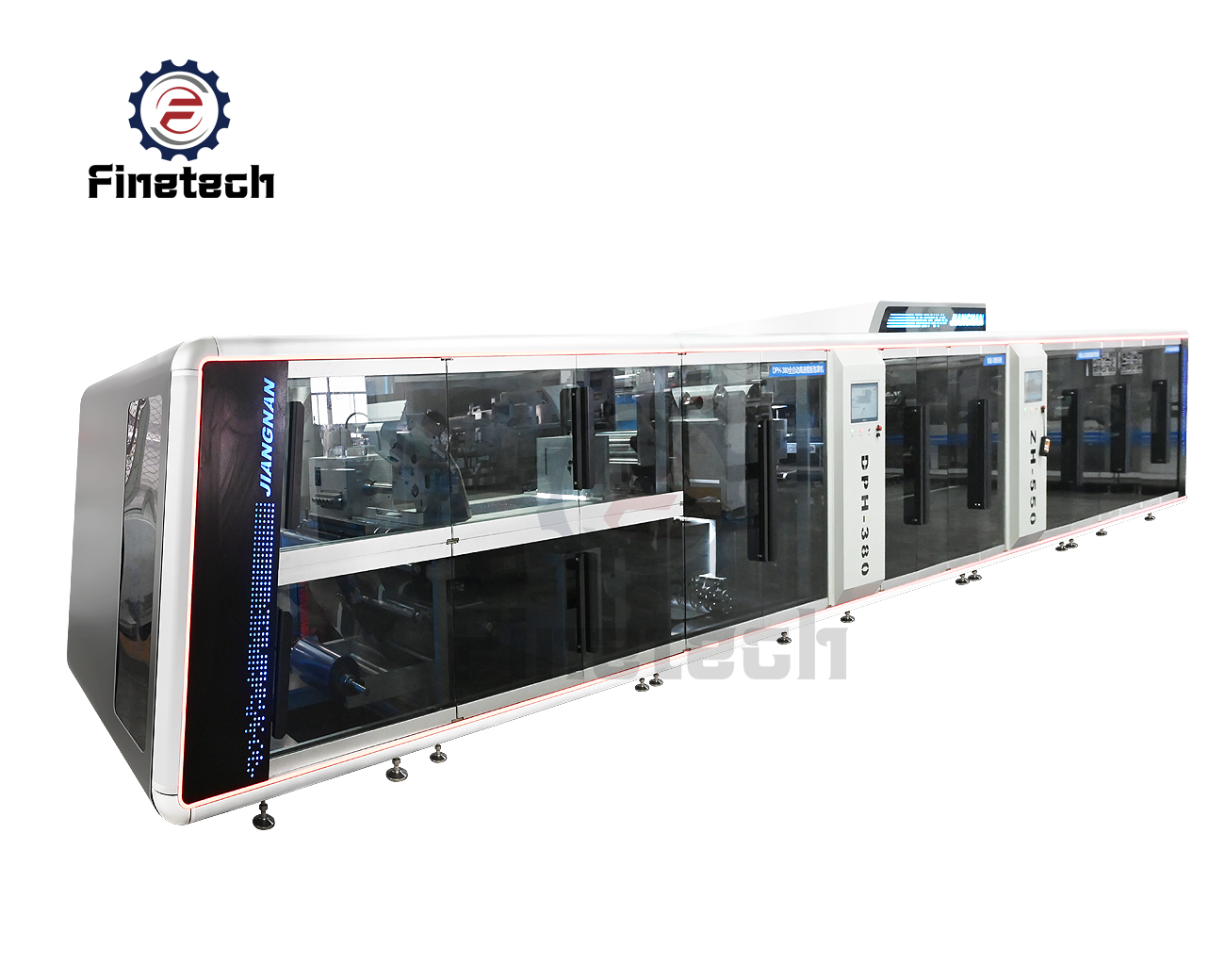
A packaging line in the pharma industry is a series of connected machines and processes that prepare a product for distribution.
It begins with the moment tablets, capsules, or liquids are ready to leave the manufacturing facility and ends when they are sealed, labeled, serialized, and packaged for shipping. This ensures that every unit is accurately counted, protected from contamination, and labeled.
In simple terms, a packaging line handles:
- Filling (blistering, bottling, pouching, etc.).
- Sealing and labeling.
- Serialization and aggregation (tracking codes required by regulators).
- Final packing into cartons, bundles, and cases.
Types of Packaging Lines in Pharma
Pharmaceutical products move through multiple stages before reaching distribution. Each stage of packaging has a specific purpose: protecting the product, ensuring compliance, and preparing it for logistics.
Here’s how it works, broken down into three packaging line types:
1. Primary Packaging
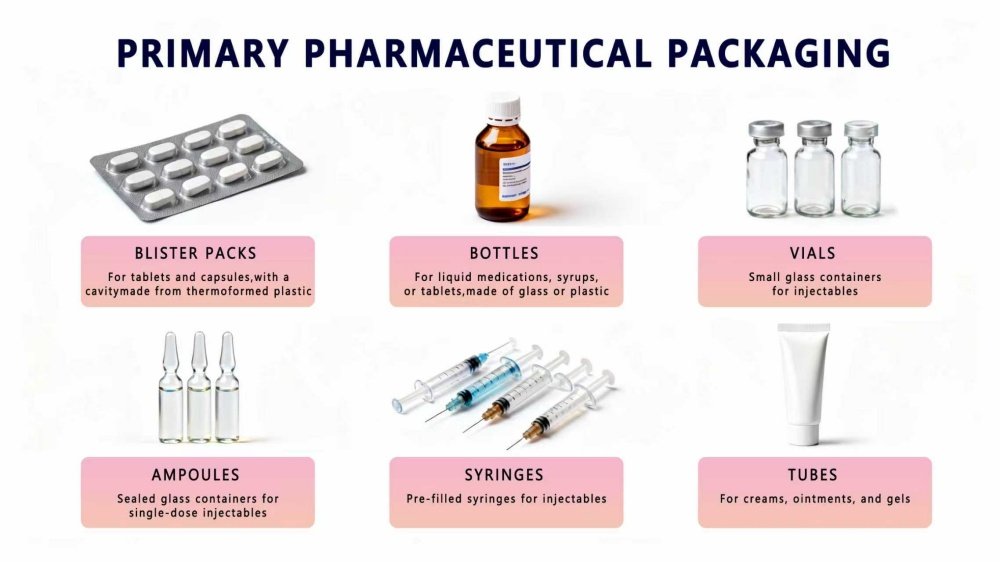
Primary packaging is the first layer that comes into direct contact with the product. Its main job is to protect the drug from moisture, contamination, and physical damage while maintaining its integrity.
Standard primary packaging equipment includes:
- Blistering machines: Seal tablets or capsules in blister packs with aluminum or PVC foil.
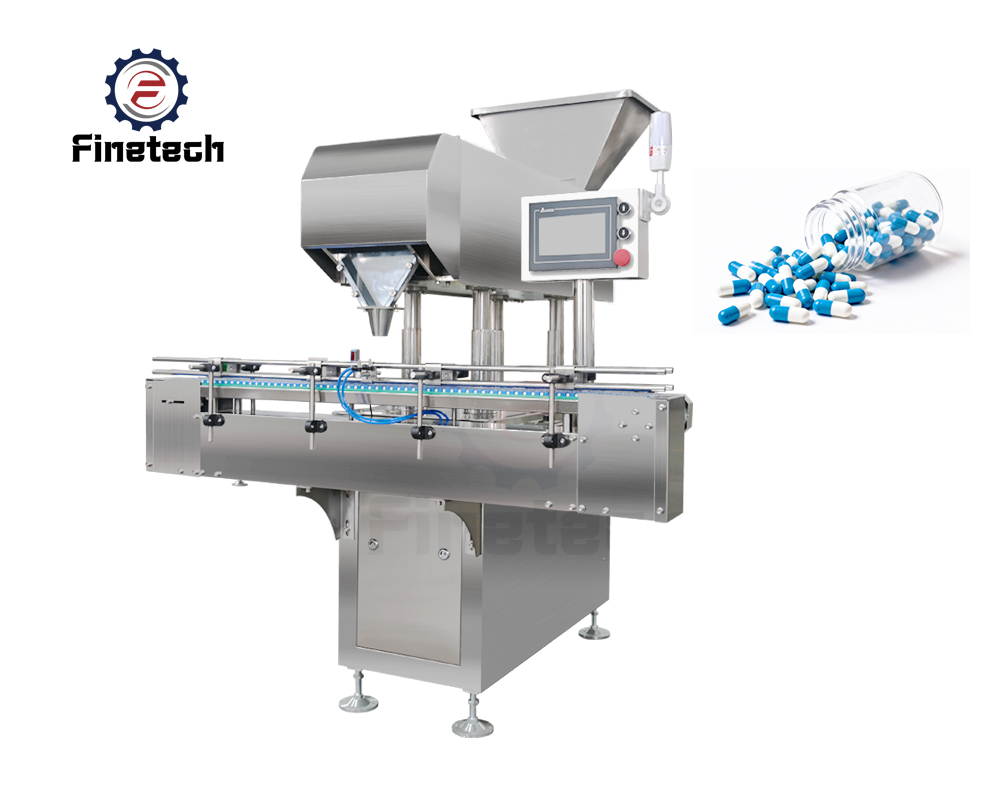
- Bottle counters and filling lines: Count capsules or tablets and fill them into bottles.
- Tube, vial, or ampoule filling lines: For liquids and semi-solids.
This stage ensures that the medicine is safe, protected, and sealed before proceeding to labeling or boxing. Once sealed, the product becomes a SKU-ready unit, which means it’s now a trackable item.
2. Secondary Packaging
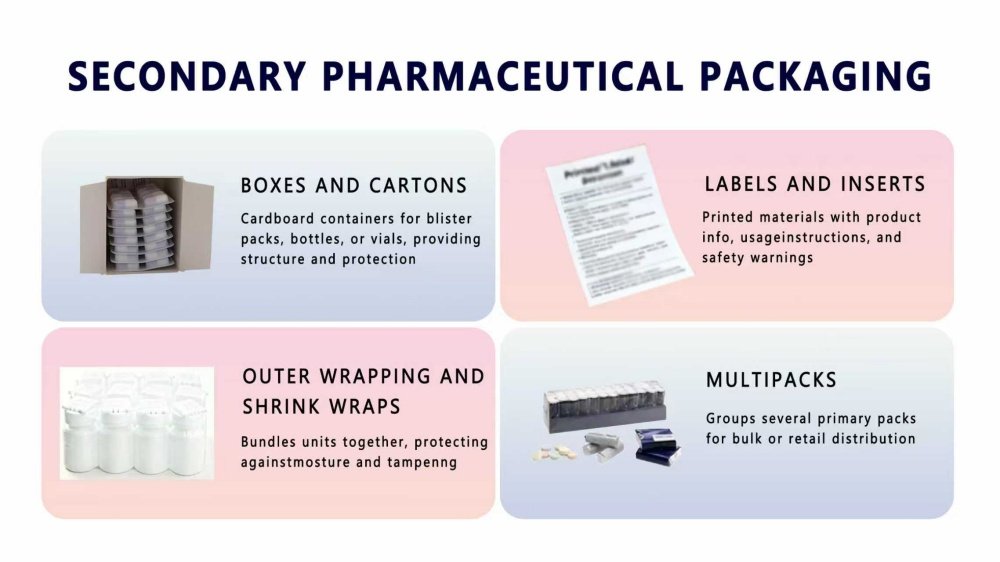
Secondary packaging focuses on presentation, labeling, and compliance. This is where regulatory requirements, such as serialization and batch traceability, are applied. The packaging machines used in this category are:
- Cartoning machines: Place blisters or bottles into individual cartons.
- Bundling machines: Group cartons together using shrink wrap or paper wrap.
- Labeling units: Print and apply barcodes, batch numbers, and expiration dates to units.
- Serialization systems: Generate and apply unique serial numbers required by global regulatory authorities.
In this stage, the packaging line ensures that every unit is traceable and that the printed information is correct and compliant.
3. Tertiary Packaging
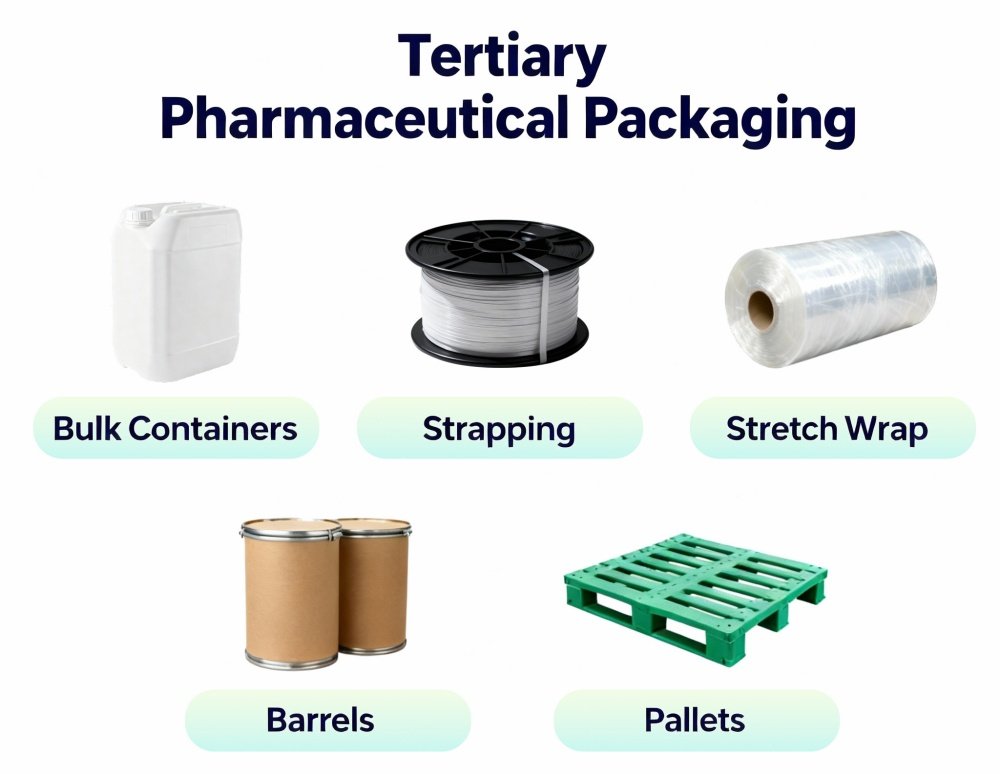
Tertiary packaging prepares the product for transportation and distribution. The goal here is accuracy and safety during shipping. Common machines included in this category of packaging equipment:
- Case packers/shipper forming machines: Pack product bundles into shipping cartons.
- Palletizers: Stack cases onto pallets for stable transport.
- Aggregation systems: Link cartons, shippers, and pallets under a single parent code.
This stage ensures products can move through the logistics chain without damage or loss.
How to Calculate the Number of Packaging Lines (Simple Formula)
Most discussions on packaging lines stop at “it depends.” But companies need a clear method to determine the actual number of lines required. Here’s the simplest way you can calculate the number of packaging lines you need:
The Formula
Line Requirement (per product) = Annual demand ÷ Adjusted annual output per line.
This formula determines the number of packaging lines required based on actual throughput and operating conditions.
Apply The Formula (Example)
Let’s plug in some numbers for a blister packaging line:
| Input | Value |
| Annual Product Demand | 50 million tablets per year |
| Line Speed | 200/minute → 0.005 hours/unit |
| Available Hours | 16 hours/day x 300 days/year = 4,800 hours |
| Utilization Rate | 70% |
Now calculate:
- Calculate the annual output per line first:
- Annual output per line = Machine-hour capacity/cycle time per unit
- Annual output per line = 4,800 ÷ 0.005 = 960,000 units/year before utilization.
- Apply utilization rate (to account for downtime, cleaning, and changeovers):
- 960,000 × 0.70 = 672,000 units/year.
- Determine the number of lines needed:
- Line Requirement = Annual demand / Adjusted annual output per line
- Line Requirement = 50,000,000 / 672,000 ≈ 75 lines.
Rounded answer: 75 blister packaging lines needed.
Why Utilization Rate Matters
On paper, a single line may seem enough. However, in reality, it includes multiple components such as:
- Cleaning and sanitation.
- Changeovers between products.
- Equipment stops and rejects.
- Line clearance for GMP compliance.
That’s why the utilization rate is used instead of 100% uptime, because no packaging line ever runs at maximum speed all year.
Factors That Determine How Many Packaging Lines You Need
You don’t need to copy any other plant because it depends on measurable factors that directly affect output and batch release timelines. Below are the key variables that determine the number of packaging lines a pharmaceutical plant needs.
1. Annual Production Volume
The first step is to understand how much product needs to be packaged each year.
The higher the volume, the greater the packaging capacity required. If demand is steady and predictable, dedicated high-speed lines are better. However, when demand fluctuates seasonally (familiar with OTC products), flexible lines make more sense.
2. Product Mix (SKUs vs. Dedicated Line)
Some plants run only a few high-volume products, while others manage dozens of SKUs. The more product variations you have, the more frequently you will stop the line to change tools, packaging materials, or instructions.
If changeovers occur daily, you may need multiple shorter lines rather than one long line. You can also have a shared line for many SKUs, but that means more changeovers.
3. Changeover Frequency + Downtime
This is the silent productivity killer. Every time a line switches from one product to another, it must be cleaned, cleared, verified, and documented.
Changeovers can take:
- 30 minutes on high-performance lines.
- 8+ hours on poorly structured plants.
A quick method that you can use to calculate the lost time due to changeovers is:
Annual changeover loss = (changeover time × changeovers per week × 52 weeks)
Example:
2 hours/changeover × 3 changeovers/week × 52 weeks = 312 hours of lost packaging time
You can easily reduce the changeover time by standardizing materials and using SMED (Single-Minute Exchange of Die) principles. This increases available line hours without buying another packaging line.
FAQs
1. Are packaging lines expensive to install and validate?
Yes, capital expenditure is significant and validation/qualification (IQ/OQ/PQ) adds time and cost. Costs vary widely by format, automation level and cleanroom requirements.
2. What is line OEE and why does it matter?
Overall Equipment Effectiveness (OEE) measures a line’s availability, performance and quality. Higher OEE can reduce the need for additional lines by improving existing-line capacity.
3. How does batch size influence the number of packaging lines?
Larger commercial batch sizes often require higher capacity lines or multiple parallel lines. EMA guidance notes batch sizes should be compatible with qualified equipment and may influence line selection and quantity.
Get the Right Packaging Lines For Your Needs
Finding the correct number of packaging lines needed isn’t about buying as many machines as possible. It’s about choosing the correct number of lines so your plant runs at full capacity. Too few lines create bottlenecks, while too many lines drain budget, space, and manpower.
If you’re looking for reliable equipment that meets your production needs, Finetech has you covered.
We are a one-stop pharmaceutical equipment partner with complete production and packaging solutions. You can get blister packing machines, capsule counters, bottle filling lines, or even a fully customized packaging setup from us.
Get an instant quote today and let our specialist handle your requirements.
References
TOP 10 Packaging Line Manufacturers In The World.
Packaging Line Equipment | Everything You Need to Know.
Pharmaceutical Bottle Packaging Line.