内容をスキップ
  Japanese
  English
  Russian
  Turkish
  Spanish
  French
  German
In the pharmaceutical industry, URS, short for User Requirement Specification, is one of the first and most important documents in any project.
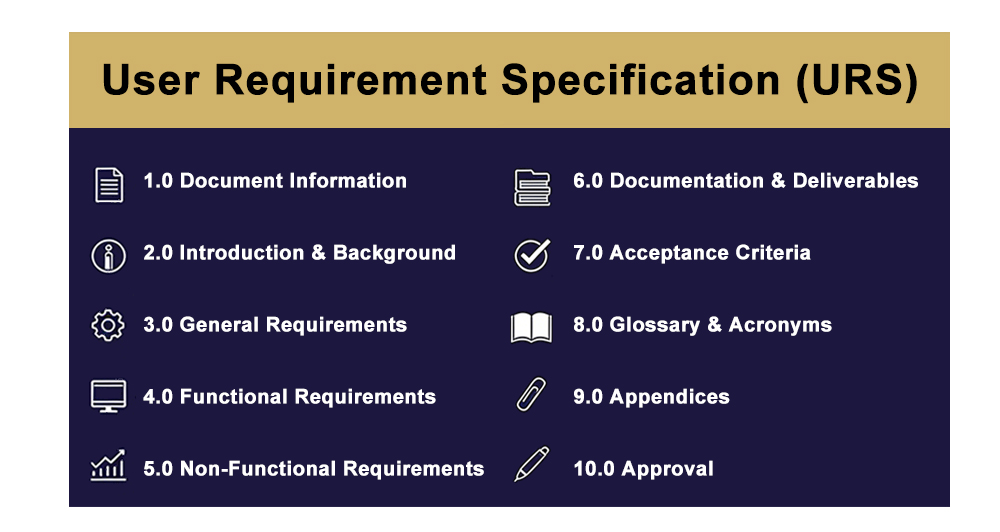
Before equipment is purchased, software is selected, or validation begins, a URS defines exactly what the user expects the system to do. It focuses on user needs, regulatory expectations, and operational requirements.
If you’re wondering what a URS (User Requirement Specification) in pharma is and why it matters, this guide will walk you through everything you need to know.
Let’s get into the details!
What Is URS (User Requirement Specification) in Pharma?
URS is a document that clearly describes what a user expects from a system, 装置, or process. It explains the needs of the user before anything is designed, purchased, or installed. In simple words, a URS answers one basic question:
What should this system do to support safe and compliant operations?
A URS is written from the user’s point of view. The main focus remains on what is required for daily operations, product quality, and regulatory compliance.
For instance, a URS may state that a system must record data accurately, restrict unauthorized access, or support GMP documentation.
When Is a URS Required in Pharma Projects?
A URS is required whenever a system, piece of equipment, or process can impact product quality, patient safety, or data integrity. In these situations, URS is not optional. It is a mandatory starting document that is needed in the following situations:
- Equipment Purchase: When buying manufacturing, packaging, or inspection equipment, a URS defines what the user expects before selecting a vendor.
- Computerized Systems: URS is required for systems such as LIMS, MES, ERP, SCADA, and data loggers.
- Utilities and Critical Systems: Systems like HVAC, purified water, compressed air, and clean steam require URS because they directly impact product quality.
- Manufacturing Lines: URS is required for new production lines, line expansions, or major upgrades.
- Validated Systems: If a system requires IQ, OQ, or PQ, a URS must be in place.
Who Is Responsible for Preparing a URS?
A URS is a user-owned document, and the primary responsibility lies with the end users. These are the people who will operate, maintain, or rely on the system in daily pharmaceutical operations.
While users lead the URS, several teams are typically involved, including Quality Assurance (QA), Engineering teams, IT teams, and Validation teams.
Vendors or consultants also provide guidance or templates, but they should not own the URS. The responsibility always stays with the pharmaceutical company.
Key Components of a Pharma URS Document
Once it is clear that a URS is required, the next step is understanding what goes into the document. A pharma URS follows a logical structure so that user needs are clearly captured, easy to review, and simple to validate later.
To make this easier to follow, let’s walk you through the key components of a pharma URS.
1. Scope and Purpose
The scope and purpose section explains why the URS is being written and what it covers. This is the starting point of the document. It helps everyone understand the boundaries of the system and avoids confusion later.
In simple terms, this section answers questions like:
- What is this system or equipment being used for?
- Which processes does it support?
- What is included, and what is not included?
For instance, the scope may state that the URS applies only to a tablet compression machine and not downstream packaging. The purpose explains the business or GMP reason for the system, such as supporting compliant 製造業.
2. System Overview
The system overview provides a high-level description of the system in plain language. It provides readers with a basic understanding without delving into technical details.
This step usually describes:
- The type of system or equipment.
- Where it will be used.
- How it fits into the overall process.
Example: It may explain that the system is an automated temperature monitoring system used in a warehouse.
3. Functional Requirements
Functional requirements describe what the system must do to support operations. This is one of the most important sections of a URS.
These requirements are written from the user’s perspective and focus on actions and outcomes. Examples include recording data, generating reports, controlling process parameters, or issuing alarms.
4. Regulatory and GMP Requirements
This section explains the regulatory and GMP expectations the system must meet. In pharma, compliance is not optional, so these requirements must be clearly stated.
Some common examples of these include compliance with GMP原則, audit trail availability, controlled access, and proper documentation. This section helps make sure the system supports inspections and meets regulatory expectations.
5. Data Integrity and Security Needs
The data integrity and security section focuses on protecting GMP data. This is especially important for computerized systems.
It explains requirements such as user access control, password rules, audit trails, data backup, and protection against data loss or unauthorized changes. The goal is to ensure data is accurate, complete, and trustworthy throughout its lifecycle.
6. Operational and Environmental Requirements
The operational and environmental requirements section defines how the system must perform in its actual working environment.
This may include operating conditions like temperature, humidity, power supply, and load capacity. It can also cover ease of use, cleaning needs, maintenance access, and operator safety.
Common Mistakes in Pharma URS Documents
Even though a URS is meant to simplify projects, many pharma teams struggle with the same mistakes again and again. If you don’t want to make the same mistakes, here’s what you need to know:
1. Writing Design-Level Requirements
One of the most common mistakes is turning the URS into a technical document. Users often describe how the system should be built instead of what it needs to do.
For example, mentioning specific software, hardware models, or programming logic belongs in later documents, not the URS. The URS should stay user-focused.
2. Using Vague or Unclear Requirements
Requirements that are too general are difficult to test and validate. Statements like “the system should be user-friendly” or “the system must be reliable” do not clearly define expectations.
Each requirement should be specific and measurable. Clear requirements make validation easier and reduce interpretation differences.
3. Copying Vendor Specifications into the URS
Another common mistake is copying vendor brochures or specification sheets directly into the URS. This shifts ownership away from the user and weakens the document.
A URS should describe what the user needs, not what the vendor already offers. Vendor input can be useful, but the final requirements must reflect operational and GMP needs defined by the pharma organization.
4. Missing GMP and Regulatory Requirements
Some URS documents focus only on operational needs and forget regulatory expectations. This can lead to major compliance gaps later.
GMP requirements, data integrity, audit trails, access control, and documentation expectations should be clearly stated in the URS. You can avoid costly corrections during 検証 or inspections by including them early.
5. Poor User Involvement
When URS documents are written without input from actual users, important requirements are often missed. Operators, lab staff, and supervisors understand daily challenges better than anyone.
If there’s a lack of user involvement, you end up with systems that technically work but fail in real-world operations.
よくある質問
1. Why is the URS considered the “Cornerstone of Validation”?
Validation requires proof that a system meets its intended use, and the URS is the document that defines that “intended use” in measurable terms. Without a comprehensive URS, it is impossible to generate an accurate Traceability Matrix or establish meaningful acceptance criteria for Performance Qualification (PQ).
2. What is the difference between a Functional Requirement and a Performance Requirement?
Functional requirements describe what the system must do, such as “the autoclave must record temperature every ten seconds.” Performance requirements specify how well the system must perform, such as “the temperature must remain within ±0.5∘C of the set point.”
3. Can a URS be modified after it has been officially approved?
Changes to an approved URS are permitted but must be managed through a formal Change Control procedure. This ensures that the impact of the modification on the overall project and validation status is fully assessed and documented.
Don’t Let a Strong URS Fail at Execution
A URS (User Requirement Specification) in pharma is where every project takes shape. Having a strong URS sets the direction, but execution is what determines success.
That’s where the right equipment partner, like Finetech, matters.
With over 30 years of experience, we help manufacturers turn documented requirements into reliable, GMP-compliant production systems. We work closely with manufacturers to support customized equipment solutions and production planning.
Reach out to us to support your next phase of implementation.
参考文献:
How to Write a GMP-Compliant User Requirement Specification (URS).
User Requirements Specification (URS).
How to write a URS for pharmaceutical storage areas and TCUs.
Q&A: User Requirements Specifications Related to Commissioning & Qualification.
著作権について
ファインテック・グループの書面による事前の明示的な承認がない限り、本ウェブサイト上のコンテンツを複製、変更、公開、表示、送信、その他の方法で利用したり、そのようなコンテンツを使用して何らかのデータベースを構築したりすることはできません。コンテンツの使用許可については、こちらまでお問い合わせください: info@pharmamachinecn.com
免責事項:
本記事に含まれる情報は、一般的な情報提供のみを目的としています。当社は、いかなる情報についても、その正確性、妥当性、適時性、完全性を保証するものではなく、また、本記事の内容の誤謬または脱漏について一切の責任を負いません。.