Skip to content
  English
  Russian
  Turkish
  Spanish
  French
  German
  Japanese
If you’ve ever wondered how pharmaceutical companies create perfectly uniform powders, the answer is the pharmaceutical jet milling machine.
In pharmaceutical manufacturing, active pharmaceutical ingredients (APIs) and excipients require exceptional consistency and solubility to ensure predictable patient outcomes. Even the slightest variation in particle size can affect drug performance, stability, and patient outcomes.
That’s where the jet milling machine comes in. Using high-speed air jets, it grinds raw ingredients into ultra-fine, uniform particles, something conventional mills can’t achieve.
But what makes this technology so effective? How does it transform raw ingredients into perfectly consistent powders? Let’s find out.
What is a Pharmaceutical Jet Milling Machine?
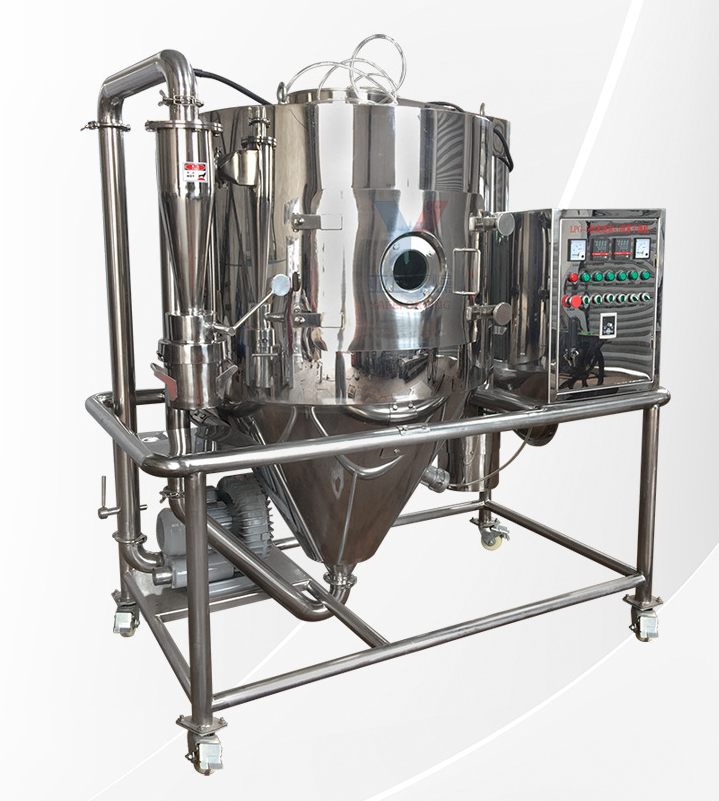
A pharmaceutical jet milling machine is key equipment in pharmaceutical manufacturing. It operates on the principle of jet milling technology.
This process uses high-velocity compressed gas to reduce the particle size of pharmaceutical powders into the micron or sub-micron range. The output is uniform, consistent particles that increase the drug’s surface area and improve its dissolution rate.
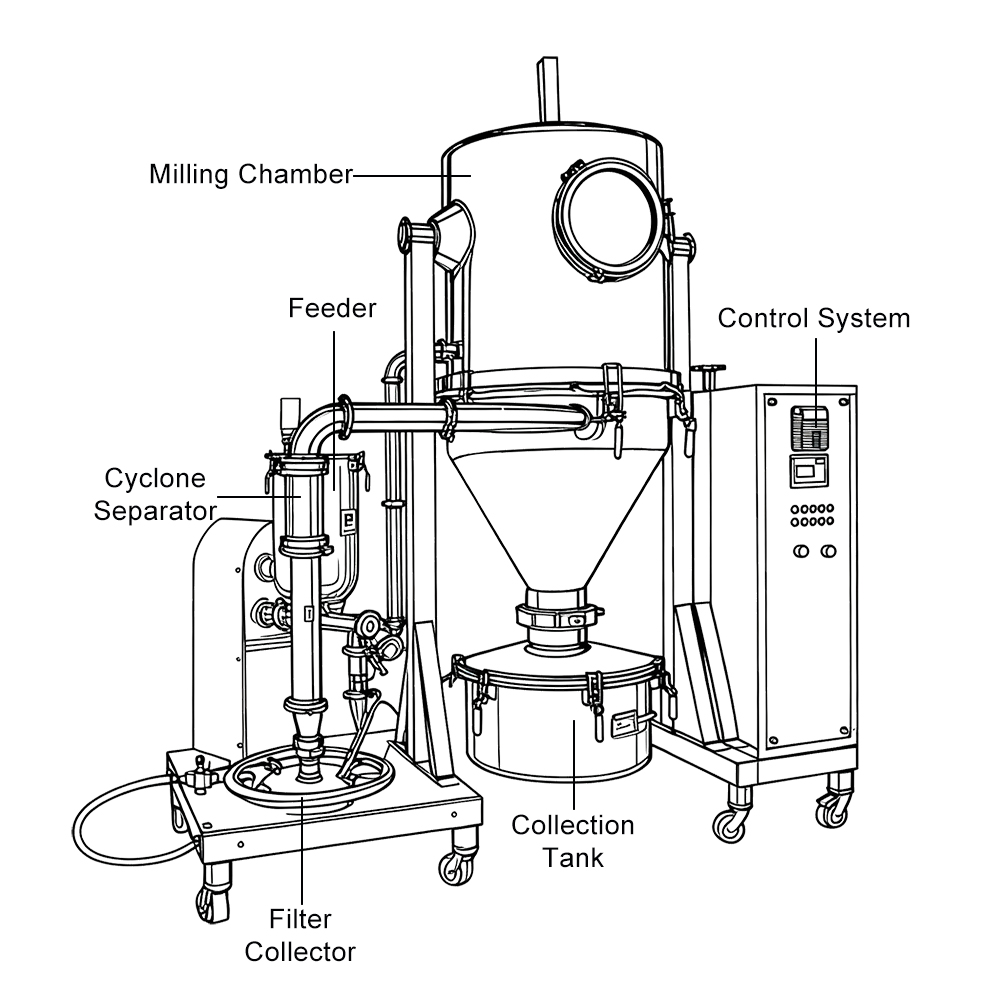
Six Main Components of a Jet Milling Machine
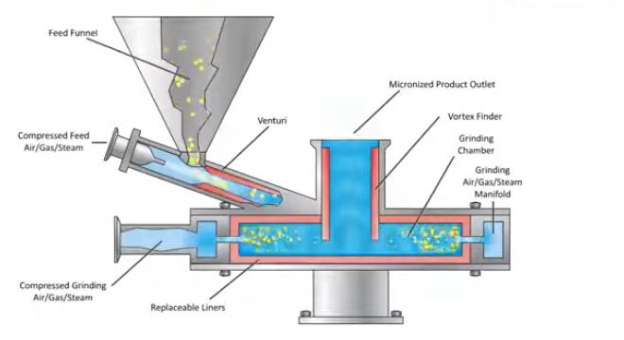
A pharmaceutical jet milling machine is an integrated system composed of different components. These components work together to achieve the ultra-fine particle size reduction required for high-quality drug manufacturing. Let’s discuss some of the main components that enable this process:
1. Hopper
The hopper is the storage reservoir at the top of the jet mill system. Its function is to hold the pre-milled pharmaceutical powder and ensure a continuous supply of material before it is introduced into the grinding chamber for micronization.
2. Feeder
The feeder is typically a rotary valve or screw feeder that regulates the rate of material transfer into the mill. A consistent feed rate is necessary for a stable operation and to maintain a constant final particle size distribution.
3. Milling Chamber
The milling chamber is the central vessel where size reduction occurs. It is often a flat, circular, or toroidal (loop) chamber, designed to withstand the high internal pressure of the process. The chamber is lined with tough materials, such as stainless steel, to prevent particle-to-wall friction from causing contamination and wear.
4. Nozzles
Nozzles are the most critical elements for initiating size reduction. They are positioned around the outer edge of the chamber’s wall. This specific placement ensures that the high-velocity gas creates a powerful, circulating whirlpool or vortex inside the mill. Compressed gas (air, nitrogen, or carbon dioxide) is injected through these nozzles at supersonic velocity.
5. Compressed Gas System
The compressed gas system is the driving force behind the entire process. It includes the Air Compressor/Gas Source, which supplies the high-pressure gas (air, nitrogen, or carbon dioxide). It also features a filter to keep the gas entering the mill clean and free of moisture or contaminants.
6. Cyclone Separator
A cyclone separator is a product collection equipment. It uses centrifugal force (created by a gas-powder mixture) to separate the bulk of the final product powder from the gas stream. This initial separation is important to reduce the load on the final filtration system.
How Does a Pharmaceutical Jet Mill Machine Work?
A pharmaceutical jet mill uses a specific fluid energy milling method to create particle-on-particle collisions within a closed chamber. This process ensures high purity and preserves the integrity of the active ingredients.
Here is the step-by-step process of how size reduction is achieved:
Step#1: Material Feeding
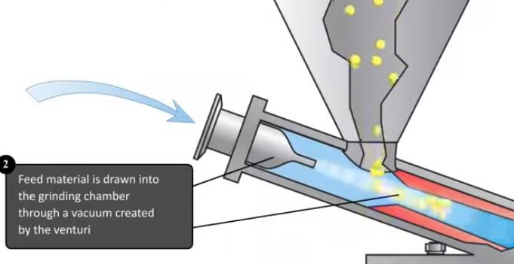
The milling process begins by introducing the coarse, pre-processed powder into the system. A rotary valve or screw feeder carefully controls the rate at which this material is metered into the grinding chamber.
Step#2: High-Velocity Gas Acceleration
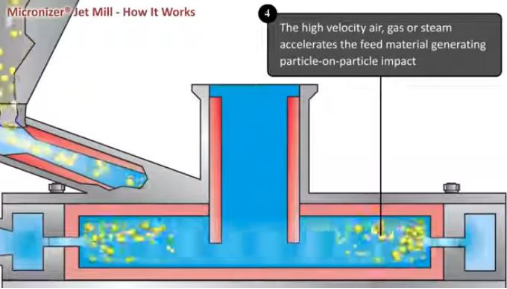
Compressed gas (air, nitrogen, or carbon dioxide) is injected through specialized nozzles into a cylindrical grinding chamber. Before injection, the gas undergoes strict filtration and purification to meet cGMP (current Good Manufacturing Practice) requirements. This high-pressure injection converts the potential energy into kinetic energy.
Step#3: Particle Collision
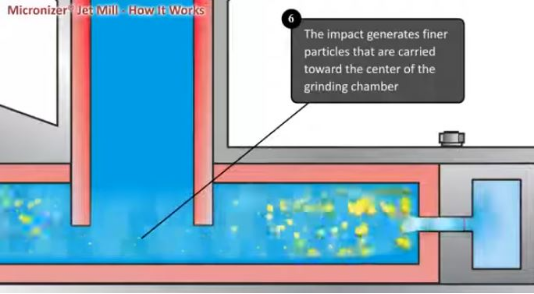
The high-velocity gas flow creates a powerful, circulating vortex. This whirlwind forces particles to travel in circular paths at extremely high speeds. They collide with each other, the primary method of size reduction known as particle-on-particle attrition. This self-destructive action is highly effective and minimizes damage to the mill walls.
Step#4: Size Reduction
The impact of these high-energy collisions breaks larger particles into much smaller fragments (1 to 10 microns). The kinetic energy of accelerated particles drives this grinding as they crash into one another. Continuous crushing of material particles results in uniform size reduction without generating the high heat associated with mechanical friction.
Step#5: Self-Classification
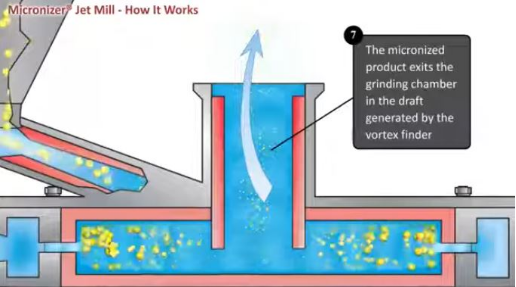
A classifier, such as the central outlet itself, separates the particles by size. Due to the intense centrifugal forces, the larger, heavier particles are forced to circulate back into the grinding chamber for further milling. At the same time, the smaller particles are light enough to be carried to the outlet by the drag force of the gas stream.
Step#6: Discharge and Collection
The final micronized powder is carried out of the mill and collected in a two-stage system. First, a cyclone separator captures the bulk of the powder and separates the material from the gas stream.
Then, the gas is exhausted through a bag filter, which collects any remaining ultrafine dust to achieve maximum yield. The collected micronized powder is then typically sent to the next manufacturing stage, often a rapid mixer granulator.
All steps image Source: YouTube
Key Advantages of Pharmaceutical Jet Milling Machine
Jet milling is preferred in pharmaceutical manufacturing because of how it addresses critical issues in formulation and drug efficacy. Its core benefits relate to product quality, safety, and performance.
1. Enhance Drug Solubility
Jet milling is primarily used for BCS Class II (low solubility, high permeability) and Class IV (low solubility, low permeability).
These APIs are typically antivirals and antifungal agents. Micronization reduces the particle size to 1 to 10 µm, which increases the material’s surface area. This larger surface area significantly improves the drug’s water solubility and increases its dissolution rate.
2. Improve Drug Bioavailability
A faster absorption rate indicates better dissolution, making the drug readily available to the bloodstream. This means better absorption and utilization by the patient’s body, which is the definition of improved bioavailability. Ultimately, this translates directly to a greater therapeutic effect and better clinical outcomes for the patient.
3. Minimal Risk of Contamination
Unlike mechanical grinding, size reduction is achieved through particle-to-particle collision. The absence of moving parts and grinding media eliminates contamination from wear and tear, such as metal fragments. This makes jet milling a high-purity process that minimizes the risk of product contamination.
4. Suitable for Heat-Sensitive Materials
Many pharmaceutical compounds are sensitive and can degrade when exposed to heat. Jet milling generates minimal to no heat. In fact, the expansion of the high-pressure gas as it exits the nozzles creates a cooling effect. As a low-temperature operation, it is ideal for heat-sensitive and waxy APIs and helps maintain their physical and chemical stability.
FAQs
1. Why is temperature control important in jet milling?
Sensitive drugs can degrade when heated. Since jet mills use air instead of blades, they generate very little heat, which protects heat sensitive compounds.
2. Does jet milling improve drug bioavailability?
Yes. Smaller particles have a larger surface area, which can improve dissolution and absorption of poorly soluble drugs.
3. Can a jet milling machine handle multiple products?
Yes, but only with proper cleaning and changeover procedures. Many facilities dedicate machines to specific product groups to reduce risk.
Maintain Purity and Performance With the Best Equipment
A pharmaceutical jet milling machine is a significant investment that can be energy-intensive and lead to high operational costs. However, in the long run, it enables you to consistently produce ultra-fine, contaminant-free powders that enhance drug efficacy and pass strict regulatory scrutiny. This makes the jet mill an essential, economically justified choice for modern pharmaceutical production.
Pharmaceutical manufacturing demands the best equipment to ensure product quality and patient safety. Take no chances and choose Finetech. Our line of pharmaceutical machinery guarantees 100% customer satisfaction, which always keeps you ahead of your competitors.
Contact our team and see how our technology accelerates your path!