Skip to content
  English
  Russian
  Turkish
  Spanish
  French
  German
  Japanese
When it comes to industrial automation, electric motors (especially servo motors and stepper motors) are the heartbeat of productivity.
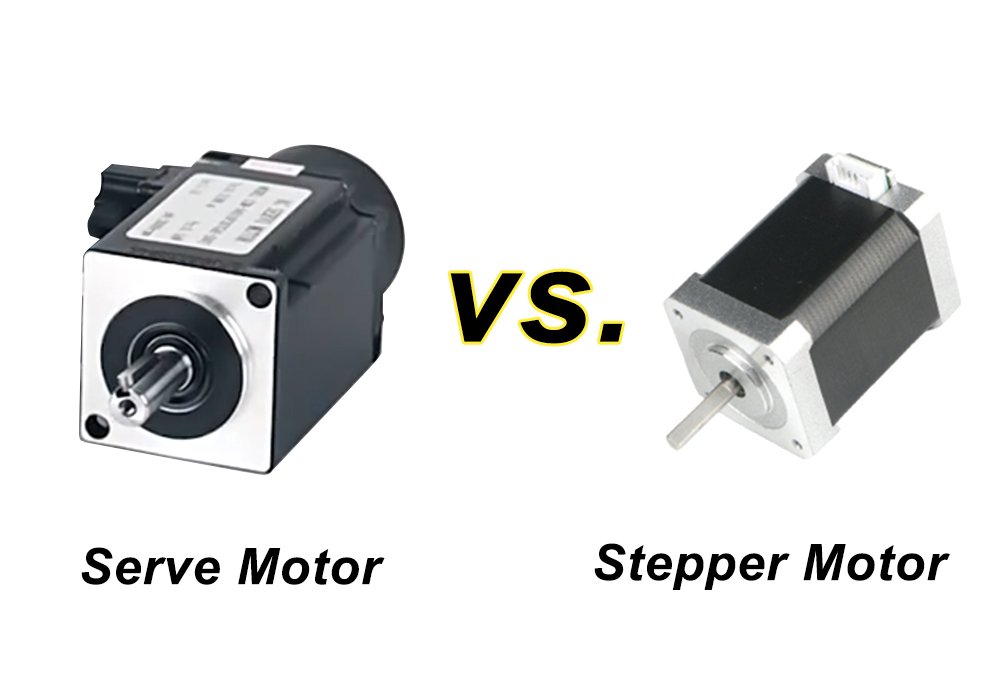
Every automated task, from a vial-filling machine’s dose dispensing to a rotary tablet press’s synchronised indexing, depends on the motor’s performance. This dependence makes the selection between a servo motor and a stepper motor one of the most critical engineering decisions. Many professionals hesitate, unsure which motor truly fits their application.
But don’t worry! This guide breaks it all down for you.
We’ll provide a detailed, side-by-side comparison of servo vs stepper motors, covering how each works, as well as their advantages and applications.
Key Takeaways: Servo Motor vs Stepper Motor
| Features | Servo Motor | Stepper Motor |
| Control Loop | Closed-Loop. Uses an encoder for continuous feedback | Open-Loop. Relies on pulse counting |
| Design | Low Pole Count (8–12 poles) | High Pole Count (50–100 teeth/poles per cup). |
| Speed | Up to 4,000+ RPM | Best below 1,000 RPM |
| Torque | Dynamic torque | Static holding torque |
| Efficiency | High Efficiency. Current draw is proportional to the required workload | Low Efficiency. Draws near-maximum current continuously |
| Complexity | Highly Complex | Low Complexity |
| Risk of Error | Low. Encoder ensures real-time correction | High (in open-loop). Can lose steps or stall under unexpected load changes. |
| Best For | High (in open-loop). Can lose steps or stall under unexpected load changes | Fixed-positioning, and low-cost applications (e.g., 3D printing, Scanners). |
What is a Servo Motor?
A servo motor is a highly specialized motor designed for the precise control of rotary or linear motion. It is designed to operate as a critical component within a closed-loop system for the regulation of position, velocity, and acceleration in numerous applications.
The working principle of a servo motor revolves around its feedback mechanism. An encoder or resolver attached to the motor shaft provides real-time position and velocity data to the control system.
The encoder feedback is instantly compared to the desired setpoint. The resulting error signal is processed by the servo drive. This process dynamically adjusts the motor’s power and drives it to the correct target position or speed.
What is a Stepper Motor?
A stepper motor is a brushless electric motor that converts digital pulses into calculated mechanical shaft rotation. Unlike a standard DC motor, it operates in discrete, equal-sized increments called steps for highly accurate, repeatable control of position and speed.
It is an open-loop system that relies on the input pulse count rather than a feedback sensor. The working principle involves a controller that sends electrical pulses to the motor’s coils in a specific sequence.
This causes the internal rotor to advance exactly one step for each pulse. Therefore, the motor’s position, speed, and direction are entirely determined by the number, frequency, and order of these pulses.
Servo Motor vs Stepper Motor: Key Differences
Both servo and stepper motors are widely used in motion control systems across industrial automation, robotics, and CNC machinery. However, they possess numerous fundamental differences in their design, working principle, cost, and performance.
Understanding these differences can help you make a better choice between a servo motor and vs stepper motor. Here is a detailed comparison of both motors:
1. Motor Design
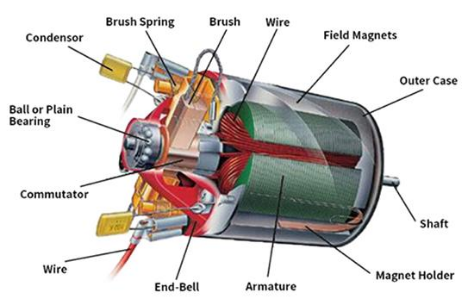
The core design difference between these two motors lies in magnetic pole count and rotor configuration. The servo motor utilises a radially magnetised rotor with segmented permanent magnets without any intricate teeth. This leads to a lower pole count (often 8 to 12 poles), which is the primary reason for its distinct performance profile, including higher speed capability.
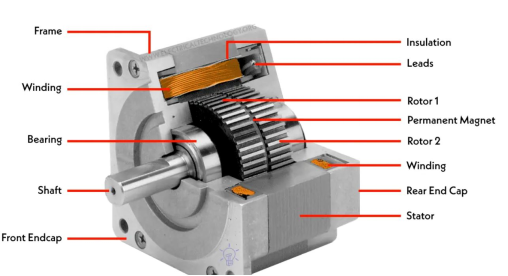
A stepper motor achieves a very high number of poles (50 to 100 per rotor cup) by a magnetized permanent magnet between two finely toothed rotor cups. These teeth become polar opposite to each other and create numerous stable magnetic detent positions. This high pole density allows the stepper to move in repeatable steps in a loop operation.
2. Control System
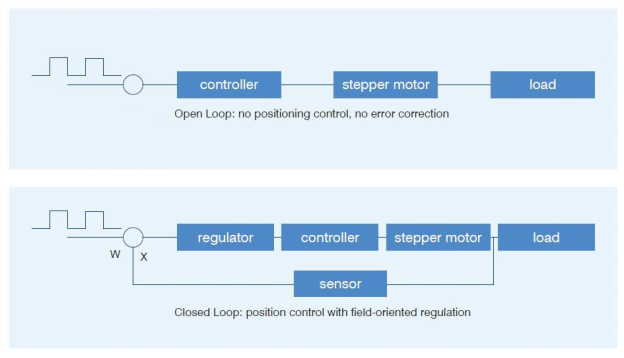
Servo motors work in a closed-loop system for better accuracy. An integrated encoder continuously measures the motor’s real-time position and speed, and sends this feedback to the controller. The controller compares the feedback with the command, generating an error signal that adjusts the motor’s power until it reaches the desired target.
Stepper motors operate in an open-loop system because they rely solely on the control signal. The controller sends digital pulses, and the system counts these pulses to track the motor’s position without any feedback to verify the actual movement. This simplicity makes the stepper motor cost-effective and easy to implement.
3. Torque and Speed
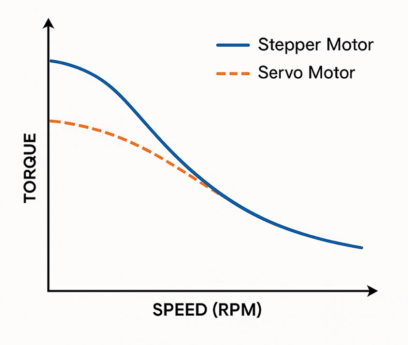
Servo motors excel at maintaining high torque throughout a wide RPM range, typically up to 4,000 RPM or more. Their low-pole-count design and continuous current adjustment allow them to sustain peak torque for acceleration and handle dynamic loads. This makes them ideal for rapid and high-power applications.
Stepper motors offer high torque at very low speeds, and they are excellent at generating holding torque when stopped. However, their high pole count and constant current design cause torque to drop off significantly as speed increases above 1,000 RPM.
4. Complexity and Setup
A servo motor has a complex setup that needs an integrated or external high-resolution encoder and a specialised servo drive. The motor and its control system require careful tuning to accurately match the connected mechanical load. This process involves complex adjustments of drive parameters, such as proportional, integral, and derivative (PID) gains.
Stepper motors offer a visible advantage in terms of setup and ease of use. They only require a basic motor driver to accept step and direction pulses. The installation process is also straightforward, as they usually do not need a separate sensor or complex tuning process.
5. Cost of Servo and Stepper Motors
Servo motors have a higher initial cost. All the key components including the motor, encoder are more complex and expensive. While the purchase price is higher, the servo’s superior efficiency and high-speed performance can offer better value and lower long-term operating costs in industrial environments.
Stepper motor systems comparatively have a lower initial cost. As compared to servo motors, they are less expensive and need simple drivers. This type of motor is best suited for operations requiring slow to moderate acceleration, excellent static holding strength, and the option of simpler or more advanced control.
6. Power Consumption
Servo motors are highly power-efficient, as their current draw is proportional to the workload. They only consume the necessary power to move or hold the load at the set point, which minimizes heat and maximizes performance.
Stepper motors demand near-maximum current to maintain the magnetic field for holding torque. They draw high power regardless of whether they are moving slowly or sitting idle. This constant current consumption leads to wasted energy and significant heat generation.
Three Key Applications of a Servo Motor
Servo motors are widely adapted across different industries that need strict control of position, speed, and torque. Below are a few of their key applications:
1. Pharmaceutical Industry
Servo motors are extensively used in the pharmaceutical sector for their calculated and repeatable movements to maintain quality control.
They enable accurate dosing in ampoule and vial filling machines, gel and cream filling systems, and synchronize high-speed indexing for rotary tablet presses. Their reliability minimises errors and waste, which is critical in drug manufacturing.
2. Automated Manufacturing
In automated factory environments, servos provide the control needed for high-speed, high-accuracy production. They are essential for controlling components within fast-moving systems like conveyors and robotic assembly lines.
Servo motors place and transfer components with high speed and accuracy. This superior speed and torque control maximizes throughput and quality in advanced packaging and material handling processes.
3. CNC Machinery
Servo motors are the standard choice for Computer Numerical Control (CNC) machine tools. They are used to drive the axes of lathes, mills, and routers and translate digital commands into high-force movements.
Their closed-loop accuracy is critical for maintaining tight tolerances during cutting, drilling, and engraving required in component manufacturing.
Three Key Applications of a Stepper Motor
Just like servo motors, stepper motor systems are also used in numerous industries. Steppers are valued for their simplicity and cost-effectiveness in different automated tasks. Let’s see how they are applied in these key areas.
1. Pharmaceutical Industry
Stepper motors facilitate processes that require consistent dosing, positioning, and the handling of delicate materials. Their accurate, fixed-step motion helps tablet-filling machines and tablet-counting machines with accurate product volumes. They are also used in blister packaging and offer reliable performance without the higher cost of a servo.
2. 3D Printing
Stepper motors are the driving force of nearly all consumer and professional 3D printers. They drive the axes (X, Y, and Z) that precisely position the extruder and the build plate, as well as the extruder mechanism itself. Their inherent ability to move in discrete, repeatable steps allows the printer to build layers with the necessary micron-level perfection and resolution.
3. Home Automation Systems
Stepper motors are commonly used in different home automation systems. Common applications include controlling the movement of smart security cameras, adjusting the position of automated window blinds or curtains, and managing airflow vanes in HVAC and ventilation systems. The high holding torque of these motors helps them maintain a set position without consuming continuous power.
Choose the Optimal Motor Solution For Your Next Project
Servo and stepper motors each have unique strengths and challenges, which make them suitable for distinct operational environments. While both are fundamental to modern automation, the ultimate choice depends entirely upon your specific production needs.
Choose a servo motor system if your application demands high speed, extensive load handling, superior efficiency, and the lowest risk of error. Conversely, go for a stepper motor if your project requires excellent holding torque, a simpler setup, and a lower initial cost.
And if you need a platform that gives you the best of both worlds, choose Finetech! We engineer machinery where the right motor perfectly complements the task, be it a high-speed tablet counting machine or an inline packaging system. Visit our website and optimise your production with the best pharmaceutical machinery!
There is also another article written about Mechanical Drives in Packing Machinery Application.