Skip to content
  English
  Russian
  Turkish
  Spanish
  French
  German
  Japanese
If you work in pharma manufacturing, nutraceuticals, or R&D, knowing the tablet compression machine parts name for each component is going to save you a lot of headaches. The better you understand how these parts function and interact with each other, the easier it gets to keep your equipment running right and your tablets coming out consistent.
1. Punches (Upper and Lower)
Punches are probably the first tablet compression machine parts most people learn about. Every tablet press uses a set of upper and lower punches that compress powder into a finished tablet.

On a single-punch tablet press, the upper punch handles most of the compression. It drops down into the die cavity and presses the powder while the lower punch stays more or less in place.
The machine still has both punches, but it gets called a single-punch press because only one is actively moving during the compression cycle.
Rotary presses are a different story. Both punches move at the same time, applying force evenly from the top and bottom. That balanced compression gives you tablets with more uniform density and hardness, which matters a lot when every tablet has to deliver the same dose.
Punches come in all kinds of tip shapes and sizes, so you can make round tablets, oblong caplets, scored tablets, or custom shapes with logos stamped into the surface. The punch material is usually hardened steel or carbide-tipped steel. It has to hold up through thousands of compression cycles without wearing down.
2. Die System
The die system is paired directly with the punches. It’s a metal plate with one or more machined cavities that hold powder during compression. Together with the punches, it forms the core of the whole tableting process.
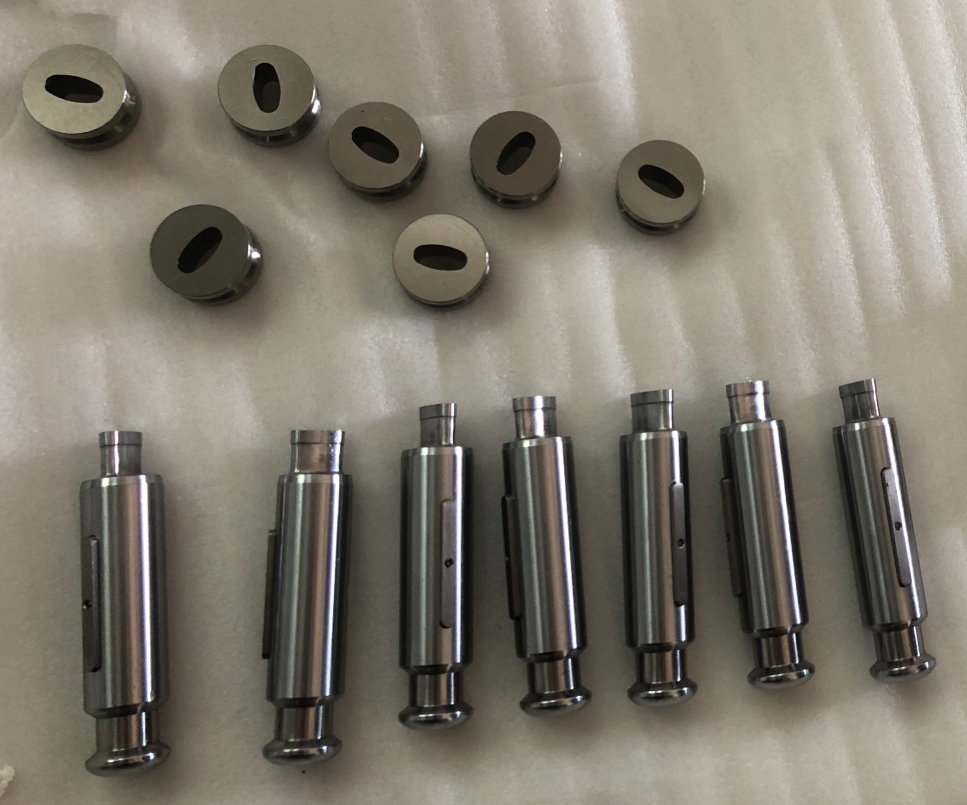
Each die cavity sets the tablet’s diameter. Combined with the lower punch position, it controls thickness and weight too.
There are two common die types used in tablet compression machines. Tapered dies have a slight angle at the cavity opening that lets trapped air escape during compression. This really helps when you’re working with fine powders that hold a lot of air.
Straight dies don’t have that taper, but they’re better at keeping powder from spilling out of the cavity during filling.
Choosing between them comes down to the formulation. Sticky or fine powders usually need tapered dies, while granulated materials tend to run fine with straight dies.
3. Turret
The turret only shows up on rotary tablet presses. It’s the big rotating platform that holds all the punch and die sets in a circle. As it spins, each station moves through filling, compression, and ejection one after another.
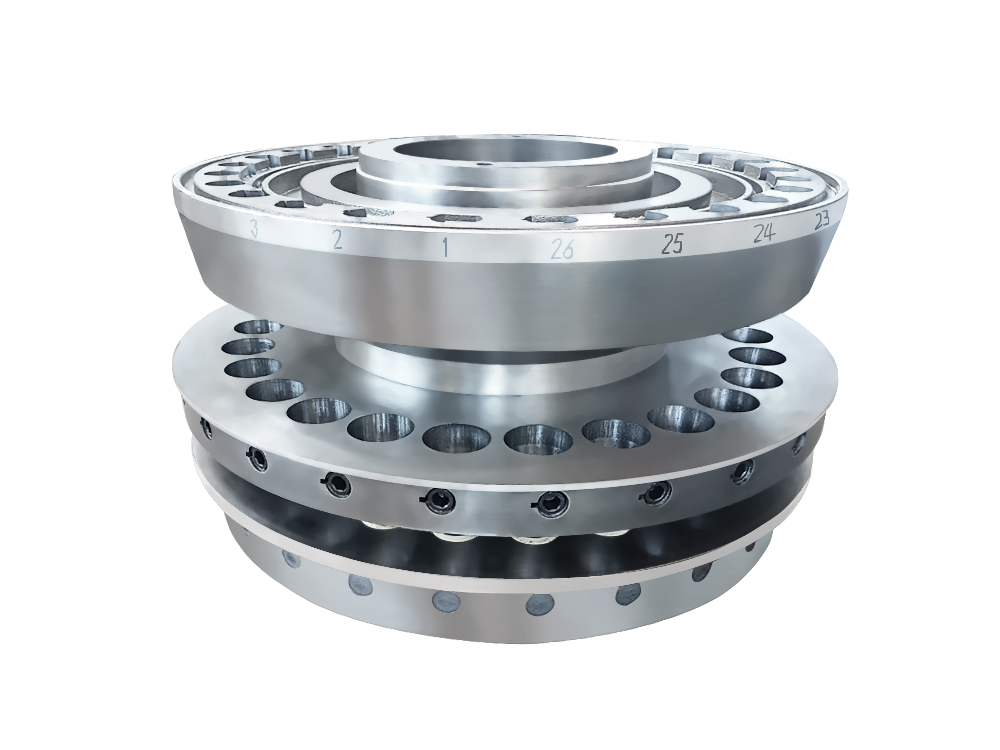
Turret speed controls the output, measured in tablets per hour. A faster turret gives you more production, but only if the machine can stay stable at that speed. Any wobble or vibration can cause uneven tablet weight, hardness, or mechanical failure.
Building a turret requires very tight tolerances. They’re usually machined from a single block of high-grade steel or cast iron and carefully balanced. Regular maintenance keeps the press running smoothly and producing quality tablets.
4. Hopper
The hopper sits at the top of the press and it’s where raw material enters the tablet compression machine. It works as a holding container for the powder or granules before they get compressed.
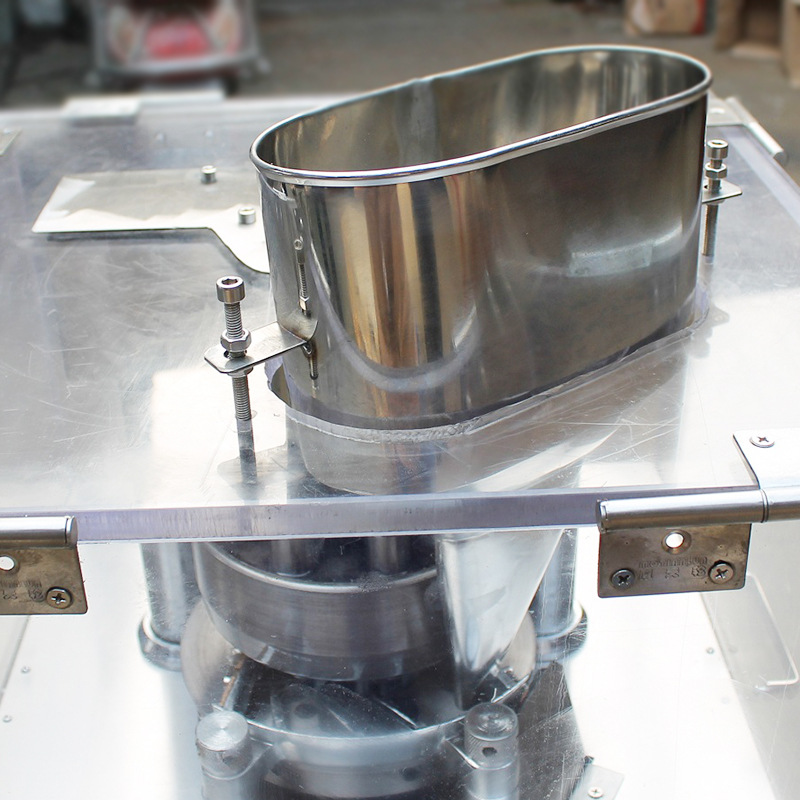
On simpler single-punch machines, the hopper is usually just a stainless steel funnel. It feeds powder into the die cavity by gravity, nothing fancy.
It’s a simple design, but there’s a catch: if the powder blend isn’t mixed well enough before it goes into the hopper, the tablets that come out won’t have a consistent composition.
That’s why most operators mix their powder formulations in a separate blender before loading the hopper. Some presses do have built-in mixing in the hopper, but most production floors handle blending as a separate step.
Hoppers are almost always stainless steel because it prevents contamination and cleans up easily between batches. Size and shape depend on the machine model and how much material you’re running through it.
5. Feeder System
After powder leaves the hopper, it has to reach the die cavities in a controlled way, and that’s what the feeder system does. It’s one of the most important components of a tablet compression machine for achieving high tablet quality.
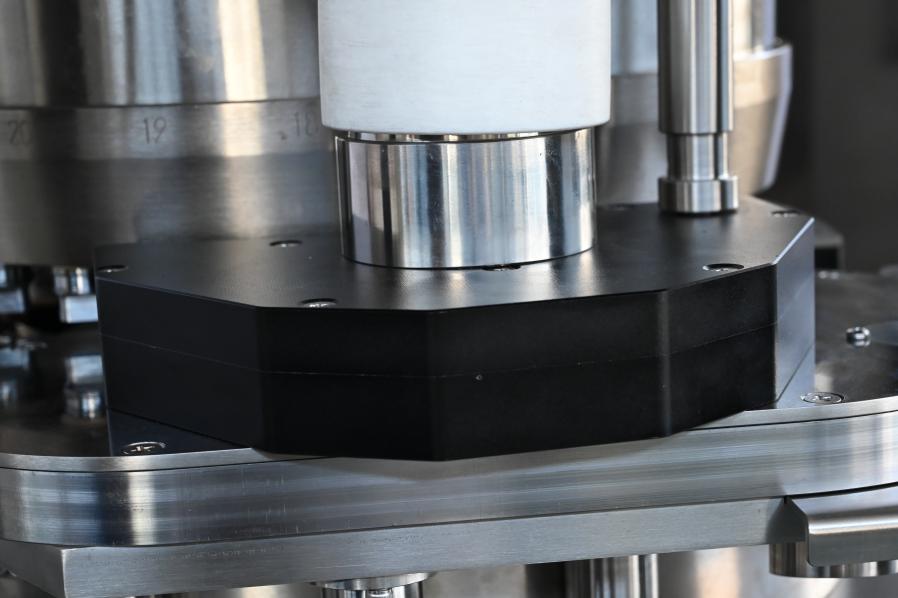
A feeder system has two main components: the feeder housing and the feeder paddles. The housing is a stainless steel enclosure that takes powder from the hopper and channels it toward the die table. Inside, the paddles rotate and spread the powder evenly over the die openings.
Paddle accuracy matters more than most people think. Without them, powder flows unevenly into the cavities and you end up with tablets that vary in weight and dosage.
You can usually adjust paddle rotation speed to match whatever powder you’re running. Faster for free-flowing granules, slower for fine or sticky powders that need more time to settle into the cavities.
On high-speed rotary presses, there may be both an open feeder and a force feeder. The force feeder has extra paddles that push powder into the cavities under light pressure, which you need when the turret spins too fast for gravity alone.
6. Filling Station and Weight Control
After the feeder system deposits powder into the die cavities, the filling station and weight control system make sure every cavity holds the same amount of material. The weight of powder in each cavity sets the dosage of the finished tablet, so even small variations here cause problems downstream.
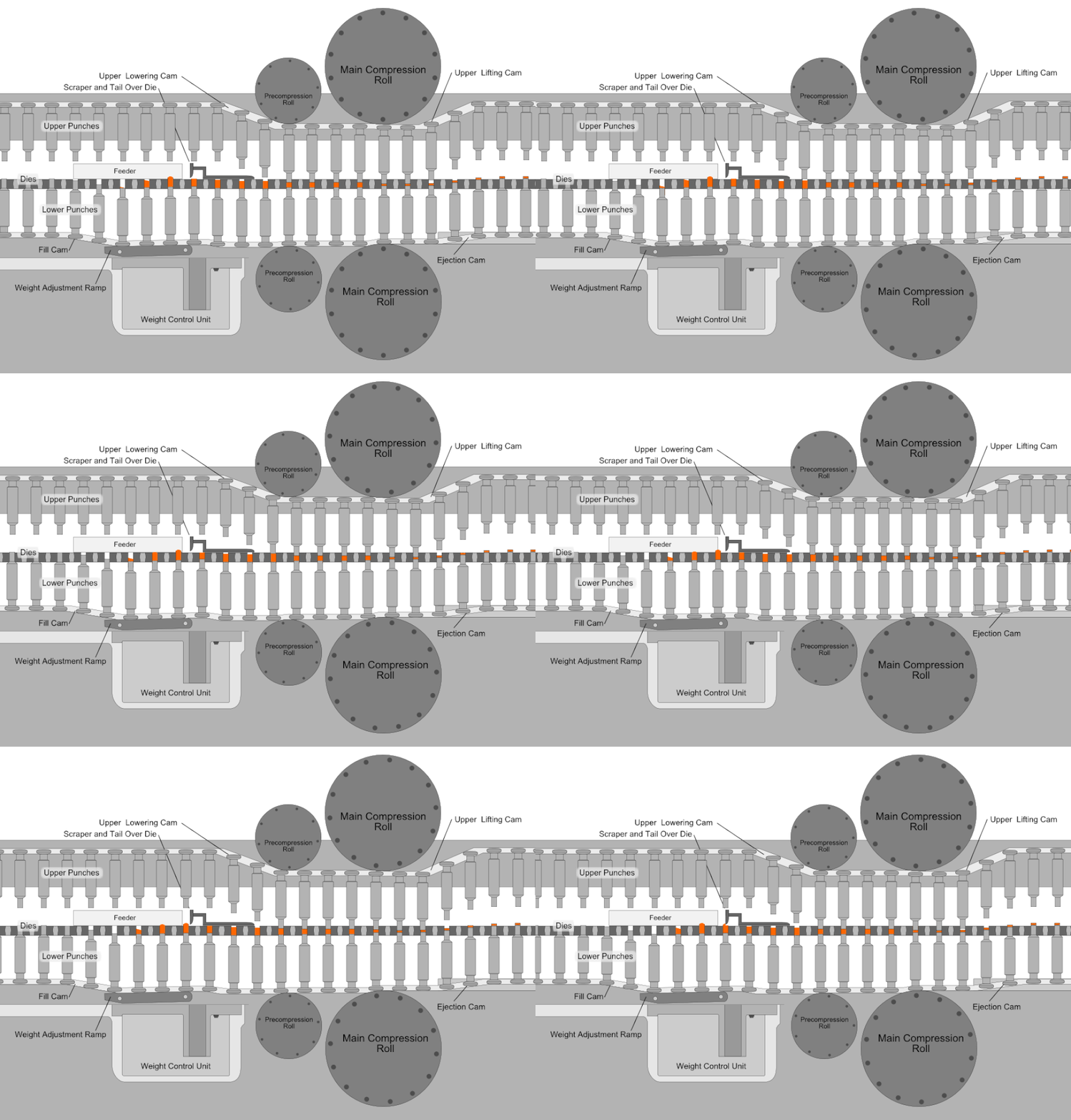
Die cavities are overfilled on purpose during the initial feeding stage. As the turret goes around, the lower punches ride over a weight adjustment cam that raises them a bit, which pushes extra powder above the die surface.
A scraper or dosing mechanism sweeps that surplus powder away so that each cavity holds the same amount.
The weight control system lets operators dial in this process by adjusting lower punch position during filling. Small adjustments here show up immediately in tablet weight, so it’s one of the first places a technician looks when troubleshooting weight variation.
7. Cam Tracks
Cam tracks are unique to rotary tablet compression machines. They’re the grooved or profiled tracks that guide the upper and lower punches through their up-and-down movements while the turret rotates.
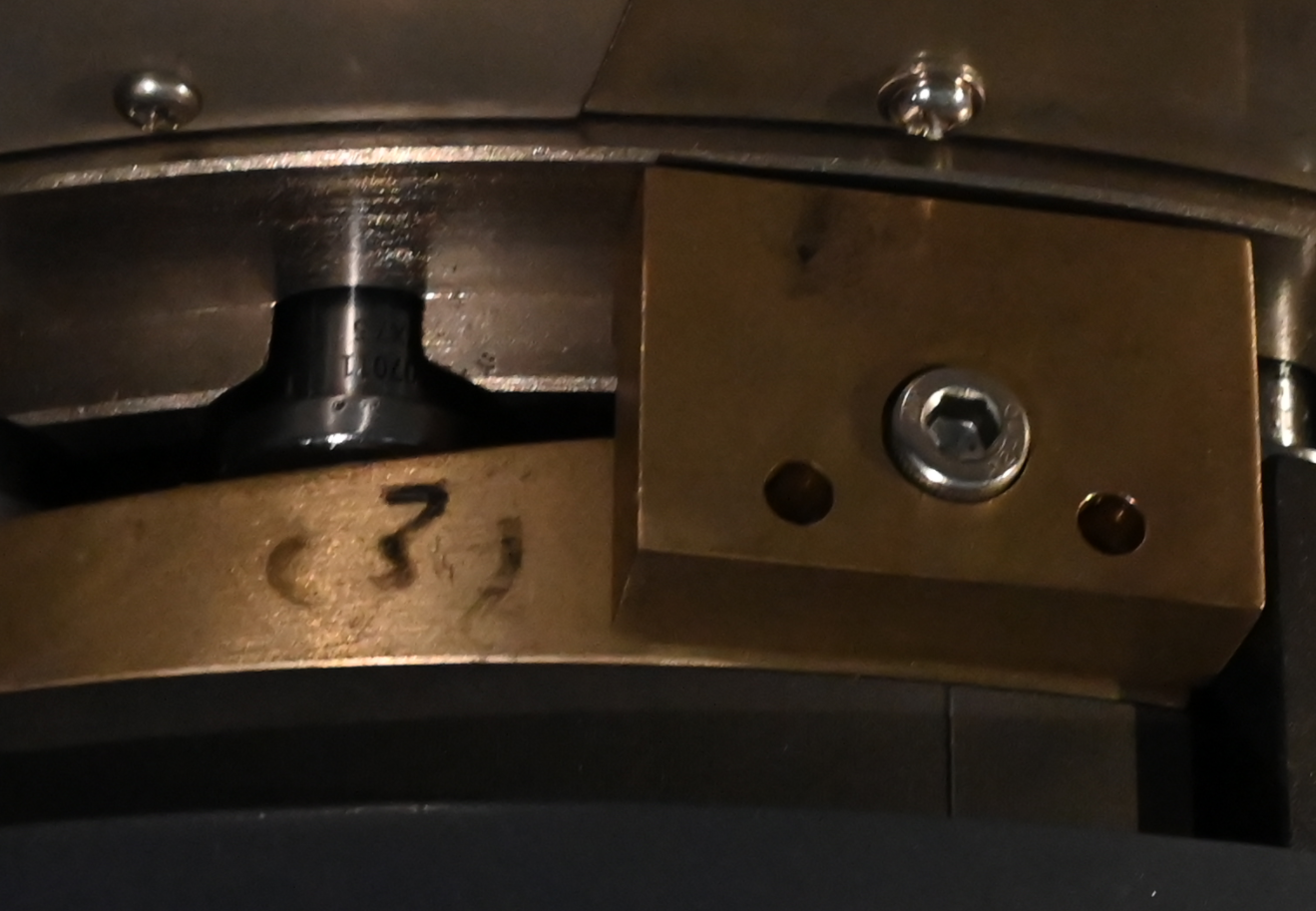
A rotary press usually has three sets of cam tracks. The upper cam track moves the upper punches, lifting them for powder filling and pushing them down for compression.
The lower cam track handles the lower punches, pulling them down so the die cavity has room for powder and then raising them later for ejection.
Then there’s the ejection cam, which pushes the lower punches up at the end of the cycle so the finished tablet comes to the die table surface.
Without cam tracks, there’d be no way to coordinate dozens of punch sets all moving at once. Cam track condition has a real impact on tablet quality, so worn or damaged cams need to get replaced fast.
8. Compression Rollers
Compression rollers are what actually apply the force that turns loose powder into a solid tablet. Most machines have two sets: pre-compression rollers and main compression rollers.
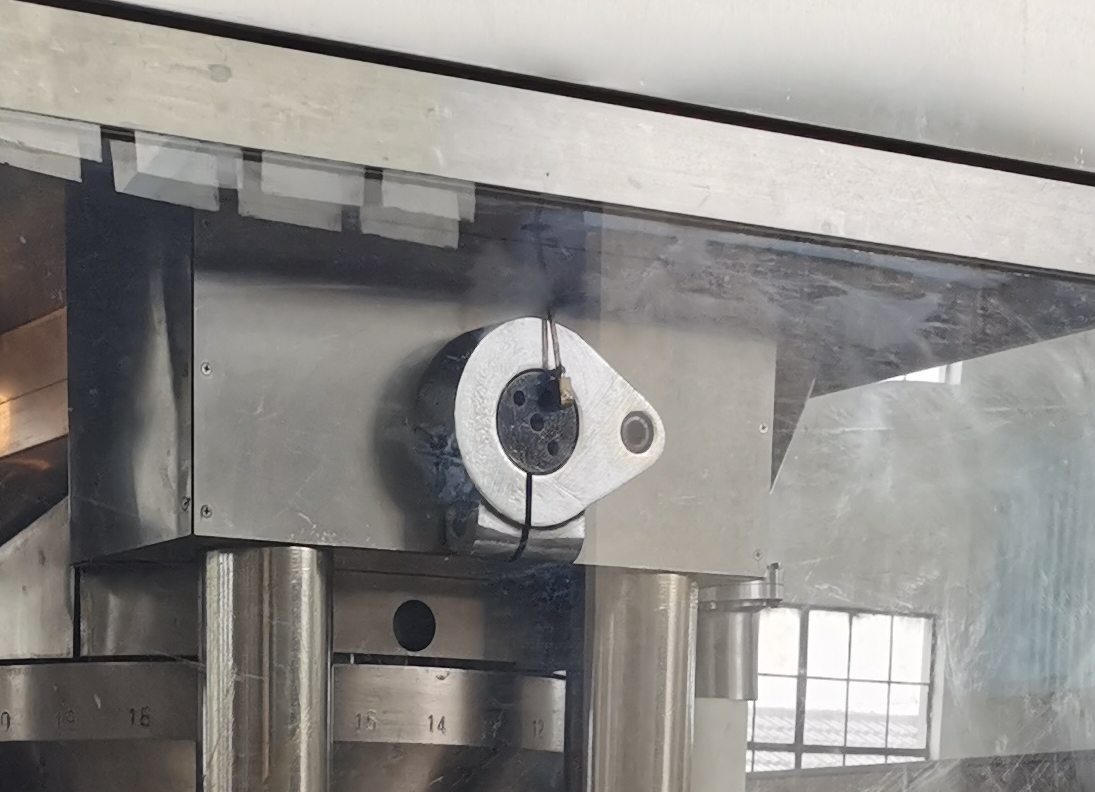
Pre-compression rollers go first and use a relatively gentle force. They’re mainly there to squeeze trapped air out of the powder bed before the main compression happens. Skipping this step or not using enough force tends to produce tablets that cap, laminate, or fall apart from air pockets inside.
After that, the punch set reaches the main compression rollers, which hit the powder with a lot more force to form the final tablet. Main rollers are physically bigger than pre-compression rollers since they deliver more hydraulic pressure.
Operators can tweak the pressure on both roller sets to get the right tablet hardness and friability. Getting these settings dialed in means balancing what the formulation needs with what you want the finished tablet to look and feel like.
9. Ejection Cam
After compression is done, the tablet has to come out of the die cavity. The ejection cam pushes the lower punch upward until the tablet rises to the die table surface.
This has to happen smoothly. If the lower punch comes up too fast or at an angle, the tablet can chip or crack on the way out.
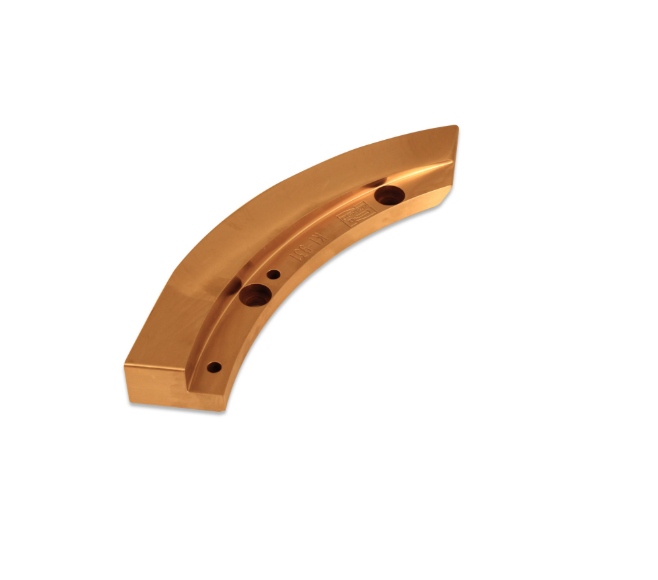
The ejection cam is really just a specialized section of the lower cam track system. Once the tablet reaches the surface, the lower punch drops back down and the whole cycle starts over with fresh powder.
10. Take-Off Blade and Discharge Chute
The last step in tablet compression is getting the tablet off the die table. Once the ejection cam brings a tablet to the surface, the take-off blade (a small scraper positioned right at the edge) pushes it off toward the discharge chute.

The discharge chute is a channel or container that collects finished tablets and moves them along to coating, packaging, or quality inspection.
Some machines have a dust extraction system built into the discharge chute that pulls loose powder off the tablets during ejection.
The take-off blade and discharge chute look simple, but alignment and condition matter a lot. If the blade is off, it can damage tablets or knock them back onto the die table and mess up the production flow.
Conclusion
Every part on this list has a specific job, and when one wears out or falls out of spec, you’ll usually see it in the tablets pretty quickly.
Knowing each tablet compression machine part by name makes it easier to talk to suppliers, train new staff, and identify quality issues before they worsen.