Skip to content
  English
  Russian
  Turkish
  Spanish
  French
  German
  Japanese
The pharmaceutical operations take place under a regulated framework. These rules are designed to ensure quality management at each step. Whether it’s production, testing, or packaging, a small shift can affect product integrity. To manage modifications effectively, a systematic approach is required.
It’s where change control in the pharmaceutical industry comes in. This structured system ensures that every alteration is properly reviewed, approved, and documented. Let’s discuss how this process actually works!
What is Change Control in Pharma?
Change control in the pharmaceutical industry is a formal process to optimize operational adjustments. It involves monitored steps to prevent deviations from established standards. As it’s a part of GMP guidelines, it ensures quality from manufacturing to implementation.
In this approach, changes to materials, equipment, or staff are identified. Then, its effect on product integrity is assessed by a qualified review team. ResearchGate study reports that effective change management aligns people and processes for product consistency. It upholds the effectiveness and compliance throughout the drug development.
Different Categories of Changes
Categorizing modifications helps organizations apply the right level of control system. Based on their impact, updates are classified into three main categories. Here’s an overview:
Minor Changes
These are small adjustments that have minimal or no impact on the final product. It means that they do not alter the safety or quality of the formulation. Examples include:
- Updates in documentation text size.
- Formatting variations in Standard Operating Procedures (SOPs).
- Label design alterations.
- Minor shifts in equipment calibration.
Also, these low-risk modifications do not require strict regulatory approvals. They are managed by a simplified change control in the pharmaceutical industry.
Major Changes
Major changes have a more appreciable impact on the resulting dosage form. It’s a high-risk update that can influence the product’s overall quality. Under change control in the pharmaceutical industry, such alterations are carefully reviewed. They require detailed risk assessment, validation, and approval.
Examples:
- Shifting manufacturing location.
- Making adjustments in the drug’s chemical composition.
- Altering the sterilization process for the dosage form.
Studies have shown that a systematic procedure ensures that changes do not affect the product’s safety.
Critical Changes
When it comes to product efficacy, critical variations require thorough evaluation. If not managed properly, they can significantly affect therapeutic effectiveness. So, the control management department conducts an extensive validation procedure. Such updates are managed with the highest level of scrutiny to prevent potential risks.
Examples of critical alterations include:
- Changing active ingredients APIs in dosage forms.
- Modifying the equipment used for drug production.
| Categories of Changes | Level of Impact | Approval Requirements | Examples |
| Minor Changes | Minimal or low | Simplified procedure with limited approval | Label updates, document format alterations |
| Major Changes | Moderate | Detailed assessment and quality assurance approval | Process adjustments, change in manufacturing location |
| Critical Changes | High | Extensive evaluation, and validation | Change in formulation, or active ingredient |
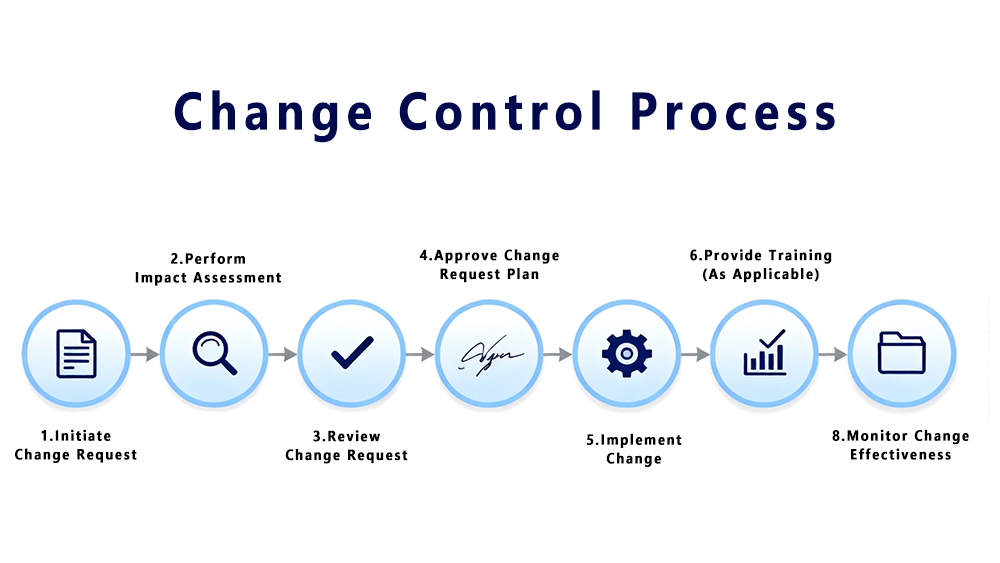
Steps of Change Control in the Pharmaceutical Industry
The update control management follows a step-by-step approach to manage modifications properly. Each step plays a crucial role in maintaining product consistency throughout the process.
Initiation of Change Request
The process begins when an alteration request is raised. It describes the reason, scope, and potential impact of the proposed modification. This request can originate from any department, such as production, quality assurance, or engineering.
Impact Assessment
Once the request is submitted, a detailed evaluation is conducted. This step determines how the proposed update may affect the formulation or process. For that, risk assessment tools are often preferred. They are used to identify potential effects on product quality and compliance.
Approval and Planning
After assessment, the update is reviewed by the quality team or the Change Control Board (CCB). If approved, an implementation plan is developed. It outlines responsibilities, timelines, and necessary resources.
Implementation
The approved modification is executed according to the defined plan. During this stage, proper monitoring is required. This step ensures that the adjustment is performed as intended. Also, it alleviates the likelihood of new risks.
Verification and Review
Following implementation, verification activities are carried out. They confirm that the adjustment achieved its intended results. In addition, you need to evaluate that it doesn’t have any negative effect on the process.
Closure
The procedure concludes with documentation. It’s a formal closure by the quality department or CCB. All records are maintained for audit and regulatory compliance.
Change Control Regulatory Guidelines
Around the world, regulatory bodies have designed standards for compliance. These guidelines are efficient for validating a product’s efficacy. Pharmaceutical companies must adhere to these requirements for desired results. Main agencies involved:
- ICH Q10: This regulation emphasizes astructured process for quality assurance.
- FDA 21 CFR Part 211:Under this section, proper documentation and approval are required. You especially need to record those modifications that impact a drug’s quality.
- EU GMP Chapter 5 & 6:It mandates a change control management for manufacturing and quality control processes.
FAQS
Why is Change Control Important in Pharma?
It prevents deviations from defined quality standards. Also, this approach reduces risks and ensures regulatory compliance.
Who Approves Updates in the Pharmaceutical Industry?
Modifications are typically approved by the quality assurance department. Likewise, the Change Control Board (CCB) also reviews some requests based on the update impact.
How does Change Control Benefit Patients?
Managing alterations ensures that the medicines retain their quality. Thus, it directly protects patient health.
Conclusion
Change control in the pharmaceutical industry is more than just a regulatory requirement. This structured procedure evaluates the updates before implementation. It can minimize risks and maintain product integrity. For those looking to improve their management system, consider Finetech now. We streamline your operations with our reliable solutions. By offering expert advice and quality equipment, we cover your formulation needs. So, make every alteration efficient with our reliable offerings!
Copyright Notice:
You may not reproduce, modify, publish, display, transmit, or in any way exploit any content on this website, or use such content to construct any kind of database without prior express written approval by Finetech Group. For permission to use the content, please contact: info@pharmamachinecn.com
Disclaimer:
The information contained in this article is for general information purposes only. The Company does not guarantee the accuracy, relevance timeliness or completeness of any information, and the Company assumes no responsibility for errors or omission in the content of this article.