English
  Russian
  Turkish
  Spanish
  French
  German
  Japanese
Regulatory Affairs (RA) is the strategic backbone of a pharmaceutical company. This discipline ensures every medicine is proven, reliable, and safe by following international guidelines.
The integrity of this process is critical, especially when considering constant threats like falsified and substandard products. A recent WHO report estimated that US$30.5 billion is spent annually on these dangerous medical items. This massive figure highlights a huge vulnerability in global supply chains.
Regulatory Affairs (RA) emerges as a two-way strategic effort to achieve maximum compliance and protection. Keep reading this article if you want to know what regulatory affairs in pharma is, who drives it, and why they are so critical for your business.
What are Regulatory Affairs in the Pharmaceutical Industry?
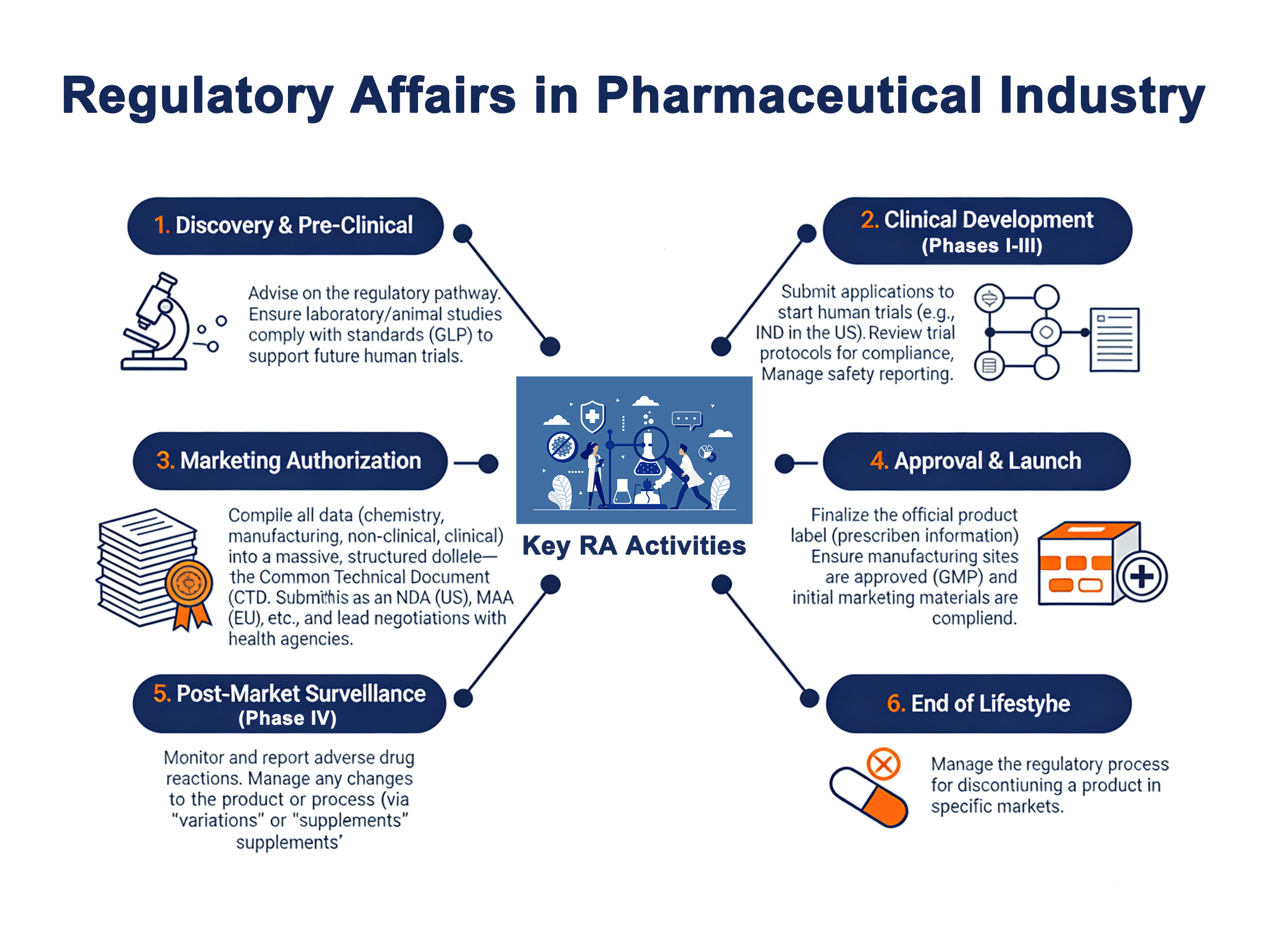
Regulatory affairs (RA) is an essential department within every pharmaceutical manufacturing organization. It acts as the strategic connection between the company and global drug regulatory authorities. The department’s primary role is to ensure that every drug meets the legal and scientific requirements for safety, quality, and therapeutic performance.
Beyond overseeing safety protocols, the RA department manages the entire journey from lab to patient. This means they are involved in everything from guiding pre-clinical testing and clinical trial submissions to preparing the regulatory dossiers for market authorization.
Who are Regulatory Affairs Professionals?
RA professionals are experts with backgrounds in pharmacy or medicine, often holding specialized Regulatory Affairs (RA) certifications.
They possess strong knowledge of scientific product data, regulatory laws, and compliance guidelines. Working closely with research, manufacturing, and clinical teams, RA professionals help maintain compliance and secure market approvals.
Their key goal is to ensure that pharmaceutical products meet the standards set by global regulatory authorities, such as the WHO and the U.S. FDA.
Key Global Drug Regulatory Authorities
Drug regulatory authorities are the national and international organizations that certify a medicine’s fitness for public use. They establish global standards to ensure that every medication, including the drug manufacturing process, meets quality standards and is safe and effective.
The primary role of Regulatory Affairs (RA) is to act as the essential liaison and interpreter between the company and these global drug regulatory authorities.
Let’s have a look at some of the world’s most influential agencies and how they work.
1. World Health Organization (WHO)
The World Health Organization (WHO) is a specialized United Nations agency that creates and promotes global norms for pharmaceuticals. Its core role is to ensure that all medicines are high-quality, safe, and deliver the intended effect. The WHO sets critical standards, such as Good Manufacturing Practice (GMP), which national authorities use to inspect and certify drug production sites worldwide.
2. U.S. Food and Drug Administration (FDA)
The U.S. Food and Drug Administration (FDA) is the federal regulatory agency responsible for protecting public health in the United States. Its mandate covers human and veterinary drugs, vaccines, medical devices, food, and tobacco. The FDA regulates products, grants necessary market approvals, and takes action to ensure that all products sold are safe, reliable, and compliant with federal law.
3. European Medicines Agency (EMA)
The European Medicines Agency (EMA) is the European Union agency responsible for monitoring and supervising the safety of human and veterinary medicines. Its duties are to provide scientific advice to industry, promote innovation, and monitor drug safety throughout the product life cycle.
4. National Drug Regulatory Bodies
National drug regulatory bodies are local government agencies that monitor the quality and safety of medicines and related products sold within their respective countries. Examples include Health Canada, Japan’s Pharmaceuticals and Medical Devices Agency (PMDA), and the UK’s Medicines and Healthcare products Regulatory Agency (MHRA).
Managing Regulatory Affairs: Responsibilities and Processes
Regulatory affairs professionals are the backbone of a pharmaceutical organization’s entire lifecycle management. From the API approval to the product’s final market authorization, they are responsible for keeping every professional action legally compliant. Here are some key responsibilities that define their extensive role:
1. Active Pharmaceutical Ingredient Submissions
The first step in drug manufacturing is to secure regulatory compliance for the APIs. Regulatory Affairs professionals prepare and submit essential documentation, such as drug master files (DMFs), gap analysis, and sustainability certificates. This is necessary to prove that the APIs you use are of the highest quality and manufactured in compliance with international standards.
2. Compliance and Quality Assurance
Compliance and quality assurance in pharmaceutical manufacturing have a direct impact on patient safety. Regulatory affairs professionals verify that all products and processes adhere to strict international regulations, such as Good Manufacturing Practice (GMP) and Good Clinical Practice (GCP).
They also ensure that the production process follows the SOPs in the pharmaceutical industry and that machinery and facilities meet desired quality and validation standards.
3. Clinical Trials and Submissions
RA professionals are integral to the clinical phase as they develop comprehensive regulatory strategies and advise on compliant clinical trial design.
They are responsible for creating documents, such as the Investigational New Drug (IND) application to begin human trials. The team also prepares the extensive New Drug Application (NDA) for final product approval by health authorities like the FDA.
4. Market Approval and Authorization
After the clinical trials, securing market authorization is also a critical task. RA professionals assemble all relevant information, including the Common Technical Document (CTD), scientific research, non-clinical study results, and exhaustive clinical data.
This comprehensive dossier is essential for meeting the requirements of both local and international authorities and for building the company’s case for public market access.
5. Liaison and Communication with Authorities
The regulatory department is the primary point of contact between companies and key regulatory agencies, such as the FDA and EMA.
From simple correspondence to professional negotiations, these professionals manage questions, respond to deficiency letters, and discuss necessary elements of the product.
6. Post-Market Management and Lifecycle Compliance
After the medicine gains approval, regulatory affairs teams have to manage the product’s lifespan through post-market management and lifecycle compliance. A major component is pharmacovigilance, which involves continuous safety reporting and overseeing adverse event data to protect patient health.
Lifecycle compliance includes filing complex variations for every subsequent change to the approved product. These necessary changes could involve an alteration to the manufacturing site, a revised therapeutic indication, or an update to the final product labeling.
Risks of Regulatory Non-Compliance
Pharmaceutical regulatory compliance has non-negotiable standards, and any weak link can lead to severe consequences. Even a minor lapse in oversight within the drug lifecycle can lead to heavy fines, product recalls, and penalties. Here is how:
Risk No 1: Public Health Impact
The general public is the first and most vulnerable victim of substandard or falsified medicine. According to the WHO, approximately one in ten medicines in low- and middle-income countries are substandard or falsified. Such drugs lead to treatment failure, disease progression, and even death, especially with critical medications like cough syrups or malaria medicines.
Risk No 2: Delayed/Denied Approvals
Bringing a new medicine to market is already a decade-long process. It can often take 10 to 15 years from initial research to final market availability after passing through all clinical testing phases. Any serious regulatory violation or documentation flaw can further delay or altogether deny market approval.
Risk No 3: Fines and Legal Action
Manufacturing and selling fake or substandard medicines is a highly criminal offense in almost all countries. For example, in the U.S., selling or distributing counterfeit drugs can lead to penalties of up to 10 years in prison and a $250,000 fine for individuals. These penalties highlight the seriousness with which governments treat violations that jeopardize public health.
Secure Your Product With Compliance and Innovation
Though not typically the direct responsibility of Regulatory Affairs (RA) in the pharmaceutical industry, the quality of manufacturing equipment plays a crucial role in sustaining compliance.
Without reliable, validated, and well-maintained equipment, even the most diligent compliance and quality efforts can fall apart. That’s why, in addition to hiring an RA, it’s essential to invest in high-quality, compliant manufacturing systems and partner with trusted equipment suppliers like Finetech.
At Finetech, we go beyond delivering advanced technical solutions. We empower your team through comprehensive on-site training and help you maximize output, maintain compliance, and achieve long-term manufacturing excellence. Contact Finetech today and secure your future in compliant, innovative manufacturing.
Copyright Notice:
You may not reproduce, modify, publish, display, transmit, or in any way exploit any content on this website, or use such content to construct any kind of database without prior express written approval by Finetech Group. For permission to use the content, please contact: info@pharmamachinecn.com
Disclaimer:
The information contained in this article is for general information purposes only. The Company does not guarantee the accuracy, relevance timeliness or completeness of any information, and the Company assumes no responsibility for errors or omission in the content of this article.