English
  Russian
  Turkish
  Spanish
  French
  German
  Japanese
Safety and efficacy are must-have elements in pharmaceuticals. For that, you need an innovative system that ensures your product is top quality while helping you comply with stringent regulations. That’s where the pharmaceutical quality management system (QMS) comes in!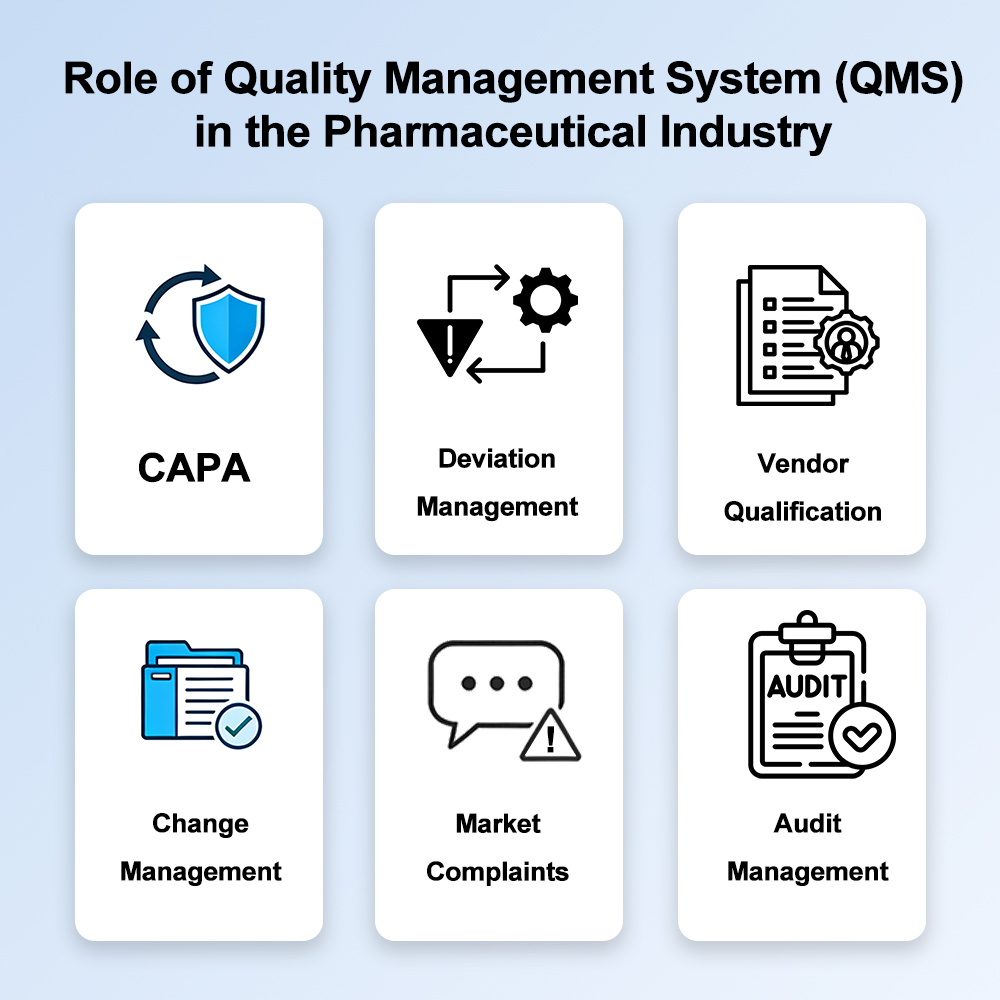
It makes sure that drugs are produced consistently and maintain a high degree of purity. But what exactly is a QMS, and what are its benefits? How to establish a QMS for your pharma business? Let’s find out the answers!
What is a Pharmaceutical Quality Management System?
Typically, a pharmaceutical quality management system comprises defined processes and policies critical to product quality. It covers the entire lifecycle of the medication —from design through development and testing —to maximize patient safety.
Audits, change management, process control, and proper documentation are all parts of a QMS. You can rely on this system to handle risk, track any possible deviations in product quality, and have robust regulatory adherence. Before you dig into the details of a QMS, here’s an overview of what quality means in pharma:
- Verifying the presence of active pharmaceutical ingredients that are essential for medication effectiveness.
- Ensuring impurities and ICH Q1, Q2, and Q3 elements are either not present or are in acceptable, safe limits.
- Applying process controls and confirming assay accuracy to determine whether the drug exactly delivers the desired therapeutic effect.
- Documenting every step properly and meeting all necessary pharmaceutical regulatory standards, including 21 CFR 210/211.
- Detecting and preventing defects before they occur to maintain product integrity and meet and exceed customer expectations.
Top Regulations in the Pharmaceutical Quality Management System
Now that you are aware of the key concept of a pharmaceutical quality management system, it’s time to discuss the top regulations that revolve around product quality:
ISO 9001:2015
ISO 9001:2015 is a popular standard within the ISO 9000 family that defines the key requirements for a QMS and helps pharma businesses become more efficient. It covers the following areas:
- Risk-based thinking.
- QMS.
- Change.
- Leadership.
- Process Approach.
This standard from the International Organization for Standardization aligns with the cGMP and ICH guidelines and emphasizes data-driven decision-making and continuous improvement. The following are the key QMS components outlined in the ISO 9001:2015:
- Set clear objectives and understand the internal and external factors that affect them.
- Define key roles and responsibilities, and involve top management.
- Identify risks and take immediate steps to mitigate them. Also, find beneficial opportunities that help you achieve your objectives.
- Secure all the resources needed for pharma quality control and maintain proper documentation.
- Carefully evaluate the pharmaceutical QMS’s performance and update it as needed.
FDA 21 CFR Part 210
Another important standard for the pharmaceutical quality management system (QMS) is 21 CFR Part 210, which provides the basic framework for pharmaceutical tablets manufacturing. It applies to drugs, biological products for human use, and “human cell, tissue, or cellular or tissue-based product (HCT/P) that is a drug”. It’s listed in the Code of Federal Regulations (CFR) and has three sections:
- 210 (1): Discusses the status of current GMP (Good Manufacturing Practices).
- 210 (2): Applicability of the current GMP.
- 210 (3): Covers key terms and definitions applicable to parts 210, 211, 225, 226.
While it may seem less significant or detailed than the later parts, it provides the foundation for several FDA regulations. All pharmaceutical companies in the US that seek to market their products must comply with 21 CFR Part 210 of the FDA.
If, by any chance, you fail to do so, it’s considered a regulatory breach, and you might receive warning letters, fines, product recalls, and, in serious cases, a complete facility shutdown.
ICH Q8 (R2)
The ICH Q8 (R2) is a detailed guideline that outlines how to integrate product design and process development into the pharmaceutical quality management system. It encourages companies to build quality into their drugs by understanding processes and applying sound science as well as risk management. Here’s a more detailed breakdown of all the key concepts of ICH Q8 (R2):
- Quality Target Product Profile: Define the key desired characteristics of the drug product and its performance. For instance, you need to outline the drug dosage and route of administration, among other things.
- Critical Quality Attributes: Key attributes of the raw materials and processes that significantly impact overall product quality and need to be controlled.
- Design Space: Range of conditions and parameters that give the product the desired quality output.
- Control Strategy: A Detailed plan for managing the manufacturing process to get all the expected product quality attributes.
- Risk Assessment: Identify key risks in pharmaceutical development and quality processes, and develop plans to mitigate them.
ICH Q10
The ICH Q10 is a standard known as the “Pharmaceutical Quality System” and is adopted by all major regulatory bodies, including the FDA (USA), EMA (EU), PMDA (Japan), and Health Canada.
It spans the complete drug lifecycle from basic development to commercial manufacturing and even discontinuation.
This standard relies on the QMS elements like the product monitoring, CAPA systems, change management, and management review for the success of its three principles:
- Product Realization.
- State of Control.
- Continual Improvement.
What truly makes it shine is that it has harmonized the technical requirements for pharmaceuticals. The goal is to improve patient safety and drug efficacy worldwide.
PIC/S GMP (PE 009-14)
Pretty much like the ICH Q10, the PIC/S GMP (PE 009-14) also aims to align GMP standards and inspection processes across different locations so that high-quality medications are produced consistently.
It also defines the requirements for a quality management system, such as the responsibilities of senior management and the premises and equipment. Since it aligns the national and international quality systems, the reliability of pharmaceutical supply chains significantly increases.
What is the Documentation Structure of a Pharmaceutical Quality Management System?
Now that you know the regulations and standards that are part of the pharmaceutical quality management system, here’s an overview of its documentation structure:
Quality Policy
Starting with the quality policy, it’s a high-level document that outlines the company’s commitment to quality. It covers the company policies, objectives, and risk management strategies, serving as the guiding light for the complete pharmaceutical quality management system.
Quality Manual
The quality manual discusses the core processes, structure, and scope of the pharmaceutical QMS. In addition, it covers the interrelationship between the different pharma processes. You’ll usually find the quality manual mentioned in ICH Q10, PIC/S GMP, and EU GMP.
Procedures and Work Structure
Next up are the procedures and work structure of the quality management system. In this, you share step-by-step instructions for different processes, whether it’s drug design or development, using visuals and tables to make the content easy to understand. You also develop the SOPs for each step that pave the way for consistent quality products.
Forms and Records
Forms and records, such as laboratory reports and batch records, serve as evidence of the work performed. It’s an important part of QMS, helping you determine whether each procedure complies with the aforementioned regulations.
Key Elements of a Pharmaceutical Quality Management System Process
The pharmaceutical quality management system comprises multiple elements, including document control, change management, training management, and audit management. Let’s discuss these in detail:
- Document Control: It involves the creation, approval, distribution, revision, and implementation of documents. So what happens is that a document is created, approved, and assigned a unique identifier, and then shared with the relevant personnel. They then perform the procedures as outlined in the document; if there’s a major change, training is given to avoid quality issues.
- Change Management: Change management is actually a systematic process in which changes made to any QMS process and documentation are handled. Each change comes with a detailed justification and the affected systems for better clarity. The goal is to ensure that the change is viable and that products remain safe for end patients, with no major risks involved.
- Training Management: This document, as its name implies, contains training plans, records of completed training, and assessments to keep employees up to date and qualified.
- Risk Management: These are a set of procedures for identifying, assessing, and mitigating risks related to product quality and patient safety. They are properly documented and integrated into the system for proper monitoring.
- Audit Management: Audit management is also an element of the pharmaceutical quality management system. It revolves around the planning, execution, documentation, and follow-up of external and internal audits. You can use it to review compliance and find room for future improvements.
Benefits of Implementing Quality Control Management System
Do you know the global quality management software market size was estimated at USD 11.14 billion in 2024 and is projected to reach USD 20.66 billion by 2030? This huge growth is because many industries, including pharmaceuticals, are adopting QMS to reap the following benefits:
Products Consistency
When you implement a pharmaceutical quality management system, all processes are standardized. There are no variations that lead to consistent, improved product quality despite changing teams and shifts. This significantly reduces errors and enhances customer satisfaction and trust in your products and services.
Improved Competitiveness
A pharmaceutical QMS also increases your company’s reputation and market share. More and more customers connect with your business, and you can easily tap into new markets with effective deviation and change management strategies in place.
Better Compliance
As a pharma company, it’s a must for you to adhere to international and national regulations and standards. A QMS helps you in this regard as it keeps traceable records of internal and external audits. During inspections, you can extract data from the system to show compliance with FDA, EMA, and ICH standards with unshakable confidence and clarity.
Enhanced Operational Efficiency
The QMS has structured documentation that reduces the need for manual tracking, errors, and any rework. All workflows are standardized, which further allows for smooth operations. Hence, you see low production costs, more efficiency, and improved bottom line.
Challenges in a Pharmaceutical Quality Management System
While a pharmaceutical quality management system offers several benefits, it also has some challenges you should be aware of, such as:
- Both international and national standards are revised and updated with the changing times and needs. Keeping up with these changes and timely integrating them into the quality management system can be a hassle.
- Due to supply chain issues, you often have to rely on multiple suppliers and distribution partners. However, cross-checking whether they are complying with the set guidelines is very difficult, which can compromise the end product quality.
- Well, the life sciences industry, including pharma, produces the equivalent of 5 billion pages of text every 24 hours. This amounts to tens of terabytes of data every single day, which is huge. The storage of this much data and quickly pulling the needed data remains a major concern.
- Providing adequate training to employees and making them learn to adapt to new changes and processes isn’t always smooth and leads to frustrations.
Therefore, when implementing a pharmaceutical QMS, you should have proper tricks to manage these challenges and provide your customers with top-quality drugs.
FAQs
How to ensure quality management compliance in the pharmaceutical industry?
To ensure quality management compliance in the pharmaceutical industry, you should implement a QMS, define quality control attributes, and comply with GMP and other regulations.
What is supplier management in a quality management system?
Supplier management in a pharma QMS refers to the process of evaluating, selecting, and monitoring suppliers to ensure they meet quality standards regarding raw materials and equipment.
How is a pharma QMS different from a biotechnology QMS?
A pharmaceutical QMS is more focused on drug development and the final dosage form, whereas a biotechnology QMS is better suited for biologically driven products such as cell-based therapies.
Conclusion
Having a pharmaceutical-quality management system is essential if you want to win customers’ trust and stay ahead of competitors. Wondering where you can get top-notch equipment and compliant equipment for your manufacturing needs? Get in touch with Finetech’s Pharmaceutical Equipment and explore our innovative solutions range today to streamline your daily tasks!
References:
The full guide to QMS in pharma for quality assurance professionals.
Quality management system for the Pharmaceutical industries.
QMS (Quality Management System) in the Pharmaceutical Industry
Pharmaceutical Quality Management System (QMS)
Guidance for Industry Q10 Pharmaceutical Quality System.
Copyright Notice:
You may not reproduce, modify, publish, display, transmit, or in any way exploit any content on this website, or use such content to construct any kind of database without prior express written approval by Finetech Group. For permission to use the content, please contact: info@pharmamachinecn.com
Disclaimer:
The information contained in this article is for general information purposes only. The Company does not guarantee the accuracy, relevance timeliness or completeness of any information, and the Company assumes no responsibility for errors or omission in the content of this article.