English
  Russian
  Turkish
  Spanish
  French
  German
  Japanese
21 CFR Part 11 guidelines for pharmaceuticals exist because regulators do not trust data unless it is controlled, traceable, and protected. One missing audit trail, one shared login, or one uncontrolled system can turn into a serious compliance issue.
However, the major issue is that many pharmaceutical companies struggle with 21 CFR Part 11 because it is often misunderstood. Some think it applies to software vendors, while others assume validation alone is enough.
To make sure this doesn’t happen in your facility, we will explain what 21 CFR Part 11 guidelines are and how you can stay compliant.
What Is 21 CFR Part 11?

21 CFR Part 11 is a U.S. FDA regulation that defines how electronic records and electronic signatures must be handled. Its purpose is simple. If you choose to use electronic systems instead of paper, the FDA must be able to trust the data.
The regulation was introduced when pharmaceutical companies began moving away from paper records.
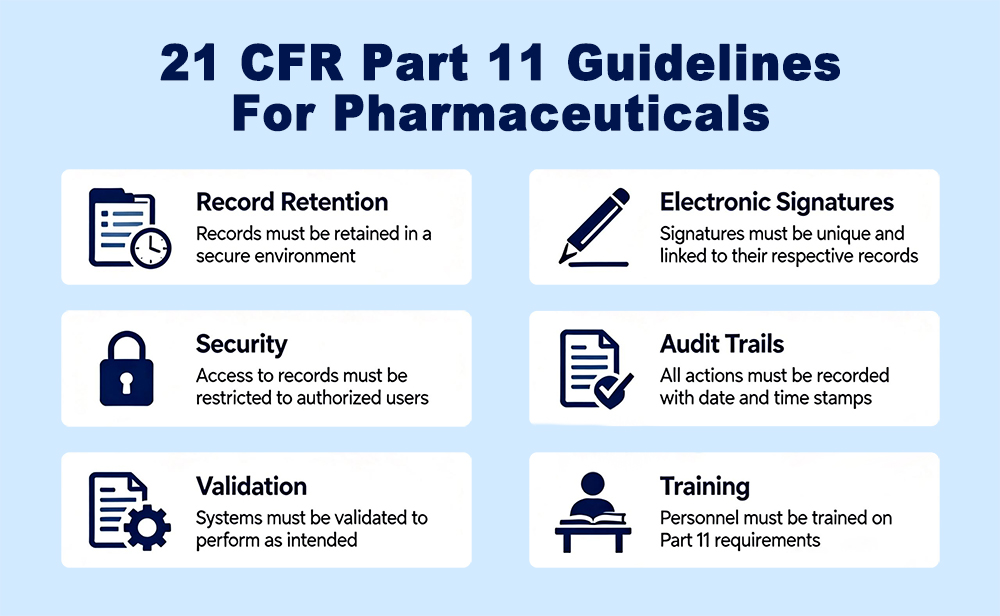
It requires controls such as audit trails, user access controls, system validation, and secure electronic signatures. These controls allow regulators to verify who did what, when it was done, and whether the data was changed.
21 CFR Part 11 Guidelines for Pharmaceuticals You Should Know
The 21 CFR Part 11 guidelines explain what the FDA expects when pharma companies use electronic systems. If these guidelines are not met, electronic records can be challenged or rejected during an inspection.
Below is a practical explanation of each key guideline.
1.1 Electronic Records Requirements
An electronic record is acceptable under Part 11 only if it can be trusted in the same way as a paper record. This means the record must be accurate, complete, and protected from improper changes.
Accuracy means the data must reflect what actually happened during manufacturing, testing, or review. If a value is changed, the system must capture who made the change, when it was made, and why.
Records must also remain readable for their entire retention period. This includes clear formatting, proper timestamps, and the ability to review records years later. If the system cannot display old records, it fails this requirement.
1.2 Electronic Signatures Requirements
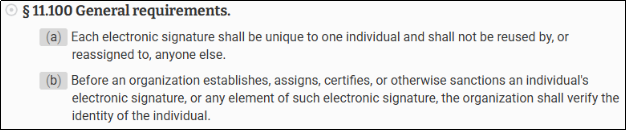
Electronic signatures are allowed to replace handwritten signatures, but only if they are secure and uniquely linked to one individual.
A valid electronic signature must include at least two components, such as a user ID and password, or another secure authentication method. This signature must clearly show who signed the record, what record was signed, and when it was signed.
Legally, electronic signatures are binding. This means companies must control how they are issued, used, and revoked. Shared accounts or generic logins invalidate electronic signatures and are considered a serious compliance issue.
1.3 Audit Trail Requirements
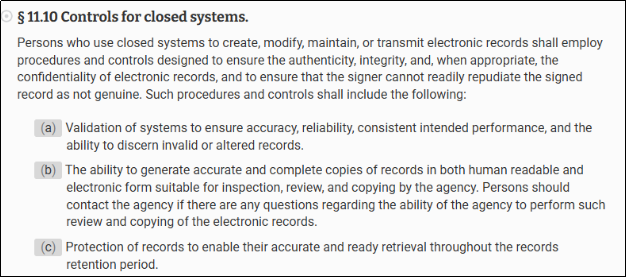
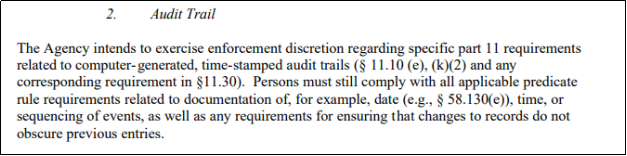
Audit trails are one of the most critical parts of 21 CFR Part 11. Inspectors rely on them to understand the history of a record.
An audit trail must automatically record changes to data without allowing users to disable or edit it. This includes changes to values, deletions, overwrites, and even failed attempts to modify records.
Each entry must capture who made the change, what was changed, when it happened, and sometimes why. Inspectors care deeply about audit trails because they reveal data integrity issues.
1.4 User Access and Security Controls
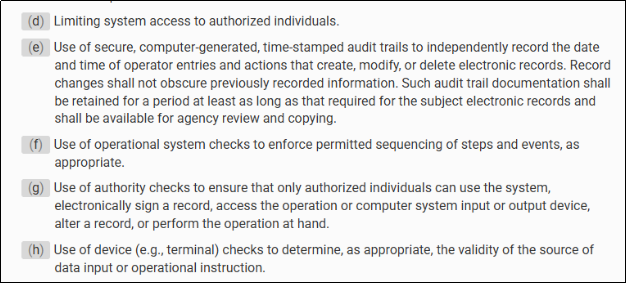
Part 11 requires strict control over who can access electronic systems and what actions they can perform.
Each user must have a unique user ID. Passwords must be protected and regularly managed. Role-based access is expected, so users can only perform tasks related to their job. For instance, operators should not approve records, and reviewers should not modify raw data.
Shared logins violate this guideline directly. When multiple people use the same account, it becomes impossible to prove responsibility.
1.5 System Validation Expectations
Validation is required to prove that a system works as intended for its specific use. It is not enough for a vendor to claim that a system is “Part 11 compliant.”
Companies must validate systems based on intended use. This includes documenting requirements, testing key functions, verifying security controls, and confirming audit trail behavior.
This validation must show that the system and any involved GxP processes consistently perform correctly. Inspectors often review validation documentation to confirm systems remain under control.
1.6 Record Retention and Retrieval
Electronic records must be retained for the same period required for paper records under GMP regulations. During this time, records must remain secure, readable, and accessible.
Retrieval is just as important as storage. Inspectors expect records to be produced quickly and completely during audits. If there are any delays, missing data, or unreadable files, they raise immediate red flags.
Which Systems Must Follow 21 CFR Part 11 Guidelines?
21 CFR Part 11 guidelines apply to any system that creates, modifies, maintains, or stores electronic records used to meet GMP requirements. The type of system matters less than how it is used.
If a system supports decisions related to product quality, safety, or compliance, Part 11 applies. Some of these common systems include:
- Manufacturing Execution Systems: MES systems manage batch execution, process parameters, and production records. Because the records replace paper batch records, Part 11 controls are mandatory.
- Laboratory Information Management Systems: LIMS systems store test results, calculations, and approvals. Any electronic lab data used for release or stability must meet Part 11 requirements.
- Quality Management Systems: QMS platforms handle deviations, CAPAs, change controls, and approvals. Since these records are regulatory evidence, Part 11 applies.
- Software and Embedded Systems: Many production and lab instruments generate electronic data. If that data is used for GMP decisions, the system must have access control, audit trails, and validation.
- Spreadsheets and Custom Tools: Spreadsheets often get overlooked. If they are used to calculate results, track data, or support decisions, they are subject to Part 11.
Common Misunderstandings About 21 CFR Part 11 Guidelines
Many compliance issues linked to 21 CFR Part 11 do not come from a lack of systems or technology. They come from incorrect assumptions. That’s why it’s better to clarify these misunderstandings early to help prevent serious consequences later.
1. Our Vendor Handles Part 11 Compliance.
This is one of the most common mistakes. Vendors can provide systems with Part 11–ready features, such as audit trails and access controls. However, they do not own compliance.
The pharmaceutical company using the system is responsible for validation, user management, procedures, and ongoing control.
2. “If the System Is Validated, We Are Compliant.
Validation is required, but it is not enough on its own. A validated system can still fail Part 11 if access is poorly controlled, audit trails are not reviewed, or procedures are missing.
Part 11 expects continuous control, not a one-time validation activity. Inspectors look at how the system is used every day.
3. “Part 11 Applies Only to Large Systems.”
Part 11 applies to any system used for GMP or regulatory decisions, regardless of size. Small tools, spreadsheets, or embedded equipment software are often overlooked.
If a system creates or modifies electronic records used to support product quality or release, Part 11 requirements apply.
4. “Shared User Accounts Are Acceptable”
Shared logins are a serious violation. Part 11 requires unique user identification to ensure accountability and traceability.
When multiple people share credentials, it becomes impossible to prove who acted. Inspectors routinely cite this issue because it undermines data integrity.
FAQs
1. What defines an “Electronic Record” according to the FDA?
An electronic record is any combination of text, graphics, data, audio, or pictorial information represented in digital form that is processed by a computer system. For pharmaceutical companies, this includes everything from laboratory results and batch records to quality audits and clinical trial data.
2. What information must be visible in a Signature Manifestation?
Whenever an electronic signature is applied, the system must clearly display the printed name of the signer, the date and time of the execution, and the meaning of the signature, such as authorship or approval. This metadata must be permanently linked to the electronic record so it cannot be altered or removed.
3. How should pharmaceutical companies handle shared logins?
The use of shared or generic login credentials is strictly prohibited under 21 CFR Part 11 because it eliminates individual accountability. Every user must possess a unique identification code and password combination to ensure that all actions within the system are traceable to a specific person.
Make Compliance Work on the Production Floor
21 CFR Part 11 guidelines for pharmaceuticals cannot be followed by software alone. It depends on how the equipment is installed, how the systems are used, and how people are trained every day.
At Finetech, we support manufacturers beyond machines. We help set up equipment correctly, train operators, design efficient production lines, and provide ongoing technical support to keep operations stable and inspection-ready.
If you are planning a new line, upgrading existing equipment, or facing compliance challenges, our team is here to help with over 30 years of experience.
Contact Finetech today to discuss your production needs!
References:
21 CFR Part 11 Data Management are the basis of Data Integrity.
21 CFR Part 11 Total Confidence. Absolute Integrity.
Food and Drug Administration CFR Title 21 Part 11.
Copyright Notice:
You may not reproduce, modify, publish, display, transmit, or in any way exploit any content on this website, or use such content to construct any kind of database without prior express written approval by Finetech Group. For permission to use the content, please contact: info@pharmamachinecn.com
Disclaimer:
The information contained in this article is for general information purposes only. The Company does not guarantee the accuracy, relevance timeliness or completeness of any information, and the Company assumes no responsibility for errors or omission in the content of this article.