...

Professional supplier of overall solutions for pharmaceutical manufacturing and packaging

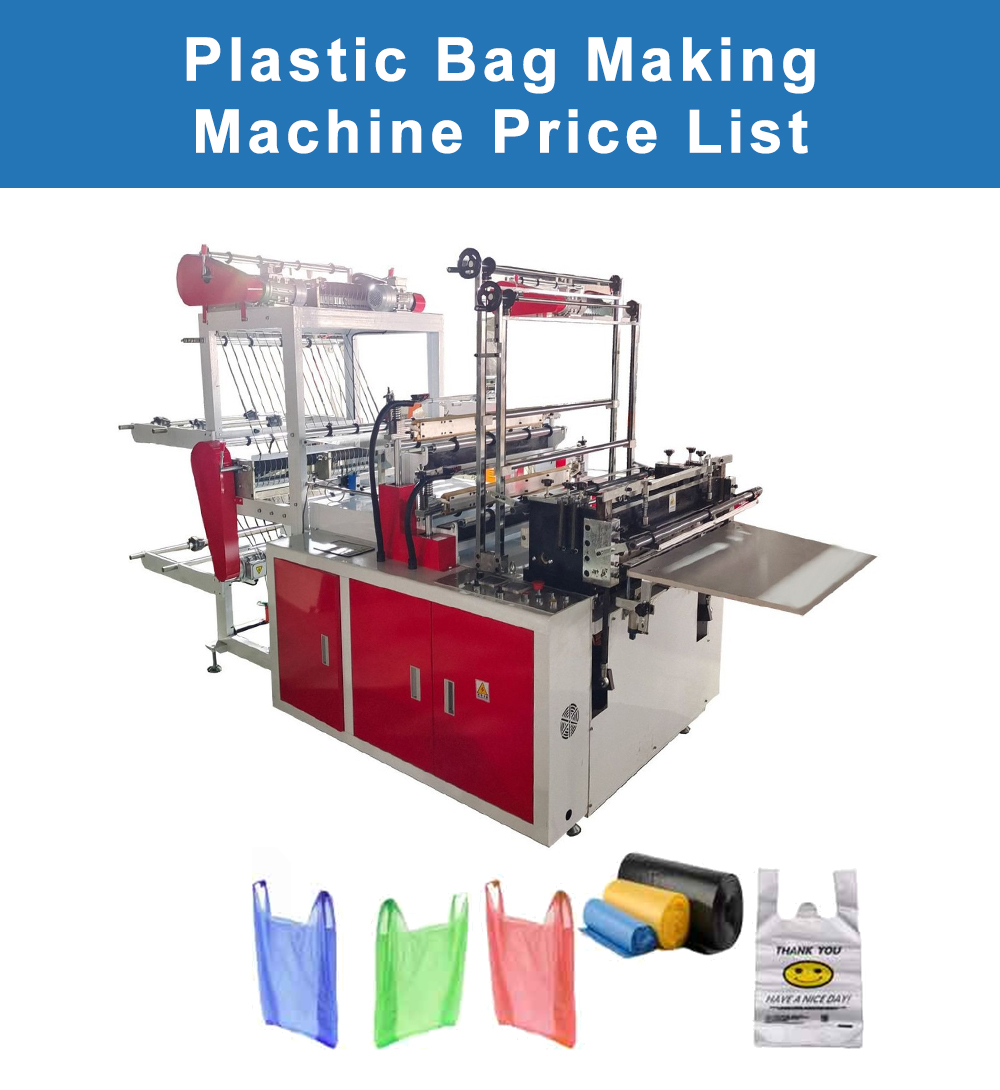
Plastic Bag Making Machine Price List

Table of Contents

Plastic Bag Making Machine Price List

FILM EXTRUSION MACHINES

Blown Film Extruder

This is where everything starts in a bag operation. Plastic pellets go in one end, and what comes out is a thin tube of film that gets inflated with air like a giant bubble. The bubble size determines your film width. Sounds simple but there’s a lot happening inside. The screw design, barrel temperature zones, die gap settings, all of it affects what you get.

Most machines handle the common stuff like LDPE, HDPE, and LLDPE. Some can switch between materials, others are optimized for one type. If you’re making grocery bags that’s different film than heavy duty garbage bags, so what you’re producing matters when you’re choosing equipment.

Single layer machines work fine for basic applications. When you need something stronger or you’re doing food packaging that requires barrier properties, you’re looking at co-extrusion. That means two or three extruders feeding into one die to create layered film. More complicated and more expensive but the results speak for themselves.

Output ranges all over the place. A small lab unit does maybe 20 kg per hour. Mid-size production machines hit 100 to 200 kg. The big industrial lines can push 500 kg per hour or even more. Bigger die, bigger motor, bigger output, bigger price tag.

Price: $8,000 – $250,000

Cast Film Line

Totally different approach from blown film. Instead of inflating a bubble vertically, cast film spreads molten plastic horizontally onto a chilled roller. What you get is crystal clear film with incredibly consistent thickness. That clarity is why stretch wrap and a lot of food packaging goes the cast route. These lines typically run faster than blown film setups but need more floor space since everything happens horizontally.

Price: $50,000 – $400,000

Recycled Plastic Pelletizer

Every bag operation generates waste. Trim from the edges, bags that didn’t seal right, startup scrap, all of it piles up. This machine takes that mess, chops it, melts it, and extrudes it back into pellets you can feed right into your extruder again.

The economics make sense pretty quickly. Instead of paying someone to haul away your scrap or selling it cheap, you’re turning it back into product. Depending on your volume, payback can happen within a year.

Quality of the output depends on how clean your input is. Mixing different plastic types or letting contaminants in gives you garbage pellets. Most operations keep their scrap streams separated for this reason.

Price: $15,000 – $80,000

Internal Bubble Cooling System

On blown film lines, cooling happens from the outside with air rings. IBC adds cooling from inside the bubble too. Faster cooling means you can run faster, and more uniform cooling means more consistent film. Not every operation needs this but if you’re pushing for higher output it pays for itself.

Price: $10,000 – $60,000

Gravimetric Blender

Mixes your plastic pellets by weight before they hit the extruder. Most bag film isn’t pure virgin resin. You’re blending in recycled material, color concentrates, additives. Getting the ratios right matters for consistent film.

Cheaper volumetric blenders measure by volume, which works okay but not great. Pellet size and density variations throw things off. Gravimetric systems weigh everything, so your blend stays accurate regardless of pellet differences. More money upfront but better consistency.

Price: $5,000 – $35,000

Screen Changer

Filters contaminants out of the molten plastic before it reaches the die. Even with clean material, bits of degraded plastic and dust end up in the melt. Without filtration that stuff shows up as specks and weak spots in your film. Manual screen changers require stopping the line to swap filters while continuous changers let you change screens without stopping. For high volume operations, the continuous type is worth it because downtime is expensive.

Price: $3,000 – $45,000

Haul-Off Unit

Pulls the film away from the extruder at a controlled speed. This tension and speed affects film thickness and properties. Too fast and you stretch the film thin. Too slow and it bunches up.

Most extruders come with a haul-off system but standalone units offer more adjustment. Nip rollers squeeze the bubble flat while pulling it along. Sounds simple but the mechanics matter a lot for film quality.

Price: $4,000 – $30,000

BAG MAKING MACHINES

T-Shirt Bag Machine

The bags with handles that look like a tank top. You see billions of these at grocery stores. Film feeds off a roll, gets sealed and cut, handles get punched or cut, and finished bags stack up ready for packaging.

Older machines used mechanical cams and linkages for timing. Newer servo-driven equipment gives you way more control and faster changeovers between bag sizes. The price difference is significant but so is the performance gap.

Speed ranges are all over. Entry level machines make maybe 80 to 120 bags per minute. High speed production lines hit 300 plus. Running fast requires good film, good seals, and operators who actually know what they’re doing. Push a cheap machine too hard and you get junk.

Price: $12,000 – $85,000

Bottom Seal Bag Machine

Simplest bag style there is. Tube of film, seal across the bottom, cut. No handles, no closures, nothing fancy. Produce bags, dry cleaning bags, simple packaging. Operation and maintenance are straightforward which makes this a good machine to start with if you’re learning the business.

Price: $8,000 – $45,000

Side Seal Bag Machine

Instead of sealing across the bottom, seals run down both sides of the bag. Film folds over and gets welded along the edges. Cleaner look, often used for heavier duty applications where bottom seals might fail.

The process is a bit different so these machines aren’t just modified bottom sealers. Dedicated side seal equipment gives better results than trying to adapt other machines.

Price: $10,000 – $55,000

Patch Handle Bag Machine

Ever notice those thick reinforced handles on bags from nicer stores? That’s a patch. Separate piece of plastic gets heat welded onto the bag to create a handle that can actually hold weight without ripping through.

Making these is more involved than basic t-shirt bags. You’re dealing with two film feeds, precise positioning, extra sealing steps. Standalone patch applicators exist but integrated lines that do everything in one pass are more efficient for volume work.

The finished product commands higher prices than basic bags, so the extra equipment cost makes sense for the right market.

Price: $25,000 – $120,000

Soft Loop Handle Bag Machine

Those flexible cloth-like loop handles on retail and boutique bags come from this machine. The handle is actually a separate strip, sometimes a different material entirely, that gets welded on during production. These bags look nicer than t-shirt style and feel more upscale. Production speeds are slower because of the handle attachment step but you charge more for the finished product.

Price: $30,000 – $150,000

Die Cut Handle Bag Machine

Punches handle holes directly through the bag material. No separate handles attached, just shaped cutouts. Common for retail bags where you want a clean look without the bulk of attached handles.

Simpler than patch or soft loop machines since there’s no separate material to attach. The die cutting adds a step but it’s faster than handle attachment processes.

Price: $20,000 – $90,000

Drawstring Bag Machine

Think garbage bags with the strings you pull to close them. The machine folds over the bag top, creates a channel around the perimeter, and threads the drawstring through during production. Way more complex than straight sealing.

String feeding, cutting, and insertion add mechanical complexity. More moving parts means more maintenance and more potential problems. But drawstring bags sell at a premium so the investment can make sense.

Price: $35,000 – $130,000

Zipper Bag Machine

Resealable bags need that zipper strip attached somehow. This machine does it. Zipper stock feeds from its own roll and gets heat sealed to the bag film. Think food storage bags, retail packaging, anything that opens and closes repeatedly.

Getting the seal right between zipper and film takes calibration. Too much heat damages the zipper mechanism. Not enough and the zipper peels off when customers try to use it. Temperature control and pressure settings need attention.

Price: $40,000 – $180,000

Wicket Bag Machine

Makes bags designed to hang on wire wicket dispensers. Bakeries, delis, produce sections, anywhere staff need to grab bags quickly one at a time. Each bag has holes punched near the top that slip onto the wicket posts. Production speeds are good once you’re dialed in but the wicket hole punching needs to be precise or bags won’t stack properly on the dispensers.

Price: $25,000 – $100,000

Garbage Bag Machine

Heavy film, large sizes, strong seals. Garbage bags take abuse so they need to be tough.

Star seal patterns at the bottom distribute stress better than straight seals. Some machines fold bags flat, others roll them onto cardboard cores. Output measured in bags per minute and these machines can really move.

Industrial garbage bag lines are serious equipment. Thick film, powerful sealing bars, high throughput. This isn’t delicate work.

Price: $20,000 – $150,000

Biodegradable Bag Machine

Standard bag machine adapted for compostable and biodegradable films. These materials behave differently than regular plastic. More sensitive to heat, affected by humidity, sometimes weaker structurally. Not every bag machine handles bio films well. The films need lower sealing temperatures and more careful handling. If this market interests you, make sure equipment is actually designed for it or you’ll fight constant problems.

Price: $15,000 – $100,000

Gusseting Machine

Creates those folded sides that let bags expand. Without gussets, bags are flat. With them, bags can hold bulkier items and stand up on their own. The machine folds the film inward on both sides before sealing.

Can be a standalone unit that processes film before it hits the bag machine, or integrated into the bag making line itself. Integrated setups are more efficient but cost more.

Price: $8,000 – $40,000

Punching Machine

Cuts holes in bags for handles, ventilation, or hanging displays. Some bag machines have punching built in. Standalone punchers offer more flexibility if you’re making different bag styles or need specialty hole patterns. Dies are interchangeable so you can switch between handle shapes, vent hole patterns, whatever you need.

Price: $5,000 – $30,000

Perforating Machine

Creates those tear lines that let you separate bags from a roll. Garbage bags, produce bags, anything sold in rolls needs perforation.

The machine runs a toothed wheel or blade across the film to create a weakened line without cutting all the way through. Getting perforation strength right takes some tweaking. Too deep and bags separate on their own. Too shallow and customers struggle to tear them apart.

Price: $3,000 – $20,000

PRINTING EQUIPMENT

Flexographic Printing Machine

Puts graphics on your film. Flexible rubber or polymer plates pick up ink and transfer it to the film. Simple machines do one or two colors. Big presses handle six, eight, even more colors for complex designs.

Registration is everything. Colors that don’t line up perfectly look blurry and cheap. Good machines have automatic registration systems that make adjustments on the fly. Cheap machines need constant operator attention.

Ink drying between colors matters too. Hot air works but takes time. UV curing is instant but the equipment and inks cost more. What makes sense depends on your volume and quality requirements.

Price: $15,000 – $300,000

Rotogravure Printing Machine

Premium printing quality for high volume work. The image gets engraved into metal cylinders. Ink fills the engraved areas and transfers to the film. The detail and consistency are amazing, especially for long runs. Here’s the catch though. Cylinder engraving costs thousands of dollars per design. Makes zero sense for short runs. But if you’re printing millions of the same bag, the per-unit cost comes way down and the quality can’t be beat.

Price: $100,000 – $500,000+

Inline Printing Unit

Mounts directly on your bag making machine and prints while bags are being made. Saves space compared to printing film separately then feeding it to a bag machine. Usually handles simpler jobs, one to four colors typically. For basic logos and text this works great. Complex graphics with lots of colors still need dedicated printing equipment.

Price: $8,000 – $50,000

Embossing Machine

Adds texture to film. Those patterns you feel on some bags, matte finishes, decorative textures, that comes from embossing. A patterned roller presses into the film and leaves an impression.

Functional and decorative uses both. Embossed surfaces can improve grip, hide scratches, or just look more interesting than plain smooth film.

Price: $10,000 – $50,000

AUXILIARY EQUIPMENT

Corona Treater

Plastic film is naturally slippery and doesn’t accept ink or adhesives well. Corona treatment fixes that. An electrical discharge modifies the film surface to make it receptive. Without this step, printing slides right off. Inline units mount on your extruder or bag line. Standalone machines handle rolls separately. Either way, pretty much mandatory if you’re printing.

Price: $3,000 – $30,000

Auto Winder

Takes film from your extruder and winds it into rolls for storage or further processing. Sounds simple but tension control determines whether you get nice tight uniform rolls or sloppy messes that cause problems downstream.

Good winders adjust tension automatically as roll diameter grows. Cheap ones need constant babysitting. For high volume operations, automatic tension control is worth the extra cost.

Price: $5,000 – $40,000

Film Slitter

Cuts wide film rolls into narrower widths. Your extruder might make film wider than you need for a particular bag size. Slitting lets you get multiple usable widths from one master roll. Blade quality and alignment matter for clean cuts. Dull or misaligned blades leave ragged edges that cause problems in bag machines.

Price: $3,000 – $25,000

Bag Stacker and Counter

Collects finished bags, counts them accurately, and stacks them neat for packaging.

Reduces labor at the end of your line and gives you reliable counts for inventory and shipping. Some units also compress stacks to reduce package volume. Others bundle bags into set quantities automatically.

Price: $2,000 – $20,000

Folding Machine

Folds finished bags for retail presentation. Boutique bags don’t ship to stores in big stacks. They go in boxes neatly folded. This machine does that folding automatically instead of having workers do it by hand.

Price: $6,000 – $35,000

Conveyor System

Moves product between machines. Bags, film rolls, whatever needs to get from point A to point B.

Speed synchronization with other equipment matters. Too fast and stuff piles up. Too slow and you create bottlenecks. Seems straightforward but poorly designed conveyor systems cause real headaches. Worth getting it right.

Price: $1,000 – $15,000

Scrap Grinder

Chops waste film and trim into small pieces for recycling. Usually feeds into a pelletizer or gets sold as regrind. Blades need regular sharpening. Safety guards are important because these machines don’t care what they’re chopping.

Price: $2,000 – $20,000

Chiller Unit

Blown film needs cooling air and chillers provide it. Temperature affects how fast you can run and how uniform your film turns out. Running without adequate cooling means slow production and inconsistent results. Size your chiller for your line. Too small and it can’t keep up. Oversized wastes energy but at least it works.

Price: $3,000 – $30,000

Air Compressor

Pneumatic cylinders, actuators, air knives, bubble inflation… bag machines use compressed air all over the place. Clean dry air at consistent pressure is the goal.

Moisture in your air lines causes problems with equipment and product quality. Industrial screw compressors handle big operations. Smaller reciprocating units work for modest needs. Don’t cheap out on air treatment though. Water separators and filters matter.

Price: $2,000 – $25,000

Hot Air Dryer

Plastic pellets absorb moisture from the air. When that moisture hits your hot extruder barrel, it flashes to steam and creates bubbles and weak spots in your film. Drying pellets before processing prevents this.

How critical this is depends on your material. Nylon and some other plastics are hygroscopic and absolutely require drying. PE is less sensitive but drying still improves consistency.

Price: $1,500 – $15,000

Heat Sealing Machine

Standalone sealer for repairs, samples, or specialty sealing. Not part of the main production line but useful to have around.

Manual, semi-automatic, and fully automatic versions exist. Hand sealers are cheap. Automatic units with conveyors cost more but handle volume work.

Price: $200 – $8,000

TESTING AND QUALITY EQUIPMENT

Film Thickness Gauge

Measures how thick your film is at different points across the web. Consistency matters for bag strength and material costs. Too thick wastes plastic. Too thin makes weak bags that fail. Handheld gauges work for spot checking. Inline scanning systems monitor continuously and some can even feedback to the extruder for automatic correction.

Price: $500 – $25,000

Tensile Strength Tester

Stretches film samples until they break and records the force required. Basic quality control for any serious operation. Tells you whether your film actually has the strength you think it does.

Price: $2,000 – $15,000

Seal Strength Tester

Pulls seals apart and measures the force needed. Weak seals mean bags that split open and unhappy customers complaining. Test your seals regularly, especially when changing materials or machine settings.

Price: $1,500 – $12,000

Dart Drop Tester

Drops a weighted dart onto film samples to test impact resistance. Simulates what happens when a full bag gets dropped. Standard quality test for bag film. Simple equipment but necessary.

Price: $1,000 – $5,000

Coefficient of Friction Tester

Measures how slippery or sticky film surfaces are. Affects how bags feed through machines, how they stack, whether customers can open them easily. Film that’s too tacky clumps together and causes problems.

Price: $1,500 – $8,000

Melt Flow Indexer

Measures how easily plastic flows when melted. Important for quality control on incoming raw materials.

If your resin supplier sends you inconsistent material, this catches it before it causes production problems. Cheap insurance against bad batches ruining your day.

Price: $3,000 – $15,000

COMPLETE PRODUCTION LINES

Entry Level Bag Production Line

Everything needed to start making basic bags. Small extruder, simple bag machine, maybe a basic two-color printer. Good for testing the market, small regional production, or learning the business before scaling up. Output is modest, few hundred kilos of bags per day depending on what you’re making. Won’t compete with big operations on volume but gets you started without massive capital outlay.

Price: $50,000 – $150,000

Mid-Range Production Line

This is real commercial production. Bigger extruder, faster bag machines, better printing. Output somewhere around 500 to 1,000 kg of finished bags daily, more or less depending on bag sizes and styles.

At this level you need trained operators and actual maintenance capability. Equipment this sophisticated isn’t quite plug and play. Problems happen and you need people who can diagnose and fix them.

Price: $200,000 – $500,000

High Volume Production Line

Industrial scale operations. Multiple extruders, high speed bag machines running flat out, full color printing capability, automated packaging systems. These lines run 24 hours with multiple shifts.

Output measured in tons per day. Requires serious electrical infrastructure, climate control, warehouse space, skilled workforce.

This is what major bag suppliers use. The investment is substantial but so is the capacity.

Price: $500,000 – $2,000,000+

Take Away

When you’re ready to invest in quality equipment that actually performs, Finetech is the partner you want. We offer top-tier plastic bag-making machinery backed by customer service that doesn’t disappear after the sale. Contact Finetech today for a quote, and let’s get your production line running right.

Leave a Comment

Your email address will not be published. Required fields are marked *

Share The Post Now:
Picture of Hey there, I’m Tony Tao

Hey there, I’m Tony Tao

I am the CEO of Finetech, with more than 10 years of experience in the pharmaceutical equipment industry. I hope to use my expertise to help more people who want to import pharmaceutical processing equipment from China.

Related Articles

Sealing Machine Price List

Sealing Machine Price List

Hand Held Sealers Mini Bag Sealer Tiny gadgets that fit in your palm. Battery powered or rechargeable. Press down on

Scroll to Top