 English
  Russian
  Turkish
  Spanish
  French
  German
  Japanese
Picture a batch of wet powder sitting on a metal plate full of tiny holes. Now imagine forcing hot air up through those holes hard enough that the powder lifts off the plate and starts floating around. Grains bouncing off each other, swirling, tumbling. The whole bed puffs up and moves like a pot of soup at a rolling boil. Wet particles keep cycling through that hot air stream until the moisture is gone.
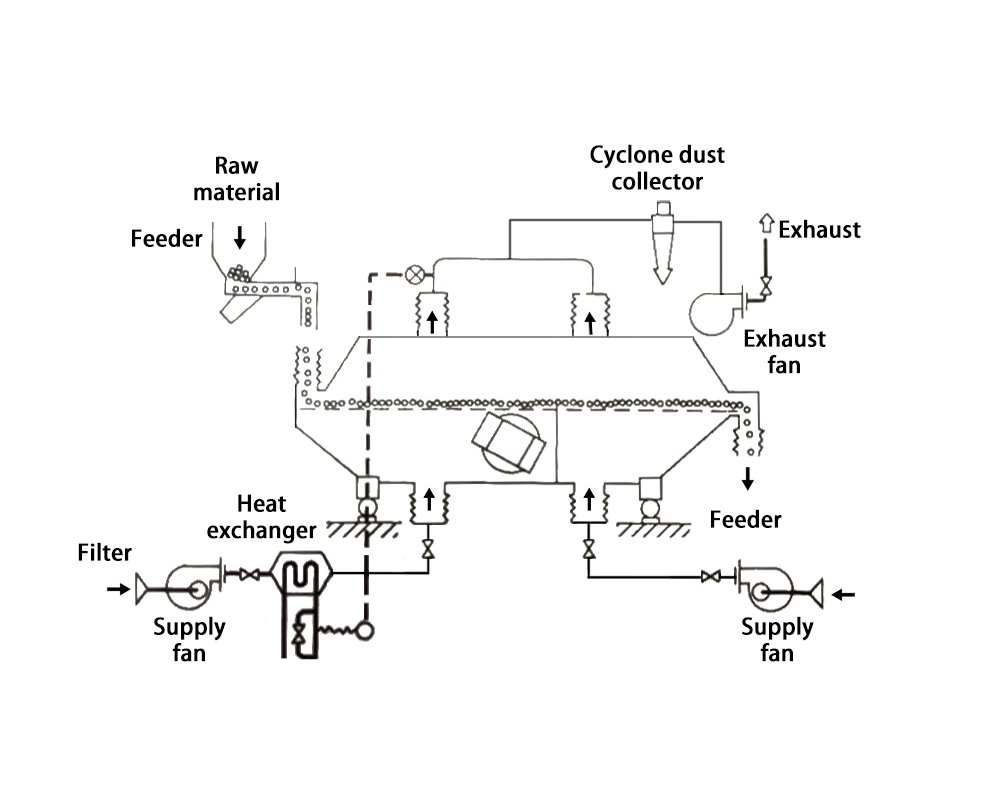
That, in roughly 60 words, is a fluidized bed dryer at work. Simple concept. But the process behind it has a number of stages that all have to line up right, or the product comes out too wet, too dry, scorched, or full of clumps.
Getting the Air Ready
Nothing touches the product until the air has been prepped. A blower sucks in ambient air from the plant, and that air goes straight through a filter bank. The filters grab dust, fibers, bugs, pollen, whatever might be floating around. Pharma and food plants push the filtration up to HEPA level because a single outside particle landing in the batch can mean a rejected lot and a very unhappy quality team.
After filtration, the air hits a heater. Big plants tend to use steam coils. Smaller or lab-scale units run on electric heating elements. Thermal oil rigs and gas-fired setups also exist, depending on what fuel source the facility has cheapest access to.
How hot the air gets depends entirely on what is being dried. A tough chemical salt can handle 120°C or more without flinching. A vitamin blend or an enzyme might start falling apart above 50°C. Picking the wrong inlet temperature is one of the fastest ways to ruin a batch, so operators spend real time dialing this in before production starts.
The Plate That Spreads the Air
Between the air supply below and the product above sits a flat plate with hundreds of drilled holes. Some people call it the distributor plate. Others call it the air plate or the grid. Whatever the name, its purpose is straightforward: take the concentrated blast of hot air coming from the heater and spread it out so every square inch of the bed above gets the same airflow.
When the plate does its job well, the entire powder bed lifts evenly. When it does not, one side of the bed floats and the other side sits dead. Dead zones dry slowly. Clumps form there. The batch ends up with a spread of moisture levels instead of one consistent number, and downstream problems follow.
Plate designs vary. Straight-drilled holes are the basic version. Angled or directional holes create a swirling air pattern inside the bed, which stirs the product harder and can cut drying time. Which design a shop runs depends on the product and what the dryer manufacturer recommended for that particular machine.
Fluidization Itself
At low air speed, the powder just sits on the plate. Air sneaks through the gaps between grains but nothing moves much. Turn the blower up and the bed starts to shift. Grains wiggle and rearrange. Keep going and suddenly the whole bed lifts. Grains separate, float free, and start colliding with each other in midair. The bed expands and behaves like a thick, churning liquid.
There is a specific air speed where the upward push of the air exactly cancels out the weight of the grains pulling them down. Below that speed, no real fluidization. Above it, the bed opens up fast. Most operators target somewhere around 1.5 to 3 times that threshold. Running in that window gives strong mixing without launching grains into the exhaust ductwork.
Why does fluidization dry things so much faster than, say, a tray dryer? Contact. A tray dryer bakes product in a still layer. Only the top surface sees hot air. Everything underneath waits its turn. A fluidized bed throws every grain through the hot air stream over and over, hundreds of times per minute. Nothing hides. Nothing sits in a stagnant pocket. A job that takes a tray dryer 8 hours might wrap up in 20 minutes in a fluid bed.
How Water Leaves the Product
Drying in a fluidized bed happens in two distinct phases, and they behave very differently from each other.
Early on, the grain surfaces are still wet. Hot air blasts across them and water turns to vapor almost on contact. The air carries that vapor away, more hot air replaces it, and the cycle keeps going. As long as the surface stays wet, drying cruises along at a flat, steady pace. Old-school drying textbooks call this the constant-rate period, and it chews through surface moisture fast.
Then the surface dries out. The easy water is gone. What remains is locked deeper inside the grain, trapped in tiny pores and channels. Getting it out requires the water to slowly migrate outward to the surface, and only then can it evaporate. The whole process slows way down. Textbooks call this the falling-rate period, and most of the total drying time gets burned here waiting for trapped water to creep out.
Operators watch the exhaust humidity to track where the batch sits in this curve. High humidity holding steady? Still in the constant-rate zone, surface water leaving fast. Humidity starting to drop? Falling-rate territory. The easy stuff is done and now the dryer is grinding through the deep moisture. Humidity flattens out at a low number and stops moving? Batch is done or close to it.
Catching Dust on the Way Out
Air leaving the top of the dryer is not clean. It picked up water vapor from the product, sure, but it also grabbed fine particles that got tossed up during all that turbulent mixing. Those fines cannot leave the building. They represent lost product, and in pharma or food work, they also represent a contamination and safety risk.
Fabric bag filters hanging in the upper section of the dryer catch most of the dust. Exhaust air passes through the bags, fines stick to the fabric, and clean air exits out the back. Over time the bags load up with dust and choke off airflow. Modern dryers fix this with pulse-jet cleaning. A short blast of compressed air fires backward through each bag on a timer, popping the collected dust cake off the fabric and dropping it back into the product bed. Keeps the pressure drop stable and the airflow consistent throughout the run.
Pharma and food operations add more layers. Anti-static bag materials for products that could spark. HEPA filters on the final exhaust. Pressure sensors that watch the filter bank and sound an alarm when the drop across the bags starts climbing toward a problem.
Running It in Batches
Batch mode is how most pharma operations run their fluid bed dryers. The full load of wet product goes in at once. Blower starts, heater is already at temp, and the bed lifts. Operators keep an eye on bed temperature, exhaust humidity, and airflow the whole time. When moisture readings say the product is done, the air shuts off and the dried material drops out through a valve or a tilting bowl.
Cycle times vary widely. A small lab batch of a fast-drying granule might be done in 15 minutes. A full-scale production load of a stubborn, moisture-heavy powder could take over an hour. The material, the batch size, and the inlet temp all push the number around.
Pharma likes batch mode because traceability is clean. One lot, one bowl, one set of records. A problem in batch 47 stays in batch 47. Nothing bleeds into the next one.
Running It Nonstop
Food and chemical plants that push high volumes often go continuous instead. Wet material feeds in at one end of a long, flat fluidized bed. It travels the length of the machine, passing through zones tuned to different temperatures. The front end runs hot and hammers the surface moisture. Middle zones ease off. The tail end might blow cool air to bring the product temperature down before it drops off the end into a collection bin.
Some continuous dryers use vibration to help move the product along. The whole bed shakes gently, nudging material from the inlet toward the outlet. Others rely on gravity or on the push of the fluidizing air itself to keep things flowing in the right direction.
No waiting. No loading and unloading. Product goes in wet at one end and comes out dry at the other in a steady stream. Plants that run 24 hours a day, 7 days a week, love continuous dryers because the line never stops.
What Operators Keep an Eye On
| Reading | Where It Comes From | What It Tells You |
| Inlet air temp | Probe after the heater | How much drying power the air carries |
| Exhaust air temp | Probe at the dryer outlet | Climbs as the product loses moisture |
| Bed temp | Probe sitting in the product | Guards against overheating touchy materials |
| Exhaust humidity | Sensor in the exhaust duct | Shows drying progress in real time |
| Filter pressure drop | Gauges across the bag filters | Warns when bags need cleaning or swapping |
| Airflow rate | Flow meter on the main duct | Confirms fluidization is in the right ballpark |
A PLC or DCS ties all of these together. Targets go in, the control system tweaks the heater and blower to hold things where they belong, and alarms fire if a reading drifts out of bounds. Newer machines log every data point for the whole run, which pharma regulators want to see and which comes in handy for troubleshooting even outside of regulated work.
Getting the Dried Product Out
Batch dryers usually discharge from the bottom. The bowl tips, a butterfly valve pops open, or the whole bowl lifts out and gets wheeled to the next step. Some designs have a side chute with a paddle for manual sweep-out.
Before anything moves forward, moisture gets checked. A loss-on-drying test or an inline NIR probe confirms the batch landed where it needed to. Came up short? Run the dryer a few more minutes. Went too far and the product is bone dry? Note it and dial back the cycle on the next batch. Most pharma specs call for a final moisture somewhere between 1% and 3%, though the exact number depends on the formula and what happens to the product next.
A sieve or screen after discharge breaks up any clumps that stuck to the walls or formed near the plate. Most fluid bed dried product does not need real milling, though. All that tumbling during the run keeps grains from fusing together the way they do in a static oven or tray setup. That is a genuine advantage of this dryer type over older drying methods, and one of the reasons it replaced tray dryers in a lot of plants decades ago.
Conclusion
Prep the air, heat it, push it through a plate, float the wet product, let the hot air strip the moisture out, catch the dust, and collect the dried material at the end. Every stage hands off to the next one, and a weak link anywhere in that chain shows up in the final product. Not complicated stuff on paper. But doing it well, batch after batch, takes more care than most people expect walking in the door for the first time.
References:
Types of Air Distribution Plates in Fluid Bed Processor.
How Many Sensors in Fluid Bed Dryer(FBD): Everything You Need to Know.
Understanding Fluidized Bed Dryer in Pharmaceutical Engineering.
Copyright Notice:
You may not reproduce, modify, publish, display, transmit, or in any way exploit any content on this website, or use such content to construct any kind of database without prior express written approval by Finetech Group. For permission to use the content, please contact: info@pharmamachinecn.com
Disclaimer:
The information contained in this article is for general information purposes only. The Company does not guarantee the accuracy, relevance, timeliness or completeness of any information, and the Company assumes no responsibility for errors or omission in the content of this article.


2 thoughts on “Fluidized Bed Dryer Working Principle”
Endlich jemand sagt es richtig. Kann dem nur beipflichten komplett hier
Sehr hilfreich und gut verständlich geschrieben für jeden