English
  Russian
  Turkish
  Spanish
  French
  German
  Japanese
Pharmaceutical manufacturing demands precision, consistency, and optimal performance from equipment. Among the key tools used in drug formulation are emulsifiers and blenders, which are often confused due to their similar roles in mixing ingredients. When comparing emulsifier vs blender in the pharmaceutical industry, it is important to understand how each machine contributes to drug formulations.
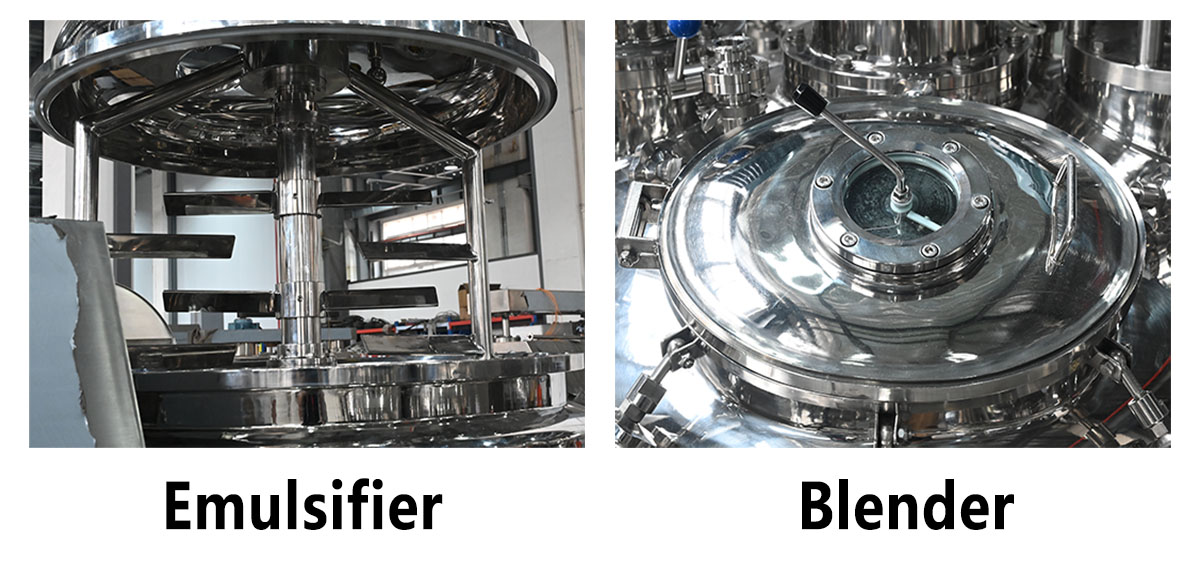
We will explore the differences, use cases, and performance of each to guide better equipment selection in pharma.
Understanding the Basics
Before we move into comparing emulsifiers vs blender, it is crucial to understand what each equipment does.
Emulsifiers
In pharmaceutical production, an emulsifier is a piece of equipment used to form emulsions, which are mixtures of two immiscible liquids, such as oil and water. Emulsions are common in creams, ointments, vaccines, and oral suspensions. An emulsifier ensures the droplets of one phase (usually oil) are finely dispersed into the continuous phase (usually water), stabilized by emulsifying agents.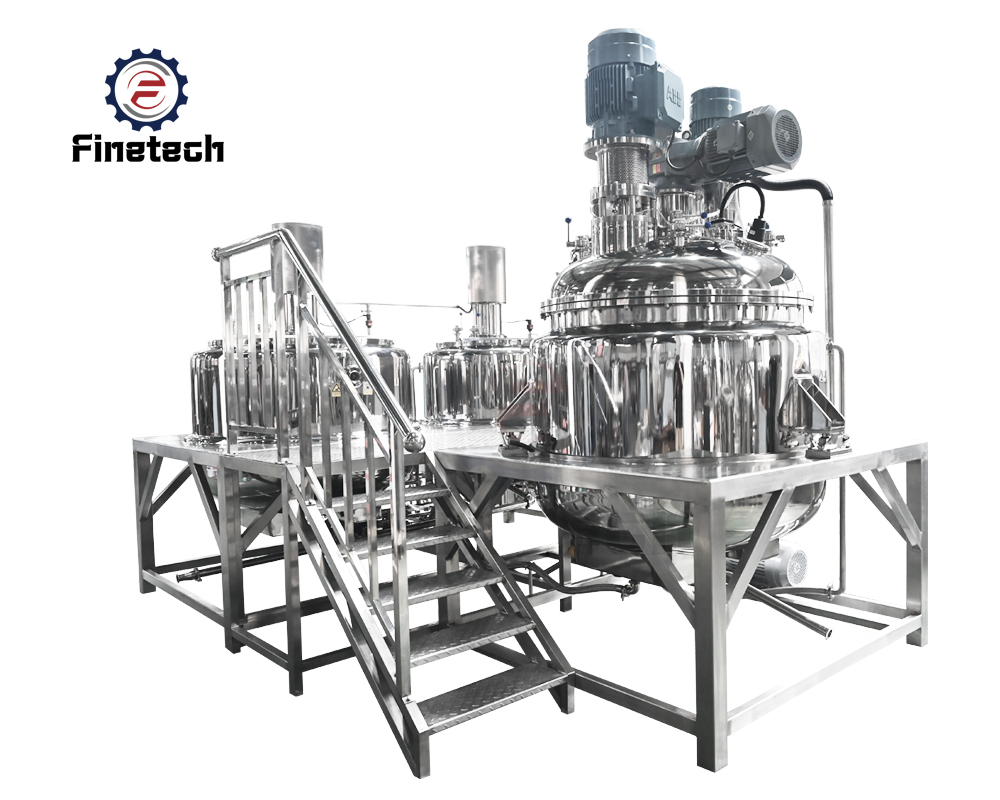
Emulsifiers are crucial when a stable emulsion is required, especially in products that need to retain homogeneity over time without separation. Pharmaceutical emulsifiers include:
- Rotor-stator mixers.
- High-pressure homogenizers.
- Ultrasonic emulsifiers.
- Vacuum emulsifying mixers.
Blenders
On the other hand, a blender is used for solid-solid mixings, such as powders and granules, or solid-liquid blending, in pre- or post-processing stages like granulation, tablet manufacturing, or capsule filling. It ensures a homogeneous mix of different powders, active pharmaceutical ingredients, and excipients.

The blending process is often less intense than emulsification and relies on gravity, diffusion, and mechanical rotation. Unlike emulsifiers, blenders are not used to reduce particle sizes or create emulsions. Common types of pharmaceutical blenders include:
Mechanism of Action
One of the most crucial distinctions in the emulsifier vs blender lies in their operating mechanisms. Emulsifiers use high-shear mixing. They work by rapidly spinning a rotor inside a stationary stator to generate intense shear forces that break down and mix immiscible liquids. This results in finely dispersed droplets and stable emulsions.
Blenders, however, work via low shear. Their action depends more on tumbling, diffusion, or convective movement to achieve uniform mixing of the powder. No significant shear is generated, making them ideal for heat-sensitive or fragile substances.
In pharmaceutical formulation, shear-sensitive APIs may not tolerate emulsification well, whereas blenders are gentle enough to preserve ingredient integrity.
Pharmaceutical Applications
The real difference in emulsifier vs blender becomes evident when looking at their applications.
When to Use an Emulsifier
Emulsifiers are used in:
- Topical formulations, such as lotions, creams, and ointments, require stable emulsions.
- Parenteral emulsions such as lipid-based injectables.
- Syrups and suspensions for pediatric or geriatric use.
- Nanoemulsions for enhancing the bioavailability of poorly soluble drugs.
Pharmaceutical emulsifiers are also indispensable in liposomal drug delivery systems, which require uniform lipid dispersion and precise particle sizing.
When to Use a Blender
Following are the applications of a blender in the pharmaceutical industry:
- Dry powder mixing for tablets and capsules.
- Granule mixing in dry granulation or before compression.
- Pre-blending of excipients before adding APIs.
- Post-lubrication blending to add glidants or lubricants.
A blender ensures even distribution of excipients and APIs to avoid dose variation, a critical aspect in oral solid dosage forms.
Product Stability and Homogeneity
When comparing emulsifier vs blender, stability and homogeneity are key quality attributes. Emulsifiers produce emulsions with uniform droplet sizes, reducing the risk of creaming, sedimentation, or phase separation. This is crucial for maintaining product stability throughout its shelf life. In contrast, blenders aim for uniform distribution of particles, which directly influences dosage accuracy, content uniformity, and patient safety.
A poorly emulsified product may separate over time, while a poorly blended powder can result in sub-potent or super-potent dosage units. Both tools directly impact product quality and regulatory compliance.
Scalability and Production Considerations
In pharmaceutical manufacturing, the ability to scale from laboratory development to full-scale commercial production is important for efficiency and regulatory compliance. When evaluating emulsifier vs blender, scalability behaves quite differently.
High-shear emulsifiers are available in various capacities and can be scaled up effectively; however, maintaining a consistent shear intensity and droplet size distribution becomes complex. This often requires precise, automated process control systems.
In contrast, blenders are generally easier to scale, especially for solid dosage forms. Adjustments to parameters such as blending time, fill volume, and rotation speed can be made with minimal impact on product quality.
Additionally, blenders tend to be more forgiving of batch variability, offering greater flexibility. Emulsifiers, however, require tighter control to ensure consistent emulsion stability, making their scale-up more demanding and technically sensitive.
Cleaning, Validation, and Maintenance
Pharmaceutical manufacturing must comply with GMP, which requires regular cleaning, validation, and maintenance of all equipment. Emulsifiers typically have complex rotor-stator assemblies that may harbor residues, making cleaning and validation more time-consuming. Cleaning-in-place (CIP) or sterilize-in-place (SIP) systems are often required.
Blenders, particularly dry ones, are easier to disassemble, clean, and validate. Since they do not involve liquid components, the risk of microbial contamination is lower. When weighing emulsifier vs blender, consider ease of validation and compliance costs for your operation.
Technological Advancements and Integration with Automation
Modern pharmaceutical production increasingly relies on automation, data logging, and real-time process monitoring. Advanced emulsifiers now integrate with PAT (Process Analytical Technology) tools, such as inline particle size analyzers, temperature sensors, and flow monitors. These features allow for real-time control and increased batch consistency.
Smart blenders can be integrated into fully automated lines with barcode scanning for batch tracking, programmable mixing sequences, and real-time uniformity testing using NIR spectroscopy.
Both technologies are evolving, and the emulsifier vs blender choice may hinge on how well each fits into your automated manufacturing environment.
Cost and ROI
When comparing equipment, cost-effectiveness is more than just the upfront price tag. Emulsifiers tend to be more expensive due to their high-shear capabilities, high energy consumption, and technical complexity; yet, they deliver long-term value in specialized formulations, such as nanoemulsions and biologics.
Blenders, on the other hand, are ideal for solid dosage forms, offering a lower initial cost, minimal maintenance, and ease of use. For accurate ROI analysis, consider operational efficiency, product yield, lifespan, and compliance with pharmaceutical regulations.
Conclusion
In pharmaceutical manufacturing, choosing between emulsifier vs blender is not about which is universally better; it is about which one best suits your formulation goals. Emulsifiers excel in liquid and semi-solid preparations requiring fine dispersion and stability. Blenders are important for solid dosage forms needing uniform mixing without degrading sensitive ingredients.