English
  Russian
  Turkish
  Spanish
  French
  German
  Japanese
Double-cone blenders are one of the most essential machines in the pharmaceutical industry for uniformly mixing dry powders and granules. This stage is critical because the mixing process can make or break the quality of the final product.
When blending goes wrong, it leads to wasted batches, lower output, and poor drug performance, problems that no pharmaceutical company can afford. In the worst cases, it can trigger regulatory actions from authorities such as the FDA or EMA. That’s why manufacturers trust the double cone blender.
It’s simple, powerful, and gentle on materials, which makes it ideal for consistent results. In this blog, we’ll break down the double cone blender principle, construction, and working process to understand why it’s a preferred choice across industries.
What Is a Double Cone Blender, and Why Is It Used?
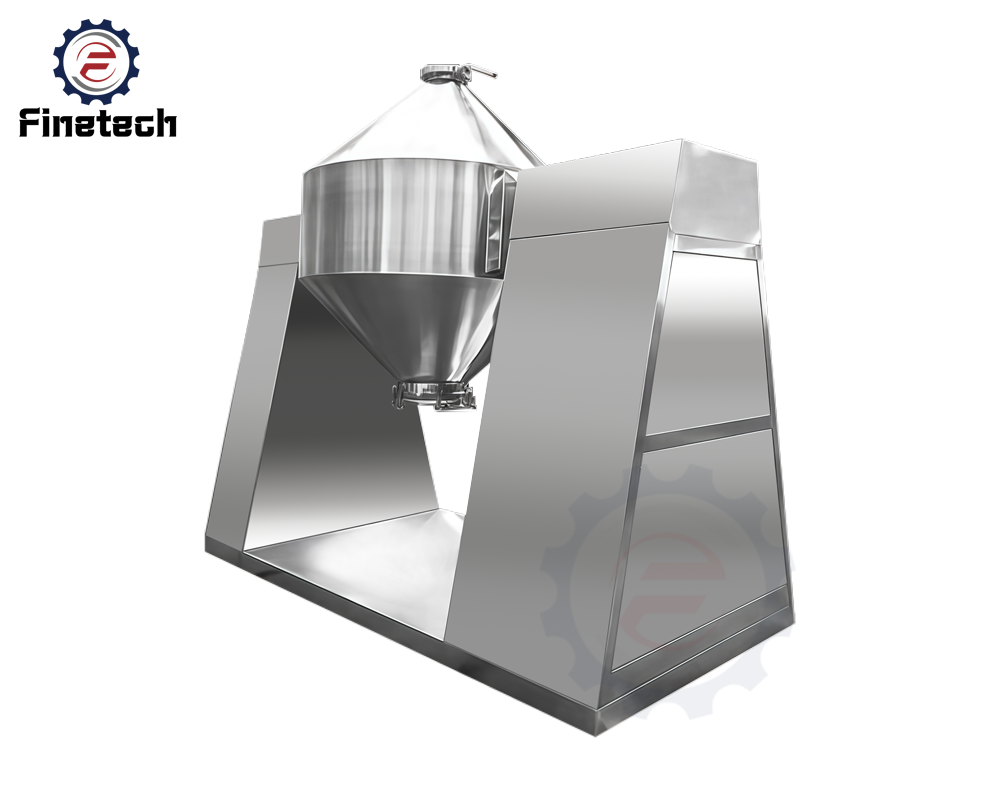
A double cone blender is a pharmaceutical machine used to mix dry powders and granules uniformly. It has two conical sections joined by a central cylindrical body, which forms a shape that lets the materials tumble and mix freely as the vessel rotates.
This gentle tumbling motion maintains the blend’s consistency and coolness, ensuring the particles remain intact during mixing.
Without this process, it’s almost impossible to assure homogeneity in powder mixture, an essential factor for maintaining product quality and performance.
Principle of Double Cone Blender: The Science Behind Tumbling Mixing
The double cone blender works on a simple tumbling principle. In physics, this means the rotation of an object in a complex way, not just smoothly around one axis. It flips, rolls, or turns over itself.
Tumbling motion is used in engineering when we want to mix with even distribution, because the continuous flipping makes all parts move and interact with each other.
This method is widely used for the dry blending of free-flowing solids when the ingredients have different bulk densities or mix ratios. As the vessel rotates, every particle gets redistributed throughout the batch, leading to a consistent mixture.
Typically, the mixing process takes around 10 minutes, though it can vary depending on particle size, shape, and material complexity.
Construction of a Double Cone Blender (Main Parts Explained)
Double cone blenders are built from several carefully designed parts that make the machine functional, durable, and easy to operate.
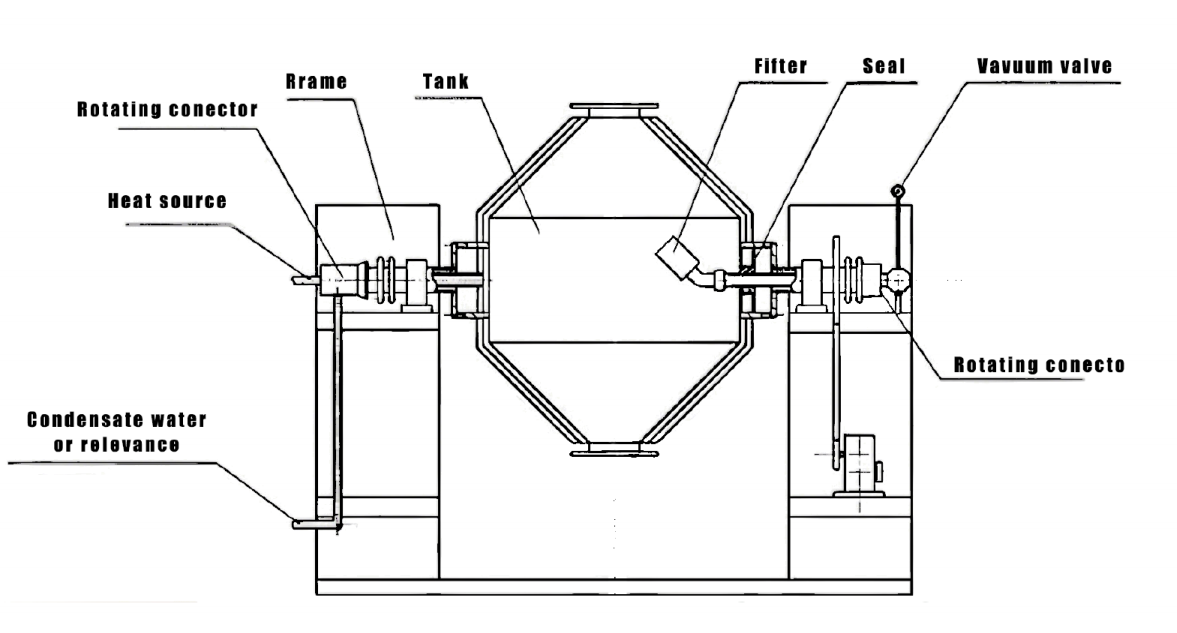
The blender vessel (a double-cone-shaped chamber) is the most crucial part of the design. All the mixing takes place inside this vessel as it rotates around its horizontal axis.
Another key component is the motor and gearbox, also known as the drive system. This system supplies the rotational force needed to turn the vessel at a controlled speed, and helps powders and granules mix evenly throughout the batch.
The blender we see in the center is mounted on a strong, stable frame that supports the vessel and absorbs vibration during operation.
For convenience, loading and unloading ports are provided for adding and discharging the blended products. Most modern models also include a control panel to adjust mixing time, speed, and rotation direction.
Step-by-Step Working of the Double Cone Blender
Here’s a simple step-by-step look at how a double cone blender works. The overall process remains the same across most models, with only a few steps varying depending on the machine’s design or operating type.
Video source: https://www.youtube.com/watch?v=CEdsJ1e7hL0
Step 1: Loading of Material
The first step begins with loading the dry powders or granules into the blender through the loading ports, typically located at the top of the machine.
While adding the powder, it is important to ensure that the material does not exceed the maximum fill level of the blender. The optimal fill ratio is between 35% and 70% of the blender’s total capacity.
Step 2: Rotation and Mixing
After the material is loaded into the double cone powder mixing machine, the blender is set into rotation. At this stage, the operator can use the control panel to set the desired speed and mixing time according to the type of material and batch size.
Once set, the mixing process will begin, and the powders will continuously cascade and tumble inside the double cone.
Step 3: Discharge of Mixed Material
In the end, the operator uses the discharge valve at the lower end to release the blended material into a suitable collection container or transfer system. It is essential to ensure that the discharge is controlled to prevent spillage in the pharmaceutical manufacturing facility.
SOPs for Double Cone Blender (Free PDF Download)
Although a double cone blender is of great help, its usefulness is only ensured when the company follows proper operating, cleaning, and maintenance procedures.
In most organizations, these are documented in a Standard Operating Procedure (SOP). This document serves as a guideline for both new and existing employees, and assures uniformity, safety, and compliance during blender operations.
The SOPs are divided into different parts. These include Objective, Scope, Responsibilities, Equipment Details, Operating Procedure, Cleaning Procedure, Safety Precautions, and Documentation.
What Each Part of the SOP Means |
|
With these sections, the SOP reminds every employee of their specific duties and the correct procedures to follow. It also helps maintain consistent performance and makes the entire blending process safer.
‘Download SOPs for the Double Cone Blender’
FAQs
1. How is the rotation speed controlled in a Double Cone Blender?
Speed is controlled through a variable frequency drive (VFD) or a control panel that adjusts the motor’s rotation rate for optimal blending results.
2. What is the ideal fill level for a Double Cone Blender?
The best fill level is between 50% and 70% of the total volume to allow free tumbling and avoid overloading.
3. How does a Double Cone Blender differ from a V-Blender?
Both use tumbling motion, but the Double Cone Blender has a conical design that promotes better discharge and slightly faster mixing for certain materials.
Upgrade Your Production with a Reliable Double Cone Blender
Modern manufacturing demands precision, consistency, and speed in powder mixing. Among popular options such as the V-shape blender and ribbon blender, the double cone blender has proven to be the most balanced solution for achieving uniform mixing.
Every particle interacts evenly, eliminating dead spots and ensuring a homogeneous blend throughout the batch. This principle of movement defines the core of the double cone blender principle, construction, and working.
However, consistent performance depends on the quality of your equipment. For proven performance and long-term value, choose powder mixing machines engineered by Finetech.
Contact us today to discuss your production needs!
References:
SOP For the Double Cone Blender.
What is V Cone Blender? A Complete Guide to Industrial Mixing Equipment.