English
  Russian
  Turkish
  Spanish
  French
  German
  Japanese
On the production floor, small design choices often create the biggest performance gaps.
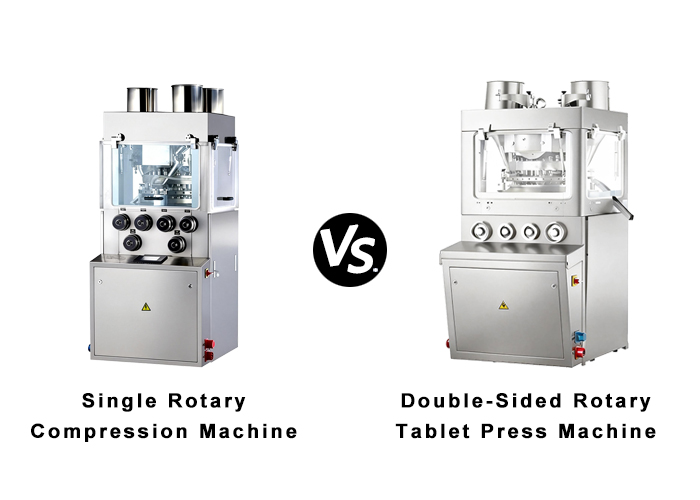
Two tablet press machines may look familiar, share the same tooling, and even run at comparable speeds on paper. Yet once production starts, their efficiency, output rhythm, and scalability can move in very different directions. That difference becomes clear when comparing a single rotary vs double-sided rotary tablet press machine.
One favors controlled output and simpler operation. The other is built for volume and continuous production. If you’re wondering how both of these differ, you’ll get your answer by the end of this guide.
What Is a Single Rotary Tablet Press Machine?

A single rotary tablet press machine uses one compression station to form tablets. As the turret rotates, powder is filled into the die, compressed once, and then ejected. Each die passes through the compression process one time per rotation. This keeps the process simple.
These machines are designed for low to medium output, which makes them suitable for small to mid-sized production runs. They offer good consistency without the complexity of high-speed systems.
What Is a Double-Sided Rotary Tablet Press Machine?

A double-sided rotary tablet press machine compresses tablets on both sides of the turret during each rotation. This means every die is filled and compressed twice per cycle. As a result, you get much higher output without increasing the machine’s footprint.
Double-sided compression significantly improves production speed. By using two compression stations, the machine can produce nearly double the number of tablets compared to a single rotary design. This makes it ideal for large-scale manufacturing.
Single Rotary vs. Double-Sided Rotary Tablet Press Machine
At first glance, single-rotary and double-sided rotary tablet press machines may appear similar. They both use rotating turrets, punches, and dies to compress powder into tablets.
However, the real difference becomes clear when you look at how they perform under production pressure. Below, we will break down the differences between the two so you can better understand which one is best for your needs.
| Factor | Single Rotary Tablet Press | Double-Sided Rotary Tablet Press |
| Compression Stations | One | Two |
| Tablets Per Rotation | One per die | Two per die |
| Production Output | Moderate | High |
| Tablet Quality Control | Easier to adjust | Highly consistent at scale |
| Tooling Efficiency | Standard utilization | Maximum utilization |
| Operational Complexity | Lower | Higher |
| Maintenance Demand | Lower | Higher |
| Floor Space Required | Smaller footprint | Larger footprint |
| Best Suited For | Low to mid-volume production | High-volume manufacturing |
Here’s the detailed comparison:
1. Production Output
Production speed is usually the first factor buyers compare. A single rotary tablet press produces tablets using one compression station per turret rotation. This means each die fills, compresses, and ejects once per cycle.
On the other hand, a double-sided rotary tablet press works differently. It uses two compression stations on the same turret. Each die passes through two compression points in one rotation. This doubles the tablet output without requiring the turret to rotate faster.
The difference matters most for high-volume manufacturers. Single rotary machines may struggle to meet large batch requirements, making double-sided rotary machines the ideal choice.
2. Compression Process
Tablet quality depends on how consistently the powder is compressed. In single rotary machines, the compression process is simpler. One compression event per tablet enables precise control, which is particularly helpful when working with sensitive formulations.
Double-sided rotary machines compress tablets at a higher throughput while maintaining uniform pressure across stations. This requires tighter engineering tolerances and more advanced control systems.
3. Tooling Efficiency
Tooling layout directly affects productivity. In a single rotary tablet press, each punch and die set contributes to output once per rotation. For these machines, tooling utilization is simple and easier to manage.
As for double-sided machines, they maximize tooling efficiency. The same number of punch and die sets produces tablets twice per rotation. This increases throughput without increasing tooling count. However, tooling alignment and wear must be closely monitored.
4. Machine Complexity
Operational complexity is where many buyers underestimate the difference. Single rotary machines are simpler to operate. Moreover, setup is faster, adjustments are easier, and operator training requirements are lower.
Double-sided rotary machines, in contrast, involve more systems working at once. Two compression stations mean more variables to monitor. The only issue is that operators need a stronger technical understanding to manage compression force, speed, and synchronization.
But this does not mean double-sided machines are difficult. It just means they require structured processes and trained operators.
5. Maintenance and Downtime Considerations
Maintenance requirements increase with machine complexity. Single rotary machines experience less wear per cycle because fewer components are under stress. Cleaning and servicing are also faster, which reduces downtime during product changeovers.
On the contrary, double-sided machines operate at higher loads. But more compression means more wear on punches, cams, and bearings. Here, preventive maintenance becomes crucial to avoid unplanned downtime.
6. Floor Space
Single rotary tablet presses usually have a smaller footprint. They fit well in compact production areas and pilot-scale facilities.
Alternatively, double-sided rotary tablet press machines are larger and heavier. That’s why they require stronger foundations, more clearance, and careful layout planning. Installation also takes longer due to system complexity.
For facilities designed around high-volume production, this is rarely a problem. However, if you have a limited space, space constraints can influence the final decision just as much as output requirements.
Which Tablet Press Machine Should You Choose?
A single rotary tablet press machine makes more sense when production volumes are low to moderate. It works well for pilot batches, frequent product changeovers, and facilities with limited space. These machines are helpful for teams with smaller technical staff.
Moreover, you need less money upfront, which makes them suitable for businesses that want controlled growth without overcommitting capital.
As for the double-sided tablet press machine, it is the better option when production demand is high and you need continuous output. It mostly suits large-scale manufacturing environments where speed, efficiency, and consistency matter.
Such machines support long production runs and reduce the need for additional shifts. They also make sense when regulatory compliance and uniform tablet quality are critical.
Common Mistakes Buyers Make When Choosing
Even experienced buyers can make costly mistakes when selecting a tablet press machine. Most issues come from focusing on one factor while ignoring the bigger picture. Here are the common mistakes most companies make:
1. Choosing Based on Price Alone
Many buyers focus only on the initial machine price. While this may reduce upfront spending, it often leads to higher operating costs, slower production, and limited flexibility. A cheaper machine can become expensive over time due to labor, downtime, or early replacement.
2. Overestimating Production Needs
Some buyers purchase high-capacity machines expecting rapid growth that never materializes. This results in underutilized equipment and poor ROI. Make sure to always base your production decisions on confirmed demand only.
3. Not Considering Operational Complexity
Advanced machines require trained operators and structured maintenance routines. Choosing a machine that exceeds the team’s technical capacity can increase errors and downtime. This means operational readiness should always be part of the decision.
FAQs
1. What is the role of pre-compression in double-sided rotary machines?
Double-sided machines utilize two sets of pre-compression rollers to remove air from the granulation before the final main compression at each station. This dual-stage de-aeration is critical for maintaining high tablet integrity and preventing capping at elevated production speeds.
2. How does dwell time vary between single and double-sided presses?
Dwell time depends on turret speed and the diameter of the compression rollers, but double-sided machines often feature larger rollers to compensate for high speeds. This ensures that even at double the output, the granules receive sufficient pressure for adequate bonding.
3. Can a single rotary press be upgraded to a double-sided press?
Upgrading is generally not possible because the internal frame and turret assembly of a double-sided press are fundamentally different to accommodate dual stations. Manufacturers must determine their long-term output needs before the initial purchase.
Choose the Right Rotary Tablet Press Machine with Support
By now, you should know the key differences between a single rotary vs double-sided rotary tablet press machine and how each one fits production. Just remember that the right choice depends on your needs and how much you plan to grow.
If you’re ready to take the next step, Finetech is well-positioned to help you out.
We offer both single rotary and double-sided rotary tablet press machines, along with other options. Even if you’re confused, our specialists can help you choose a machine that supports your business.
References
Top 10 Tablet Press Machine Suppliers in China.
What is a Rotary Tablet Press Machine? A Complete Guide.
How to Import Rotary Tablet Press Machine from China: Easy Guide.
A Complete Guide to Tablet Press Tooling in Industrial Pharmacy.