English
  Russian
  Turkish
  Spanish
  French
  German
  Japanese
The intermittent vs continuous motion cartoning machine decision shapes far more than just output numbers. It affects how often you can change formats, how many rejects you can expect, and whether your line can handle the product variation.
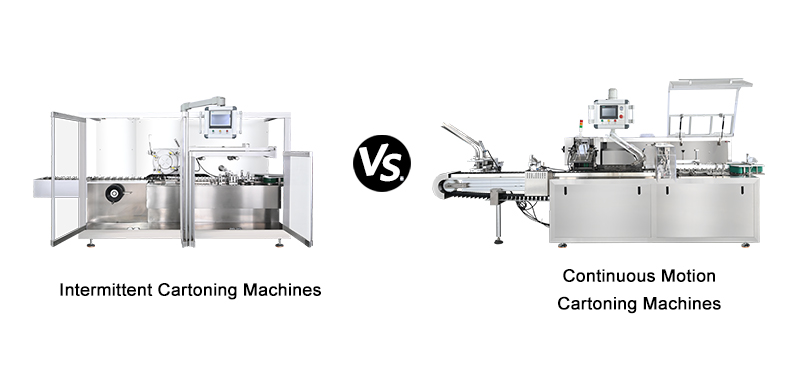
Intermittent cartoners typically max out around 60 cartons per minute, while continuous motion machines can reach up to 240. Yet this only tells part of the story. For a full picture, we will break down how each performs.
Intermittent vs Continuous Motion Cartoning Machines Performance
When you’re looking to buy an intermittent or a continuous motion cartoning machine, it’s important to look at their performance differences objectively. The table below will give you a rough idea, with further details afterwards.
| Factor | Intermittent Motion | Continuous Motion |
| Max Output | Up to 60 cartons per minute | Up to 240 cartons per minute |
| Net Real-World Throughput | Often higher per shift when cartons vary, or upstream flow is inconsistent | Higher only when materials and upstream timing are consistent |
| Changeover Time | Generally easier when formats change often | Slower. More setup precision required between runs |
| Format Flexibility | High. Built for varied SKUs and frequent changeovers | Lower. Demands steadier infeed timing and more consistent cartons to stay stable |
| Reject Rate | Lower. Efficiency of 99.5% or better. | Higher. Efficiency around 98.5%, with greater risk of chipped or sheared product. |
| Infeed Timing Requirements | Forgiving. Machine pauses for each action | Strict. Requires steady and predictable infeed flow |
| Footprint | Generally more compact | Larger. Built for sustained high-speed runs |
| Cost | Lower upfront investment ($10,000 to $300,000+) | Higher upfront investment ($25,000 to $600,000) |
Let’s discuss each of these points in detail.
1. Output Speed
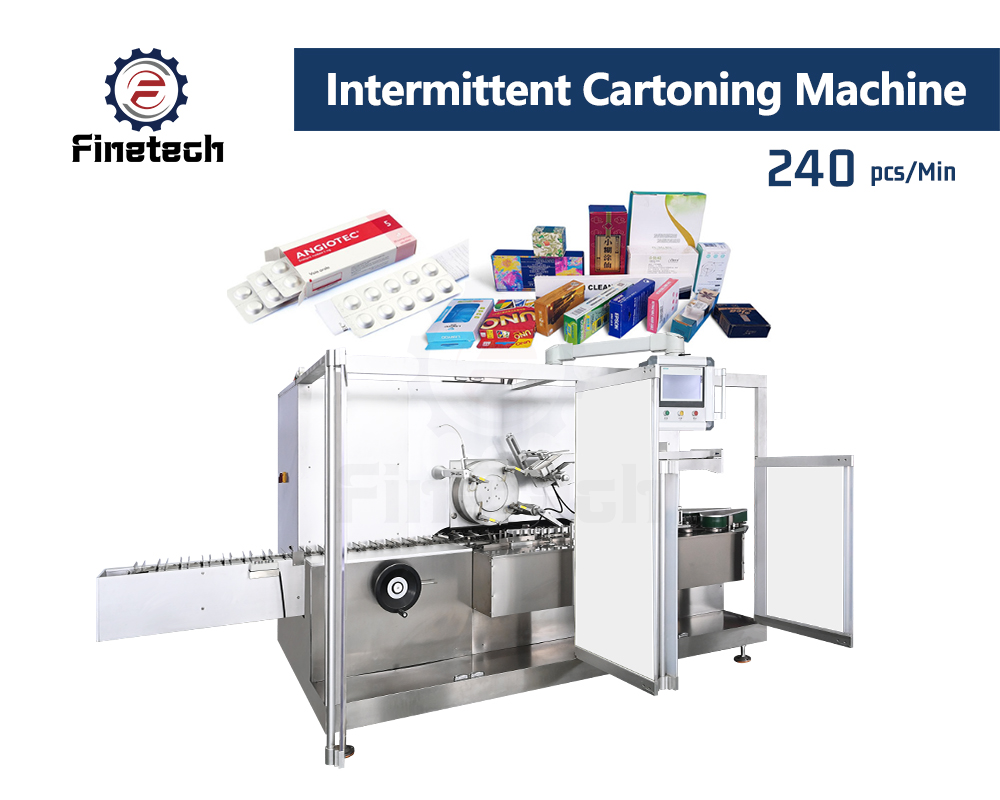
The raw numbers favor continuous motion by a wide margin. Intermittent cartoners max out at 60 cartons per minute. As for continuous-motion machines, they can reach up to 240 cartons per minute.
The former operates at about 45-60 cycles per minute, while continuous-motion machines are rated by web speed, traveling at 10 to 14 meters per minute. On paper, continuous motion wins decisively whenever throughput is the only consideration.
2. Net Output vs Rated Speed
Here is where the picture gets more interesting. Max CPM is a ceiling under ideal conditions. A spec is only useful if it predicts stability, changeover effort, and defect risk. If cartons vary and your product is finicky, intermittent designs deliver higher net output.
Continuous motion wins when materials and upstream timing are consistent, and you truly need sustained high throughput. A machine rated at 240 cartons per minute could end up producing fewer finished cartons if it keeps stalling every time a carton is off-spec.
3. Changeover Time
Intermittent motion is easier when formats change often, since intermittent cartoning machines index from station to station. They are also a common fit when you run many SKUs and rely on repeatable changeovers.
In contrast, continuous motion machines are built around a steady rhythm. Once the rhythm is dialed in for one product, switching to a different carton size or product shape means resetting timing, guides, and synchronization.
4. Reject Rate and Product Handling
This is one of the more overlooked differences, and it matters more than most buyers expect. A continuous motion machine can give faster output, especially for smaller packs, but gives problems with some products such as soft capsules.
These machines also tend to give a greater reject rate, as the product is more likely to be chipped. The efficiency of a continuous motion machine may sit around 98.5%, against 99.5% or better for an intermittent motion machine.
5. Infeed and Upstream Timing Requirements
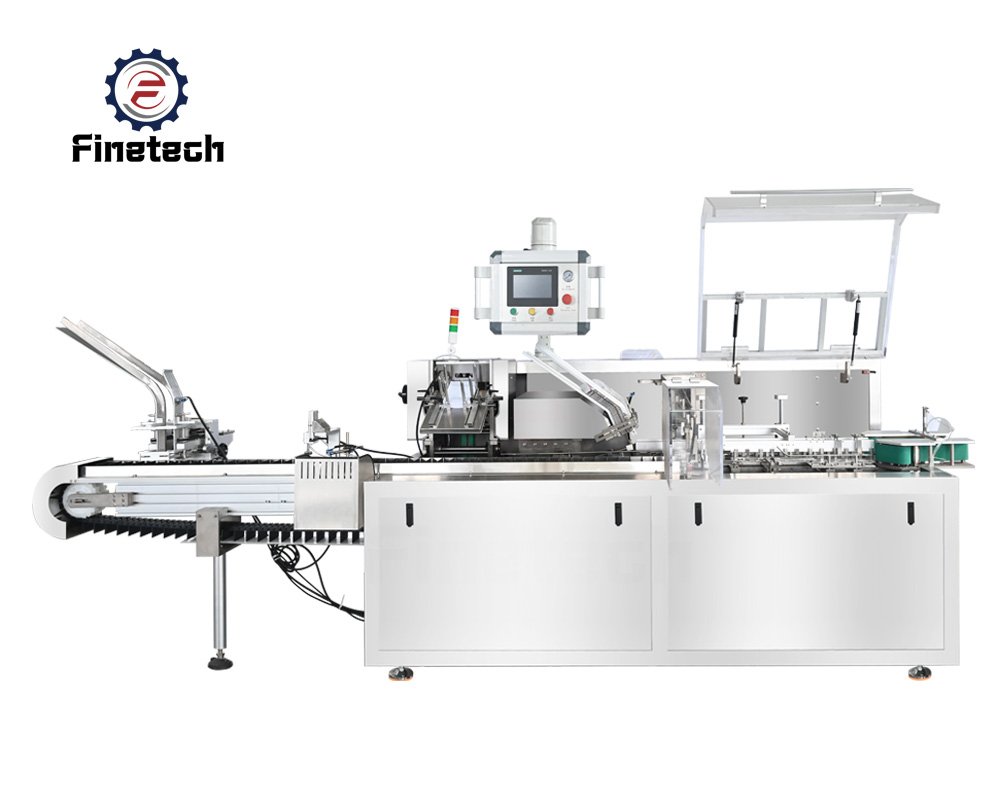
Continuous cartoning machines keep cartons moving and can reach higher speed brands, but they usually demand steadier infeed timing.
If an upstream process even briefly stutters, a continuous line either has to compensate on the fly or risks a jam or misfeed. Intermittent machines are far more forgiving here because the carton sits stationary during each action.
6. Footprint
Continuous motion machines are generally built around larger mechanical assemblies designed to sustain constant movement at speed. This translates directly into a larger floor footprint.
Intermittent machines tend to have a leaner design. That’s because of the simpler indexing mechanisms and fewer continuously synchronized stations. This makes them an easier fit for facilities with limited floor space.
7. Cost
Semi-automatic cartoning machines, which are usually intermittent, generally run from $10,000 to $50,000. Meanwhile, fully automatic continuous motion machines range from $50,000 to $300,000 or more.
In comparison, top-tier continuous motion machines built for 24/7 operation can run anywhere from $25,000 to $600,000. Much of that is tied to regulatory validation, brand reputation, and global service network coverage rather than speed alone.
Need Help Picking the Right Cartoner?
There is no single winner in the intermittent vs continuous motion cartoning machine comparison. It really just comes down to what you are packaging and how fast you need to go.
If your products change often or need careful handling, go intermittent. It is slower, but more flexible and gentler on your product. However, if you need speed and your supply stays steady, continuous motion is the better fit.
Still not sure which one is right for you? Contact Finetech, and we will help you find the perfect machine for your production needs.