English
  Russian
  Turkish
  Spanish
  French
  German
  Japanese
Nowadays, people want personalization in everything, and healthcare is no exception. They look for medicines that are particularly designed for their unique condition and provide better efficacy.
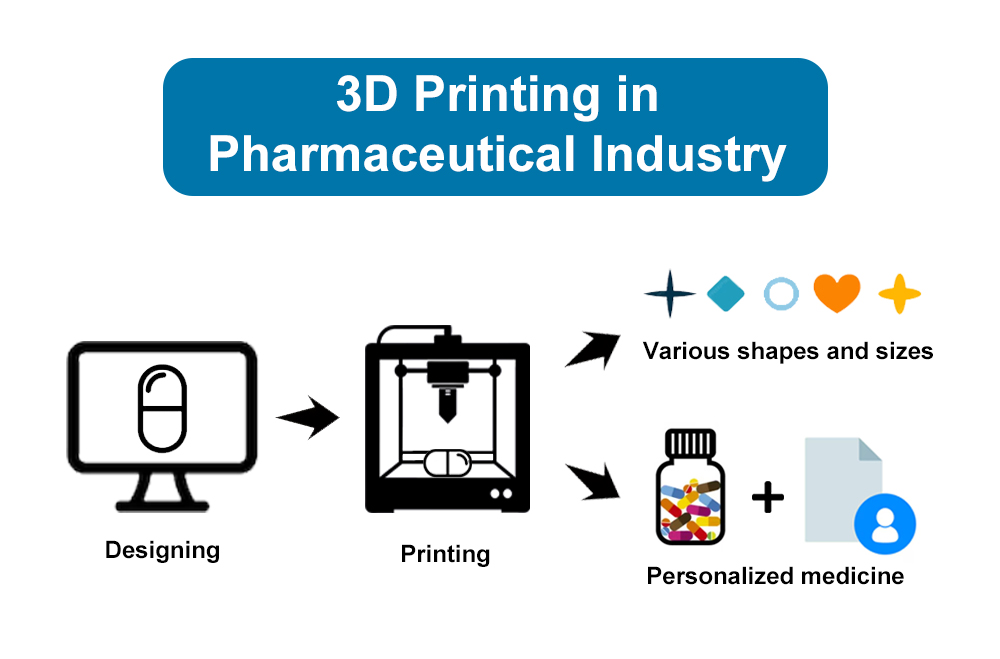
That’s where 3D printing in pharmaceutical industry comes in. This digital technology paves the way for quick and reliable prototyping as well as manufacturing of personalized medicines.
Want to know more about 3D printing in pharmaceutical industry? Continue reading!
What is 3D Printing in the Pharmaceutical Industry?
Typically, 3D printing or additive manufacturing is a technique that makes three-dimensional objects by layering materials based on a digital design. In the pharmaceutical industry, it’s useful for the creation of customized medicines and drug delivery devices, made layer by layer.
This provides you with precise control over drug dosages, release profiles, and complex geometries.
So, whether you want to produce specific drugs for children and the elderly or combine multiple drugs in one dose, 3D printing can do it all. Many businesses now utilize it, and its market size is expected to reach a massive USD 88.2 billion by 2030.
Types of 3D Printing in Pharmaceutical Industry
There’s no one-size-fits-all 3D printing solution in pharmaceuticals. Rather, you’ll come across multiple types, such as:
SLS 3D printing (Selective Laser Sintering)
SLS 3D printing (Selective Laser Sintering) uses high-power lasers to sinter small particles of polymer powder into a solid based on a 3D model.
It has been long used by engineers and manufacturers due to its low cost and high productivity. Now it’s also being employed to develop customized medicines.
However, it’s not a very efficient type of 3D printing in pharmaceutical industry as many active pharmaceutical ingredients are sensitive to lasers. Therefore, you may not be able to achieve the desired level of potency and personalization.
SLA 3D printing (Stereolithography)
SLA 3D printing (Stereolithography) is also known as vat photopolymerization or resin 3D printing. In this process, an ultraviolet laser is used to cure a liquid photopolymer resin layer by layer, transforming it from liquid to solid and then into a three-dimensional structure.
It lets you quickly and accurately create a wide variety of customized medicines while significantly reducing thermal stress.
Nonetheless, its usage isn’t that popular because only a few excipients are in resin form. The presence of monomer residues in the resin can pose additional health risks, prompting pharmaceutical manufacturers to employ alternative techniques.
3D printing FFF (Fused Filament Fabrication
The 3D printing FFF (Fused Filament Fabrication) process involves heating a thermoplastic material and then extruding it layer by layer to create 3D objects. The plastic used is the general-purpose one, including nylon and ABS.
In the pharmaceutical industry, Fused Filament Fabrication is a popular technique and for all the right reasons. It’s cost-effective and easy to use, allowing you to create prototypes and actual products without any hassle.
On top of all this, it’s safe as you mainly handle solid materials that minimize the risk of contamination. Personalized drugs with specific drug release profiles can be made using FFF, but they must not be temperature-sensitive.
How is 3D Printing in Pharmaceutical Performed?
Now that you are aware of the different types of 3D printing in pharmaceutical industry, you must be wondering about the actual process. If yes, here’s an overview:
Step 1: Create a Digital Design
The first step involves using a specialized CAD software to make a digital blueprint of the drug. This design must contain the exact shape, dosage, size, and composition of the actual drug to avoid any inconsistencies later.
Step 2: Choose the Right Materials
Once you have your digital pharmaceutical design in hand, you should move to finding the right raw materials. They need to be safe and compatible with the 3D printing technique you are opting for. Typically, these materials are in gel, resins, powders, and liquid forms.
Step 3: Printing Process
The medication is then created by the 3D printer, layer by layer, as per the digital design. For instance, in Fused Filament Fabrication, the printer heats a thermoplastic filament, such as PLA or ABS, to its melting point. Then, it is extruded through a nozzle on a build platform following the path defined by each layer.
Step 4: Post-Processing
Post-processing refers to the steps taken after a part is printed to enhance the strength, appearance, and functionality of the part. There are multiple techniques involved in this:
- Cleaning: As the name implies, the cleaning process removes any unwanted substances from 3D printed drugs that may impact their efficacy. The methods used for this include compressed air, brushes, and chemical rinses that aren’t too hard.
- Drying: After cleaning, your customized medication may still have some moisture and solvents. This is especially true if you opted for chemical cleaning. The purpose of drying is to ensure that there’s no microbial growth on the drug and to reduce overall spoilage. Common equipment used in this is dryers and vacuum ovens.
- Sanding: Sometimes the final printed drug has a rough texture, which doesn’t match the quality standards of traditional pharmaceuticals. Therefore, you can smooth it using tools like fine-grit sandpaper. This ensures that your tablet not only looks visually appealing but also has good swallowability.
- Dyeing: In this process, colors are added to pharmaceutical products to enhance their visual appeal. But that’s not all; dyeing also facilitates product identification, protects photolabile components from light, and prevents counterfeiting. Pharmaceutical regulatory bodies, such as the FDA, must approve these colors and dyes.
- Curing: Curing is often the final step in the post-processing of 3D pharmaceutical products. It involves the hardening and stabilizing of a product using heat, UV light, or chemical agents. Curing agents and thermal ovens are all part of this technique.
Benefits of 3D Printing in Pharmaceutical Industry
3D printing is bringing a huge revolution in the pharmaceutical industry. It not only allows you to create personalized medicines but also makes ways for fast prototyping and on-demand manufacturing. Let’s discuss these benefits of 3D printing in the pharmaceutical industry in detail:
On-Demand Manufacturing
One of the major benefits of 3D printing in pharmaceutical industry is on-demand manufacturing. For instance, you can quickly manufacture drugs in many small locations, including hospitals and pharmacies, rather than in large factories.
This decentralization significantly reduces patient wait times and enables speedy treatment, which can save multiple lives.
On top of this, it ensures that medicines are only created when needed. Hence, you don’t have to worry about bulk production and stockpiling. It’s helpful for medicines with short shelf life, such as heat-sensitive vaccines or anti-cancer drugs.
Speed Up Clinical Trials
3D printing is quite helpful in creating different batches of pills with varying geometries, formulations, and dosages. You can rapidly figure out how changes in shape, composition, or drug release mechanisms affect a medicine’s performance.
Then, you get a detailed insight into key parameters that impact a drug’s efficacy. All this significantly reduces development times and enhances decision-making, allowing you to send your products for clinical trials and get them approved as soon as possible.
Personalized Medical Treatment
The biggest advantage of 3D printing is that it offers personalized medical treatment. You can use it to reduce polymedicine and control the dosage rate as well as the dosage of tablets. Typically, polymedicine is a phenomenon in which a patient takes multiple tablets to treat various health conditions.
Studies show that in the US, rates of polypharmacy are estimated to be as high as 65% for adults aged 65 years and older. This is quite alarming, but thanks to 3D printing, it’s now addressable.
For instance, using 3D technology, you can tweak the composition of a drug in such a way that the drug contains multiple APIs for different diseases. Patients take only one pill for all diseases, which enhances convenience and overall practicality of the medical treatment.
As we know, the release rate of an active ingredient is linked to its geometry; you can utilize this knowledge to adjust the release rate of the API. You may make tablets with different delivery profiles suitable for a patient’s weight, size, or medical condition. This is particularly helpful for geriatric and pediatric populations that require adjustments in their drug dosage due to changes in their physiological and metabolic functions.
Overall, 3D printing also reduces your development costs as the prototyping stage is handled by the printer. There’s little to no risk of inaccuracies, and you can also cut down on labor expenses.
Disadvantages of 3D Printing in Pharmaceutical Industry
Indeed, the 3D printing industry has multiple advantages, but it’s not without its fair share of cons. Here’s an overview of some:
- Regulatory Challenges: Pharmaceutical is a sensitive industry, as you are directly dealing with patients’ lives. Currently, the 3D environment for creating custom medicines is in development stages. There are still concerns related to safety and efficacy. To produce a 3D-printed drug, extensive testing and adherence to regulatory standards, such as those set by the FDA and EMA, are necessary. All this can be extremely time-consuming and can also take a significant toll on your finances, especially if you’re a startup.
- Material Compatibility: When 3D printing medications, ensure that the material you choose is both compatible with the printer and safe for human consumption. Striking that balance often requires extensive research and also limits the number of medicines that can be produced.
- High Equipment and Operational Costs: Well, 3D printing in pharmaceutical industry requires investing in top-notch printers and materials that are difficult to purchase, operate, or maintain. You need to create a sterile environment and train employees on its usage, which can be expensive. The overall returns may also not justify the initial investment.
Case Studies and Applications of 3D Printing in Pharmaceutical Industry
Here’s an overview of the case studies and applications of 3D printing in pharmaceutical industry so you can understand the potential of this technology:
Spritam
When we look at the case studies of 3D printing in pharmaceutical industry, Spritam cannot be overlooked. It’s the first drug made using this technology and was also approved by the Food and Drug Administration (FDA) in 2015.
Spritam is developed by Aprecia Pharmaceuticals, which uses the ZipDose technology, a 3D printing model, that enables the delivery of a single high dose (up to 1,000 mg). It contains an active ingredient called levetiracetam, whose mechanism of action is unknown.
However, it’s known to treat partial-onset seizures, myoclonic seizures, and primary generalized tonic-clonic seizures. Patients simply place the tablet on their tongue with a dry hand and then take a sip of water. Know that it’s only swallowed when disintegrated in the mouth.
It’s particularly designed for people with swallowing difficulties that may lead to skipping medicines. The result? Worsening of the condition and frequent seizures. Overall, this tablet came as a sigh of relief for about 3.4 million people who have epilepsy. Of this number, 3 million are adults and a whopping 470,000 are children.
Oral Films and Dissolving Strips
Oral films and dissolving strips contain water-soluble polymers. As soon as the patient places them on the tongue, they adhere to the mucosa in saliva and quickly dissolve, delivering the dosage accurately.
3D printing finds applications in the production of these products, as it provides complete control over drug loading, as well as the thickness and size of films or strips. You can then create multiple medications for people with swallowing difficulties (dysphagia).
Implants and Prosthetics
Besides drugs, 3D printing in pharmaceutical industry is also enabling the development of implants and prosthetics. For instance, you can rely on it to create dental and orthopedic implants suitable for each patient’s unique condition. In addition, you can create drug-loaded implants that deliver medication directly to the injured site for a quick recovery.
Future of 3D Printing in Pharmaceutical Industry
The future of 3D printing in pharmaceutical industry is quite bright as there’s ongoing research and development:
- Well, there’ll be an increase in the personalization level of pharmaceuticals as products will be designed considering the genetic profile and health conditions of each patient.
- There will be an adoption of bioprinting that’ll enable manufacturers to create organs, tissues, and even complete biological systems to make transplants easier. This will eliminate the challenges associated with donor scarcity and save many patients hanging between life and death situations.
- On-demand manufacturing will reduce reliance on large manufacturers and allow you to produce small batches of the desired drug on the spot, providing healthcare benefits to low-income countries.
FAQs
How many 3D-printed drugs are approved by the FDA?
To date, only one 3D-printed drug has been approved by the FDA for human use, which is Spritam. However, one clinical study was also approved that involved the use of 3D-printed drugs to treat rheumatoid arthritis.
What types of medicinal products are made using 3D printing?
3D printing can create a variety of medicinal products, including controlled-release tablets, capsules, dispersible films, micro-needles, and implants.
How do companies protect their intellectual property in 3D printed formulations?
Companies can protect their intellectual property in 3D formulations by combining legal protections, digital security measures, and contractual agreements. Key rights involve securing patents and copyrights for inventions and designs.
Conclusion
The usage of 3D printing in pharmaceutical industry indeed has a bright future. However, if you need reliable equipment for the production and manufacturing of medications, look no further than Finetech. Reach out to us to discuss your project needs, and we’ll provide you with a dedicated solution.
References:
What Is Pharmaceutical Manufacturing Software and How Do You Choose One?
Applications of Artificial Intelligence(AI) in Pharmaceutical Industry
Introduction to Pharmaceutical Production Technology.
Copyright Notice:
You may not reproduce, modify, publish, display, transmit, or in any way exploit any content on this website, or use such content to construct any kind of database without prior express written approval by Finetech Group. For permission to use the content, please contact: info@pharmamachinecn.com
Disclaimer:
The information contained in this article is for general information purposes only. The Company does not guarantee the accuracy, relevance timeliness or completeness of any information, and the Company assumes no responsibility for errors or omission in the content of this article.