English
  Russian
  Turkish
  Spanish
  French
  German
  Japanese
Tablet hardness is an important factor in pharmaceutical manufacturing. It determines how well a tablet can withstand handling while still breaking down properly in the body. Now, the only way to achieve this balance is through a tablet hardness tester. This tool allows you to measure the maximum force required to break a tablet and calculate its hardness.
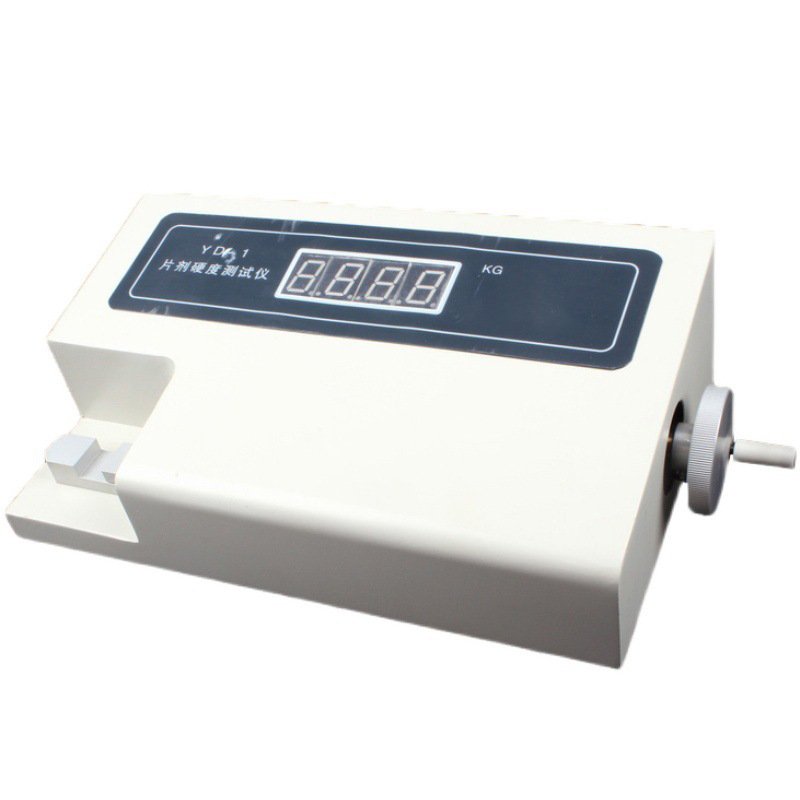
Learn more about hardness testing in this article, as we delve into its principles, standards, and the various types of testers available.
Principle of Tablet Hardness Tester
The principle of tablet hardness testing involves measuring the force it takes to break a tablet under pressure. The measurement assesses the stress resistance of a tablet, as its hardness plays a major role in its efficiency and overall performance. Tablets must be designed to remain intact during packaging, transport, and handling.
The most common method of hardness testing is the Diametral Compression Test. In this method, a single tablet is placed between two jaws, and a force is applied along its diameter until the tablet fractures. The maximum force to break the tablet will then be recorded as the hardness value.
Types of Tablet Hardness Tester
Of course, the hardness of a tablet won’t be determined by pressing one between your fingers. There are actually mechanical hardness testers, ranging from simple manual devices to advanced digital systems, doing all the heavy lifting for us.
Every type of tester relies on the same principle for a tablet hardness tester: to apply force until it fractures. They simply differ in design, precision, and ease of use. These types are as follows:
Monsanto, Pfizer, and Strong-Cobb
These three are among the earliest designs of tablet hardness testers. They operate manually, relying on springs, air pressure, or hand force instead of digital sensors. All are designed to apply force directly to one tablet at a time.
However, each tester has their own differences, such as:
Monsanto Tester: This is one of the oldest tablet hardness testers. Its design consists of a barrel having a compressible spring fixed between two plungers. The tablet is set on the lower plunger, and then the upper plunger is released on it.
- Pfizer Tester: This tester resembles a pair of pliers, making it portable and easy to handle. It works by placing the tablet between a piston and a holding anvil. The pliers are then squeezed to apply force on the tablet, which users can read on the connected force-recording meter.
- Strong-Cobb Tester: On the other hand, this tester uses a hydraulic meter to measure the breaking force. For force, it pushes an anvil against an unmoving platform where the tablet is placed. The Strong-Cobb represents a step forward in precision compared to manual spring-based devices. However, it still lacks automation and consistency.
Modern Electronic Testers with Load Cells
The modern invention of the tablet hardness tester is equipped with load cell technology, which replaces mechanical systems with electronic sensors. It also uses strain gauges that convert mechanical force into electrical signals. All of these features combine to create a tester that provides real-time measurements of force with high precision and accuracy.
Compared to older manual testers, electronic models minimize human error and provide consistent results. It also offers additional features, including multi-point testing, data logging, and customizable test protocols.
Standards of Tablet Hardness
Standards in tablet hardness testing encourage reliable and acceptable results. Without them, manufacturers would employ different methods, resulting in inconsistent product quality.
USP <1217>
In the United States, the United States Pharmacopeia (USP) <1217> directs the standard procedure for hardness testing. It specifies the required test methods, calibration requirements for equipment, and acceptable limits for tablet breaking force.
Ph. Eur. 2.9.8
In Europe, the Pharmacopoeia 2.9.8 offers a similar guidance. While its principles align with USP, there may be slight differences in their procedures. Either way, both instill that tablets meet strict pharmaceutical quality and safety standards.
Conclusions
A hardness tester plays a vital role in the quality and effectiveness of tablets. From traditional manual testers to modern electronic systems, each method builds on the same principle that all manufacturers must follow.
For more details on tablet manufacturing tools, contact us at Finetech. We offer a range of testers designed to meet industry standards and guarantee high production quality.