English
  Russian
  Turkish
  Spanish
  French
  German
  Japanese
Wet granulation has been the go-to for tablet making as long as most of us can remember. You mix your powder with a liquid binder, knead it into a wet lump, dry the whole thing in an oven, then mill it down to size. It works, but it eats up time, burns through energy, and the end point is tough to hit the same way twice.
Dry granulation skips the liquid but brings its own set of headaches. Roller compaction beats up your powder and often spits out a mix of fines and chunks that do not press into good tablets.
Somewhere between these two lives a process called moisture activated dry granulation, or MADG. It was first described back in 1987 by Ullah and colleagues, and despite being over 30 years old, most pharma companies still have not adopted it. Which is odd, because on paper it solves a lot of the problems that make wet granulation so frustrating.
So What Exactly Is MADG?
Think of it as wet granulation with the volume turned way down. Instead of soaking your powder with 20 to 50% water by weight (the norm in wet gran), MADG uses just 1 to 4%. That tiny bit of water is enough to make the binder sticky and glue fine bits together into small granules. But it is not so much water that you need to fire up a dryer after.
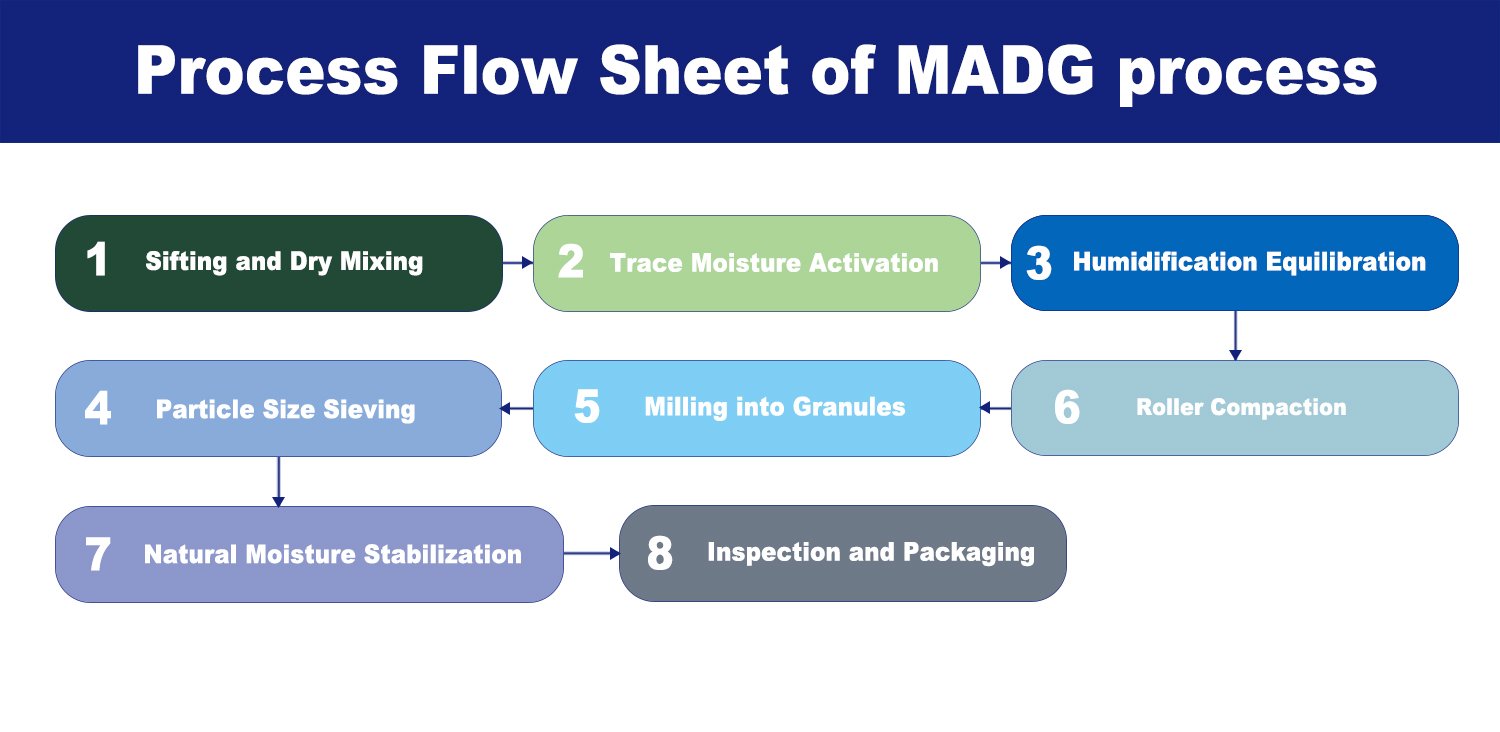
And that is the whole point. No drying step. No milling step either, since the granules come out small enough to use as they are. The whole thing runs inside a single high shear mixer in about 10 to 15 minutes.
The Two Stages
MADG breaks down into two distinct phases. Both happen in the same equipment, one right after the other.
Stage one is agglomeration. You load the drug substance along with your filler and a dry binder into the granulator. PVP K-12 and HPC are common binder choices. Blend everything until it is uniform. Then, while the impeller is still spinning, spray a small amount of water onto the powder. The droplets wet the binder just enough to make it sticky. Particles bump into each other and bond. What you get are small, roughly spherical agglomerates in the 150 to 500 micron range. This portion of the formula usually makes up about 50 to 80% of the total batch weight.
Stage two is moisture absorption and distribution. The granules from stage one still have some residual surface moisture. To deal with that, you add moisture-absorbing excipients while the mixer keeps running. Microcrystalline cellulose goes in first and soaks up most of the water. Colloidal silicon dioxide follows and grabs whatever is left. By the time both are blended in, the granulation is dry and free-flowing without ever seeing the inside of an oven. After that, you add your disintegrant, blend it, add lubricant, blend again, and you are ready to compress.
Why Bother? A Quick Side-by-Side
| Wet Granulation | Dry Granulation | MADG | |
| Water used | 20–50% of powder weight | None | 1–4% of formula weight |
| Drying needed | Yes, often hours | No | No |
| Milling needed | Yes | Yes | No |
| Process time | Hours (granulation + drying + milling) | Moderate | 10–15 minutes total |
| Endpoint sensitivity | High | Moderate | Low |
| Equipment | Granulator + dryer + mill | Roller compactor + mill | High shear granulator only |
| Works for heat-sensitive APIs | Risky | Yes | Yes |
Look at that middle column for a second. Dry granulation avoids water and heat, which is nice. But roller compaction crushes the powder so hard that the material loses its ability to press into strong tablets. You end up with soft, crumbly pills. MADG skips that problem because it bonds particles gently with a thin film of wet binder rather than brute force.
The Order You Add Things In Actually Matters
One thing that catches people off guard with MADG is how sensitive it is to the sequence of ingredient addition. In wet granulation, the order is pretty forgiving. In MADG, it is not.
Here is how a typical MADG batch runs:
- Load the API, filler, and dry binder into the granulator. Blend until uniform.
- Spray 1–4% water onto the blend while the impeller runs. This creates the moist agglomerates.
- Add microcrystalline cellulose (MCC) while blending continues. MCC absorbs the bulk of the surface moisture.
- Add colloidal silicon dioxide. It picks up any residual moisture the MCC missed.
- Add the disintegrant and blend.
- Add the lubricant (usually magnesium stearate) and blend briefly.
- Compress into tablets.
Swap steps 3 and 4 and you might end up with a granulation that is still too wet. Skip the silicon dioxide entirely and the blend might not flow well enough to feed into the press. These are small details that make or break the process.
Where MADG Really Shines
High drug-load formulas are where this process earns its keep. When the drug makes up 70% or more of the tablet weight, wet granulation gets ugly. You are dumping a ton of water onto a huge pile of drug, then trying to dry it all in an even way. It takes forever and the odds of over-wetting or under-drying climb fast.
MADG handles heavy drug loads well because the water is so limited. Studies have shown it works with metformin HCl, acetaminophen, and ferrous ascorbate at high loadings. All three are drugs that give old-school granulation a hard time due to their bulk and flow issues.
Drugs that hate water are another sweet spot. In wet granulation, a drug that will not wet properly fights you the whole way. Uneven granules, poor content spread, weak tablets. In MADG, the water targets the binder, not the drug. The binder gets tacky and does the heavy lifting. The drug just goes along for the ride.
Heat-touchy compounds round out the list. No drying oven means no thermal stress above room temp. If your API starts to break down at 40 or 50°C, MADG lets you dodge that risk from the start.
There is also a cost angle that does not get talked about enough. You are using one piece of gear instead of three. No dryer to run, no mill to clean, no transfer steps between vessels. For a CDMO juggling tight timelines across multiple products, that kind of speed matters.
What Can Go Wrong
MADG is simpler than wet granulation, but it is not foolproof. A few things trip people up on a regular basis.
The biggest one is how much water you add. Too little and the binder never gets tacky. You end up with loose powder that looks and acts like a direct blend, not a real granulation. Too much and you get wet clumps that the MCC and silica cannot soak up. At that point, you need a dryer, and the whole benefit of the process goes out the window.
The size of the water drops also matters more than you might think. Big drops from a crude nozzle create wet patches in the powder instead of even moisture across the batch. Fine mist from a good spray nozzle spreads the water out so the binder wakes up at the same rate everywhere. I would not try this process without a proper spray setup. Pouring water in from a beaker is asking for trouble.
Then there is binder choice. PVP K-12 and HPC are the safest picks based on what has been published. Maltodextrin DE16 also shows up in the research. Whatever you use, it has to flip from dry powder to sticky surface with just 1 to 4% water. Not every binder can do that. Some need way more liquid to turn on, which makes them poor fits for MADG.
Mixing speed and time during the spray step deserve a mention too. Too fast and you smear the wet binder around before it can grab onto drug particles. Too slow and the water pools in one spot. Every granulator handles this a bit differently, so expect to spend some time dialing in your impeller speed during dev work.
Why Has Adoption Been So Slow?
This is the question that comes up every time someone writes about MADG. The process was published in 1987. It is simpler, faster, and cheaper than wet granulation. It uses standard equipment. And yet most pharma manufacturers still have not tried it.
Part of it is inertia. Wet granulation is deeply embedded in pharmaceutical manufacturing culture. Regulatory filings, SOPs, training programs, validation protocols. All of it is built around wet granulation. Switching to something new means rewriting a lot of documentation and retraining staff, even if the new process is objectively easier.
Part of it is also a lack of exposure. MADG does not get taught in most pharmaceutical technology courses. If a formulator has never seen it done, they are unlikely to suggest it for a new product. Some industry voices have called for more hands-on training programs at universities and professional organizations to get the word out.
And part of it is probably just caution. Pharma is a conservative industry. When a process works, people stick with it even when a better option exists. That mindset is slowly changing, but it has not changed fast enough for MADG to reach mainstream adoption yet.
What Could Make MADG Grow
A few things would help push this process forward. Multifunctional excipients are one. Imagine a single ingredient that acts as moisture absorber, disintegrant, and dry binder all at once. That would cut the number of addition steps and simplify an already simple process. Companies like Grace have already developed mesoporous silica excipients that absorb moisture efficiently, which is a step in the right direction.
Continuous manufacturing is another area where MADG could gain traction. The process is short, uses minimal liquid, and does not need a separate dryer. That makes it a natural candidate for continuous granulation lines where speed and simplicity matter most.
Better PAT (process analytical technology) tools tailored to MADG would help too, even though the process has fewer variables than wet granulation. Real-time moisture monitoring during the spray step could make it even more robust and give regulators the data they want to see in filings.
A Few Practical Tips If You Want to Try It
Start with a drug you know well. Pick a formula where wet granulation already works but takes too long or gives you trouble at the drying stage. Run a side-by-side test at lab scale. Most people are surprised at how similar the tablet quality is between MADG and wet gran, with a fraction of the processing time.
Keep your first batches small. A 2-liter high shear granulator is more than enough for early dev work. You can scale up later once you have the water level and spray rate locked down.
Track moisture content closely during the absorption stage. A loss-on-drying test after adding the MCC and silica will tell you if the granulation is truly dry or if you need to adjust your absorbent levels. Aim for a final moisture content that matches what you would target after drying in a wet gran process, usually under 2%.
Document everything. Spray rate, impeller speed, water amount, addition order, blend times. MADG has fewer variables than wet granulation, which is an advantage. But that also means each variable has a bigger impact on the outcome. Small changes in water amount can shift your granule size by a lot.
Conclusion
MADG is not new. It is not fancy. But for the right formula, it cuts hours out of your process, saves energy, and gives you granules that press into solid tablets. The pharma world moves slowly when it comes to change, but the math on this one is hard to argue with much longer.
References:
Make more of moisture-activated dry granulation.
Guide for Wet Granulation Process in Pharmaceutical Industry.
Copyright Notice:
You may not reproduce, modify, publish, display, transmit, or in any way exploit any content on this website, or use such content to construct any kind of database without prior express written approval by Finetech Group. For permission to use the content, please contact: info@pharmamachinecn.com
Disclaimer:
The information contained in this article is for general information purposes only. The Company does not guarantee the accuracy, relevance timeliness or completeness of any information, and the Company assumes no responsibility for errors or omission in the content of this article.