 English
  Russian
  Turkish
  Spanish
  French
  German
  Japanese
In the pharmaceutical sector, accuracy and reliability in analytical results are a must. It ensures product quality, patient safety, and regulatory compliance. But how do laboratories achieve this consistency? That’s where a secondary and primary standard in pharmaceutical analysis comes into play. They are often pure and stable substances that aid in the calibration of drugs and equipment. Keep reading to know more about these standards.
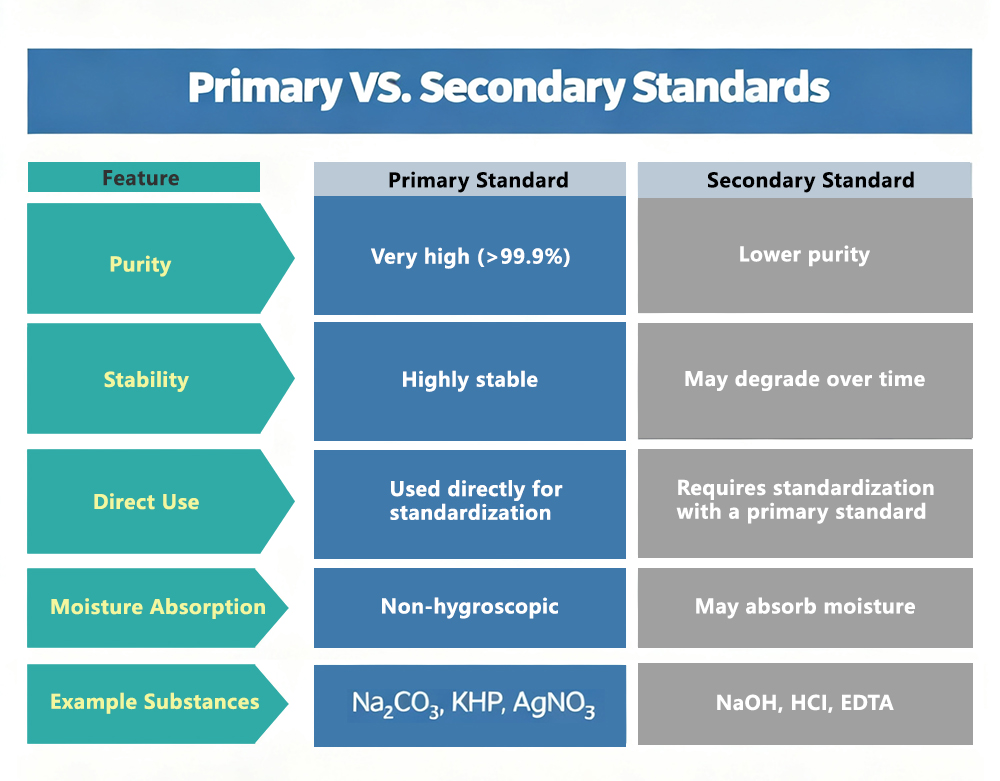
What is a Primary Standard in Pharmaceutical Analysis?
A primary standard is actually a reference material with ultra-high purity, stability, and a well-defined set of chemical properties. It’s used in analysis, including drug assay, identification, and other purity tests. Not always is the primary standard a single material; sometimes it can be a mixture containing the analyte of interest. However, make sure that it doesn’t absorb water or moisture and bear traceability.

Examples
Some examples of a primary standard in pharmaceutical analysis include sodium carbonate, potassium hydrogen phthalate, and silver nitrate. Here’s an overview of each:
- Sodium Carbonate: Sodium carbonate is the disodium salt of carbonic acid with alkalizing properties. It’s a pH adjuster to maintain stability in liquids and also provides carbon dioxide in effervescent tablets. This component is also present in many chemical reactions in the pharma industry as part of acid-base titrations.
- Potassium Hydrogen Phthalate: Potassium Hydrogen Phthalate is a white acidic salt and an inorganic compound used in laboratories. It serves as a primary standard for acid-base titrations, standardizing strong bases, and a pH calibration standard for pH meters. Overall, it’s solid, air-stable, and easy to dry, ensuring the accuracy of pharmaceutical analysis.
- Silver Nitrate: Silver nitrate is an inorganic compound with the chemical formula AgNO3 and contains silver, nitrogen, and oxygen. It’s a white, odorless, crystalline solid that turns black when exposed to light or organic matter. In the pharmaceutical industry, it is used as an antiseptic and astringent to treat skin conditions. On top of this, it’s part of precipitation titrations, allowing you to analyze drug quality.
- Potassium Dichromate: Potassium dichromate is an inorganic compound with the formula K₂Cr₂O₇. It’s a solid, bright orange in color and has applications in both laboratory and industrial settings. The primary usage of K₂Cr₂O₇ is in fertilizers, but it’s also present in pharmaceuticals for redox titrations.
Applications
Now, let’s look at the different applications of a primary standard in pharmaceutical analysis:
- Instrumental Calibration: Helps prepare solutions of accurately known concentration without the need for further calibration.
- Titrations: Serves as the reference substance to determine the concentration of acids, bases, and other analytes during titrations. For example, you can use potassium hydrogen phthalate to standardize sodium hydroxide solutions.
- Preparation of Standard Solutions: Provide you with reliable references for calibrating analytical instruments such as spectrophotometers.
What are Secondary Standards in Pharmaceutical Analysis?
Secondary standards in pharmaceutical analysis are substances or materials that have been standardized or quantified against a primary standard.

It’s handy in labs when a primary standard isn’t available, either due to cost or other issues.
Nonetheless, they are less stable and have lower stability than primary standards. They are often used in volumetric analysis and routine measurements.
Examples
The many examples of secondary standards include:
- Sodium Hydroxide: Sodium hydroxide, also known as caustic soda, is a highly corrosive, white, odourless solid. It’s a strong base for titration, particularly in preparing standard alkaline solutions for analyzing acids in pharmaceutical products.
- Hydrochloric Acid: Also known as muriatic acid, it’s an aqueous solution of hydrogen chloride. It’s found naturally in human stomachs to aid digestion and is also a common laboratory reagent. You can standardize it using sodium carbonate.
- EDTA: EDTA is another example of a secondary standard, and it’s a synthetic chelating agent that forms stable bonds with metal ions. This compound is commonly used to treat poisoning from heavy metals and is standardized using calcium carbonate.
Applications
Despite their low purity, the applications of secondary standards in pharmaceutical analysis are pretty diverse, such as:
- Quality Control Testing: Used for checking the potency of drugs and the dissolution of pharmaceutical tablets.
- Assay of Raw Materials: Applied in the quantitative determination of pharmaceutical ingredients during manufacturing.
- Cost-Effective: Since secondary standards are easier and cheaper to prepare than primary standards, they are preferred for bulk routine testing of pharmaceuticals.
How to Handle and Store Both Primary and Secondary Standards?
As standards play a crucial role in pharmaceutical analysis, they must be stored properly under specific conditions. Here are some:
- You should store the primary standard in pharmaceutical analysis in amber colored glass vials or bottles that are properly sealed or capped.
- Temperature-sensitive materials should be stored in cool chambers or at room temperature unless refrigeration is specified.
- Since many standards are hygroscopic, use dessicators, silica gel, or other drying agents.
- Each container should be labelled with the substance name, purity, and date of preparation.
- If the standard is volatile, store it in clean, tightly closed glass bottles to prevent evaporation and contamination.
- Always use clean and dry equipment for weighing and transferring the secondary and primary standard in pharmaceutical analysis.
Why Primary and Secondary Standards in Pharmaceutical Analysis are Important
If you want to learn about the importance of primary and secondary standards in pharmaceuticals, here’s an overview:
Ensure Drug Quality
Both secondary and primary standards in pharmaceutical analysis help confirm that medicines contain the right amount of active pharmaceutical ingredients. Therefore, patients receive the desired dosage, which significantly prevents any unsafe outcomes.
Regulatory Compliance
Regulatory bodies, including the FDA and EMA, require pharmaceutical companies to use validated standards. The goal is to double-check the effectiveness and safety profile of the drug.
One of the benefits of using standards is that they allow you to stay compliant with pharmacopeia guidelines and international regulations. Thus, you don’t end up with heavy fines, penalties, or disappointed customers.
In addition, they provide a highly accurate reference point and consistent results that eliminate deviations and drug rejections in final quality checks.
Primary and Secondary Standards Tablet Chart in Pharmaceutical Analysis
| Feature | Primary Standard | Secondary Standard |
| Purity | Very high (≥ 99.95%) | Lower, but well-defined (e.g., 98.0 – 99.8%) |
| Stability | Highly stable | Less stable, may require special storage |
| Preparation | Weighed and used directly | Its concentration is determined experimentally |
| Cost | Generally more expensive | More economical for routine use |
| Role | To calibrate/standardize secondary standards and instruments | For routine analysis and quality control testing |
| Source | Certified by official bodies (e.g., USP, NIST) | Prepared in-house or purchased, then standardized |
FAQs
Why is re-standardization important for secondary standards?
Re-standardization is important for secondary standards to maintain their accuracy and relevance over time because they can degrade over time. In addition, they can have a change in concentration due to factors like moisture, absorption, contamination, and chemical reactions.
Why is a primary standard in pharmaceutical analysis more expensive than a secondary standard?
A primary standard in pharmaceutical analysis is more expensive than a secondary standard due to its high purity, extensive proration, and limited availability.
Can excipients or impurities impact standards?
Yes, excipients or impurities can impact standards by reducing their stability, which is why purity is a must for them.
References:
Primary and secondary standards.
Conclusion
It’s important to have a secondary and primary standard in pharmaceutical analysis to conduct quick calibration and drug assay. Wondering where you can get top-notch pharma equipment for your daily tasks? Get in touch with Finetech today! We have a wide range of pharmaceutical manufacturing and packaging equipment that significantly enhances your operational efficiency.
Copyright Notice:
You may not reproduce, modify, publish, display, transmit, or in any way exploit any content on this website, or use such content to construct any kind of database without prior express written approval by Finetech Group. For permission to use the content, please contact: info@pharmamachinecn.com
Disclaimer:
The information contained in this article is for general information purposes only. The Company does not guarantee the accuracy, relevance timeliness or completeness of any information, and the Company assumes no responsibility for errors or omission in the content of this article.




2 thoughts on “Primary and Secondary Standards in Pharmaceutical Analysis”
This was a really informative post! I appreciate the detailed explanation of primary and secondary standards in pharmaceutical analysis. It’s fascinating to see how these standards ensure the accuracy and reliability of drug formulations. Looking forward to more posts on this topic!
This post provides a clear and concise overview of primary and secondary standards in pharmaceutical analysis. I appreciate the detailed explanations and examples that help clarify the concepts. It’s fascinating to see how these standards ensure accuracy and reliability in drug testing. Thank you for sharing such valuable information!