English
 Russian
 Turkish
 Spanish
 French
 German
 Japanese

Do you know what separates a cosmetic tube that stays sealed from one that leaks before it reaches the customer? The sealing method.

Currently, three cosmetic tube sealing technology types dominate the industry, including hot air sealing, ultrasonic sealing, and tail crimping. Each of them works differently and delivers different results in seal strength.
In the sections ahead, we will break down all three technologies so you can identify the right method for your product.
Three Cosmetic Tube Sealing Technology Types
The sealing stage is the final barrier between your product and the outside environment. Every tube that leaves the filling line depends on one of three cosmetic sealing technology types to hold that barrier intact.
Here is how each one works, what it suits, and where it performs best:
1. Hot Air Sealing
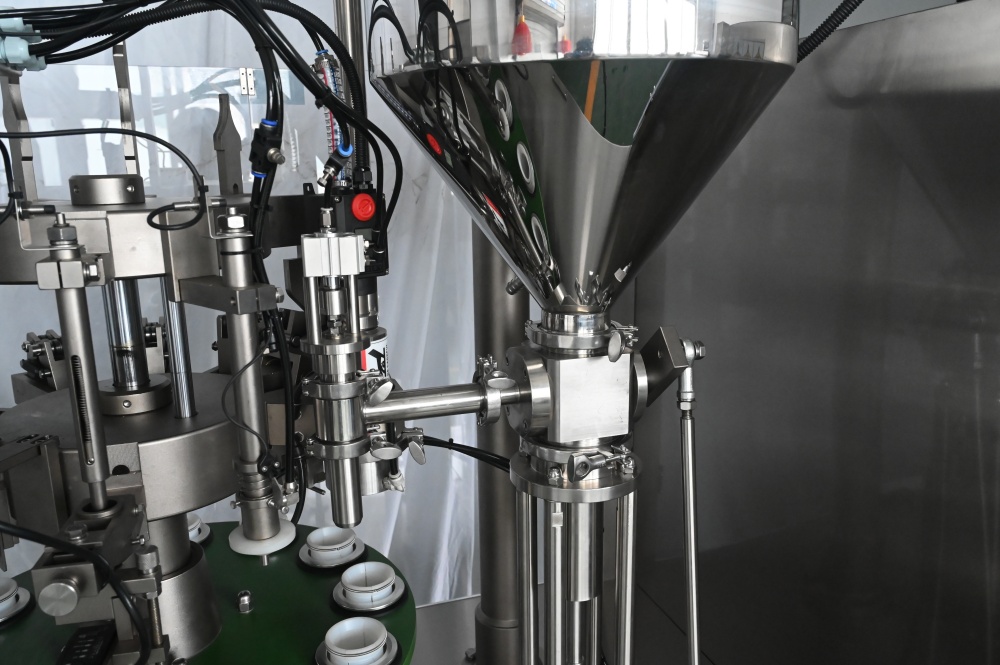
Hot air sealing is the most widely used tube sealing method in cosmetic and personal care production. It is fast, reliable, and compatible with the plastic and laminate tube materials that dominate cosmetic packaging.
How It Works
- A controlled stream of hot air is directed into the open end of the filled tube before sealing.
- The hot air raises the inner surface temperature of the tube tail to the softening point of the material.
- Sealing jaws press the softened surfaces together under controlled pressure.
- The material cools and fuses into a single hermetic seal.
Tube Material Compatibility
Hot air sealing works on plastic extruded tubes and plastic laminate tubes. It is the standard sealing method for polyethylene, polypropylene, and co-extruded plastic tube formats. Does not work on aluminum tubes.
2. Ultrasonic Sealing

Ultrasonic sealing delivers stronger, more consistent seals on laminate tubes than hot air sealing at comparable production speeds. It is increasingly the preferred sealing method for premium cosmetic and nutraceutical products.
How It Works
- An ultrasonic transducer converts electrical energy into high-frequency mechanical vibrations at 20 kHz and 40 kHz.
- Vibrations are transmitted through a sonotrade directly into the tube tail material.
- Friction generated at the molecular level creates localized heat at the sealing interface only.
- Sealing jaws apply pressure simultaneously while vibration is active.
- Vibration stops, and the material solidifies into a hermetic seal in a fraction of a second.
Tube Material Compatibility
Ultrasonic sealing works on plastic laminate tubes and co-extruded plastic tubes. It performs particularly well on multi-layer laminate tubes where the inner polyethylene layer is the sealing surface.
3. Tail Crimping

Tail crimping is the oldest tube sealing method and remains the correct and only practical sealing method for aluminum tubes. It works by mechanically deforming the tube tail rather than fusing it with heat or energy.
How It Works
- The open tail end of the filled aluminum tube is fed into a crimping mechanism.
- A series of rollers or a folding bar folds the tail over on itself in two or three progressive folds.
- The aluminum layers are compressed together into a flat mechanically locked crimp.
- No heat, no energy input, and no adhesive involved at any stage.
Tube Material Compatibility
Tail crimping works exclusively on aluminium tubes and aluminium laminate tubes. It is not suitable for plastic tubes because plastic does not deform and hold a crimp the way aluminium does.
Hot Air vs Ultrasonic vs Tail Crimping: Side by Side
Here’s a quick overview between hot air, ultrasonic, and tail crimping sealing technologies:
| Hot Air Sealing | Ultrasonic Sealing | Tail Crimping | |
| Seal Method | Heat fusion using controlled hot air stream | Molecular friction via high-frequency vibration | Mechanical deformation via progressive folding |
| Tube Material Compatibility | Plastic extruded tubes, plastic laminate tubes | Plastic laminate tubes, co-extruded plastic tubes | Aluminum tubes, aluminum laminate tubes only |
| Seal Strength | Good on plastic and laminate tubes | Superior on laminate tubes, higher burst pressure than hot air | Hermetic seal matching barrier properties of tube body |
| Production Speed | 60 to 150+ tubes per minute | 60 to 150+ tubes per minute | 40 to 120 tubes per minute |
| Heat Exposure to Tube | Outer and inner layers exposed to heat | Inner sealing interface only, outer layers fully protected | No heat exposure at any stage |
| Date and Batch Coding | Embossed directly only seal during sealing | Embossed directly onto seal during sealing | Embossed or printed onto crimp fold |
| Maintenance Complexity | Low | Medium | Low |
| Best Application Field | Cosmetics, personal care, oral care, nutraceuticals, topical pharma in plastic tubes | Premium cosmetics, nutraceuticals, oral care where print finish and seal strength | Pharma ointments, chemical adhesives, premium cosmetics in aluminium tube format |
How to Choose the Right Sealing Method for Your Product
To find the right sealing method, keep in mind the following factors. Work through each one and the correct choice becomes clear.
1. Tube Material
This is the first and decisive factor. Choosing the right tube material eliminates options immediately.
- Aluminum Tube: Tail crimping is the only option. Hot air and ultrasonic sealing do not work on aluminum.
- Plastic Extruded Tube: Hot air sealing is the standard choice. Ultrasonic also works but adds cost without significant benefit on basic plastic tube formats.
- Plastic Laminate Tube: Both hot air and ultrasonic sealing work. The decision between them comes down to seal strength requirements and outer finish protection needs.
2. Product Formulation
What is inside the tube affects which sealing method is the most appropriate. These formulations include:
- Reactive or Chemically Aggressive: Aluminum tubes with tail crimping provide the chemical resistance and barrier properties these products require.
- Standard Cosmetic and Topical: Hot air sealing on plastic or laminate tubes is appropriate or the majority of standard cosmetic and personal care product formulations.
- Oxygen and Moisture Sensitive: Aluminum tube crimping provides the highest barrier protection. Laminate tubes with ultrasonic sealing provide the second best barrier performance.
- High-Value or Active Ingredient: Ultrasonic sealing on laminate tubes protects the outer print finish and delivers stronger seals. Best choice for premium formulations.
3. Industry Compliance Requirements
Regulatory requirements in your industry may determine or narrow the sealing method options available to you. The compliance requirements are:
- Pharmaceutical Production: GMP compliance requires validated sealing processes with documented seal integrity testing. Aluminium tube crimping is standard for pharmaceutical ointments, eye preparations, and topical medicines.
- Cosmetic Production: No mandatory sealing method requirement. However, seal integrity testing is standard practice in cosmetic production to prevent leakage complaints and product recall risk.
- Food Production: FDA and HACCP compliance requirements apply. Hot air sealing on food-grade laminate tubes is the standard method for food product tube packaging.
Find the Right Tube Sealing Machine for Your Line
Hot air sealing, ultrasonic sealing, and tail crimping are the three cosmetic tube sealing technology types covered in this article. Get the sealing method right and every tube that leaves the line is sealed correctly.
So, if you are looking for a tube filling and sealing machine that covers all three technologies, Finetech has you covered.
Every machine is GMP-compliant, CE-certified, and customized to your specific tube format and production volume. On-site installation, operator training, and one-year maintenance support come standard with every machine.
Contact Finetech and get a quote for your tube filling and sealing line!