English
  Russian
  Turkish
  Spanish
  French
  German
  Japanese
Introduction to Pharmaceutical Dosage Form
Ever wonder why medicine comes in so many forms? There’s a reason you can get the same drug as a pill, a liquid, or even a patch. Drugs in their raw state are just chemicals. Not exactly something you’d want to swallow on their own.
So what happens? The drug gets mixed with other ingredients to make it usable. These mixtures are called dosage forms. The stuff added in helps with taste, shelf life, and getting the drug where it needs to go in your body.
Without all this work, taking medicine would be a mess. Bad taste. Wrong amounts. Drugs break down before they even reach your system. Dosage forms fix these issues.
Definition of Dosage Form
Here’s the simple version: a dosage form is how medicine gets into your body to do its job.
OR
Think of it as a recipe. You’ve got the active drug (called the API) plus inactive ingredients (excipients) all mixed together.
Why Do We Need Dosage Forms
So why bother with different types? Two big reasons: keeping patients safe and making drugs actually work.
- Exact doses matter. Tablets, capsules, and syrups make this possible.
- Some drugs taste terrible. Coatings and sweet syrups cover that up.
- Certain drugs won’t dissolve. Suspensions handle those tricky ones.
- People don’t want to take pills every few hours. Extended release fixes that.
- Stomach acid destroys some drugs. Special coatings protect them.
- Skin problems need direct treatment. That’s where creams and ointments come in.
- Long-term treatment sometimes needs implants under the skin.
- Lung conditions? Inhalers get medicine there fast.
- When a drug dissolves easily, solutions work great.
- Some medicines go into body openings. Suppositories handle that job.
- Air and moisture can ruin drugs. Sealed packaging keeps them stable.
Definition of Drug (Active Pharmaceutical Ingredients)
Fun fact: “drug” comes from an old French word for “dry herb.” Makes sense when you think about ancient medicine.
These days, a drug is basically any chemical that diagnoses, prevents, or treats disease. Could be for humans or animals. Modern drugs come from chemistry labs, molecular tweaking, and biotech processes. Pretty far from grinding up plants, right?
OR
The API is the stuff that actually works. Everything else in your medicine? Just there to help the API do its thing.
Definition of Excipients
What about all those other ingredients on the label?
- They’re inactive. Won’t cure anything by themselves.
- But they’re not useless. Far from it.
- Some hold tablets together. Others help pills break apart in your stomach.
- Dyes, sugars, preservatives, flavors – all excipients.
- Without them, most medicines couldn’t exist in a usable form.
Classification of Dosage Forms
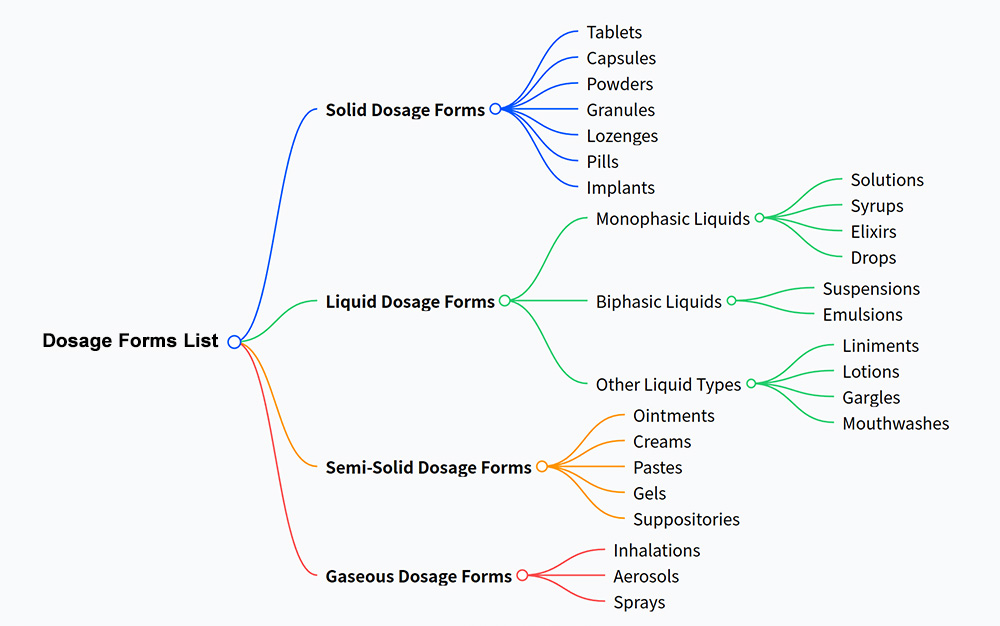
Four main categories here, based on physical state:
- Solid dosage forms
- Liquid dosage forms
- Semi-solid dosage forms
- Gaseous dosage forms
Each has its own strengths. Let’s break them down.
Definitions of Different Dosage Forms
1. Solid Dosage Forms
By far the most popular type. Easy to store, easy to carry, and most people can swallow them without trouble.
- Tablets: The classic pill. The drug gets pressed together with fillers. You’ve got chewable ones, coated ones, ones that dissolve under your tongue. Most medicine cabinets are full of these.
- Capsules: Gelatin shell with drug inside. Hard capsules hold powder. Soft ones hold liquid – think fish oil or vitamin E. Some folks find these easier to get down than tablets.
- Powders: Just finely ground drug. Mix with water or sprinkle on food. Some go directly on the skin. Pretty straightforward.
- Granules: Tiny clumps of powder. Flow better during manufacturing. Sometimes you dissolve them in water before drinking.
- Lozenges: Basically, medicated hard candy. You suck on them for sore throats. Cough drops fall into this category.
- Pills: Old term that stuck around. When people say “pill” they usually mean tablets or capsules now.
- Implants: Doctor puts these under your skin. Drug releases slowly for weeks or months. Birth control implants work this way.
2. Liquid Dosage Forms
Perfect when swallowing solids is tough. Kids, elderly patients, anyone with throat issues – liquids make dosing easier. Plus you can adjust amounts more precisely.
Monophasic Liquids (One Phase)
- Solutions: Drug completely dissolved. Crystal clear liquid, no shaking required. IV bags and eye drops are solutions.
- Syrups: Thick and sugary. That sweetness masks awful drug taste. Every kid knows cough syrup, even if they don’t love it.
- Elixirs: Got some alcohol mixed in. Helps dissolve drugs that water alone can’t handle. Less thick than syrup.
- Drops: Measured by the drop with a dropper. Super precise. Used for ears, eyes, nose.
Biphasic Liquids (Two Phases)
- Suspensions:Here’s where shaking matters. Drug particles float in liquid but don’t dissolve. That pink antibiotic kids take? Classic suspension. Always shake first.
- Emulsions: Oil and water are forced to mix. Special additives keep them from separating. Cod liver oil often comes this way to make it less gross.
Other Liquid Types
- Liniments:You rub these in hard. Good for sore muscles after a workout or a long day.
- Lotions: Lighter than creams. Pat them on for rashes, sunburn,and dry skin. No heavy rubbing needed.
- Gargles: For throat infections. You gargle, then spit. Salt water counts as a basic one.
- Mouthwashes:Swish around your mouth. Freshens breath and can treat mouth sores too.
3. Semi-Solid Dosage Forms
Somewhere between liquid and solid. Thick enough to stay put but soft enough to spread. Mostly used on skin.
- Ointments: Greasy stuff. Stays on skin for a long time and water won’t wash it off easily. Vaseline is basically just an ointment base. Works well on really dry, cracked skin.
- Creams: Way less greasy. Water rinses them right off. Most people prefer these during the day since they don’t leave that slick feeling.
- Pastes: Super thick. Loaded with powder. Zinc oxide paste for diaper rash is a good example. Stays exactly where you put it.
- Gels: Clear and cool feeling. Dry fast, no grease. Lots of pain relief products come as gels now. Hair gel uses the same basic idea.
- Suppositories: Solid at room temperature. You insert them into the rectum or vagina. Body heat melts them and releases the drug. Useful when someone can’t swallow anything.
4. Gaseous Dosage Forms
Gets medicine into lungs or sprays it onto surfaces. When you need fast action for breathing problems, this is the way.
- Inhalations: Breathe in through mouth or nose. Drug hits lungs within seconds. Asthma rescue inhalers like Ventolin are the prime example. Can be mist or powder.
- Aerosols: Pressurized can with drug inside. Press down, fine mist comes out. Same concept as hair spray but with medicine.
- Sprays: Pump action instead of pressure. No propellant gas. Nasal allergy sprays and sore throat sprays work this way.
Frequently Asked Questions on Dosage Forms
Q1: What exactly are dosage forms?
Different ways to package and deliver drugs. Pills, liquids, creams, inhalers – all dosage forms. Each delivers medicine differently.
Q2: Why so many options though?
Different situations call for different solutions. A kid who can’t swallow pills needs liquid. A skin rash needs cream applied directly. Asthma needs inhaled medicine. One size definitely does not fit all here.
Q3: How do doctors decide which form to use?
They look at patient age, what the drug is like chemically, where it needs to work, and how quickly. Sometimes patient preference matters too.
Q4: What makes tablets and capsules so popular?
Stable, accurate dosing, easy to take. You can make them release slowly too. And honestly, they’re cheaper to produce than most alternatives.
Q5: When are liquids the better choice?
When patients struggle with swallowing. When you need flexible dosing for different ages. When faster absorption matters. Kids and elderly patients often do better with liquids.
Q6: Why use creams and ointments?
Direct application to problem areas. Drug stays local instead of traveling through your whole body. Fewer side effects that way usually.
Q7: What’s special about inhalers?
Speed. Drug reaches lungs almost instantly. During an asthma attack, those seconds matter. Very little medicine ends up elsewhere in the body.
Q8: Ointment vs cream – what’s the real difference?
Greasiness mostly. Ointments are oily and stick around. Creams are lighter and wash off. Pick based on skin condition and personal preference.
Q9: Solution vs suspension – how can you tell?
Look at it. Solutions are clear because everything dissolved. Suspensions look cloudy or milky because particles are just floating there. That’s why suspensions need shaking.
Q10: Any downsides to different dosage forms?
Absolutely. Some drugs are tough to formulate certain ways. Liquids can be less stable. Costs vary wildly. Storage requirements differ. Nothing’s perfect.
References:
Different Types of Capsule Dosage Forms and How They Work.
What is Solid Dosage Formulation? Simple Guide for Everyone.
What Is the Dosage Form Definition in Pharmacy?
Copyright Notice:
You may not reproduce, modify, publish, display, transmit, or in any way exploit any content on this website, or use such content to construct any kind of database without prior express written approval by Finetech Group. For permission to use the content, please contact: info@pharmamachinecn.com
Disclaimer:
The information contained in this article is for general information purposes only. The Company does not guarantee the accuracy, relevance timeliness or completeness of any information, and the Company assumes no responsibility for errors or omission in the content of this article.