English
  Russian
  Turkish
  Spanish
  French
  German
  Japanese
In many facilities, teams know they must control exposure, but they are usually unsure which level actually matters or which number they should trust. It creates gaps between SOPs and real worker protection.
This is where OEB and OEL in pharmaceutical facilities become essential. One is used to classify risk, while the other is used to measure it. But the issue is that not everyone understands the difference between the two.
If you’re struggling with something similar, this blog is written for you. In this blog, we will explain what OEB and OEL mean, how they differ, and why both are critical for designing safe processes.
What Is OEB (Occupational Exposure Banding)?
Occupational Exposure Banding (OEB) is a method for grouping pharmaceutical compounds based on their hazard to people. Rather than asking, “What is the exact safe limit?” OEB asks a simpler question: “How toxic is this material compared to others?”
OEBs were created because new drugs do not have enough data to set a formal exposure limit. Waiting for full toxicology data can increase risk. OEB solves this by placing compounds into broad bands, usually from low hazard to very high hazard.
Simply put, OEB is a classification tool, and it does not tell you how much exposure is allowed for new drugs.
What Is OEL (Occupational Exposure Limit)?
An OEL is a measurable limit. It defines the maximum amount of a substance a worker can be exposed to in the air over a set period, usually an 8-hour workday. If air monitoring shows exposure below the OEL, the risk is considered controlled.
OELs are derived using scientific toxicology data. Experts study how a substance affects the body, how much it causes harm, and how exposure over time builds risk. Then, according to the data, they identify safe starting points.
They are divided into two main types:
- Regulatory OELs: These are set by authorities and apply across industries.
- Internal OELs: Developed by companies for compounds that do not have official limits.
OEB vs OEL: The Difference Most Facilities Get Wrong
OEB helps you decide how careful to be. Meanwhile, OEL helps you prove whether you are safe. They are connected, but they are not interchangeable. With that, let’s see how both of these differ:
| Aspect | OEB | OEL |
| What It Is | A hazard classification | A numeric exposure limit |
| Purpose | Shows how toxic a compound is | Define how much exposure is acceptable |
| Type of Tool | Planning and risk grouping tool | Measurement and compliance tool |
| Can be Measured | No | Yes |
| Output | A band or category | A measurable value |
| When Used | Early development and design stages | During operations and monitoring |
One cannot replace the other because they answer different questions. OEB cannot tell you whether workers are overexposed. Similarly, OEL cannot help you choose early containment strategies if they do not yet exist.
How OEB and OEL in Pharmaceutical Work Together
Exposure control works best when it is planned early and verified later. This is exactly how OEB and OEL in the pharmaceutical industry are meant to work together. Below is how both concepts align across real facility design stages.
1. Early-Stage Compound Handling
In early development, compounds often have limited toxicology data. At this stage, waiting for a formal OEL is impractical, which is why OEB leads the process.
OEB helps teams decide how cautiously to handle a new compound from day one. Based on available toxicity indicators, the compound is placed into a band. That band immediately informs basic handling rules.
2. Containment Strategy Selection
Once the OEB is known, it serves as a starting point for selecting a containment strategy. Higher OEB compounds demand stronger controls. Meanwhile, lower OEB compounds allow simpler solutions.
At this stage, OEB influences decisions such as:
- Open handling vs. enclosed systems
- Use of isolators or downflow booths
- Required PPE level
- Cleaning and waste handling approach
When an OEL becomes available, it is used to check whether the selected containment is sufficient. Moreover, air monitoring results are compared to the OEL. If exposure remains below the limit, the containment strategy is confirmed; otherwise, it is not.
3. Equipment Zoning and Airflow Decisions
Facility layout and airflow design rely heavily on early risk classification. OEB helps determine where equipment should be placed and how areas should be separated.
Higher OEB processes are typically located in controlled zones with negative pressure, dedicated air-handling systems, and restricted access. Alternatively, lower OEB activities may be allowed in shared or general areas.
OEL then supports airflow validation. By measuring airborne concentrations during operation, teams can confirm whether pressure cascades, air changes, and exhaust systems are performing as intended.
4. Scaling from Lab to Commercial Production
Whenever a facility scales up, new exposure risks arise. Larger batch sizes, higher throughput, and longer operating hours all increase potential exposure.
This is where OEB provides consistency during scale-up. It ensures the compound is treated with the same hazard mindset across lab, pilot, and commercial stages. Here, OEL adds precision at each step by validating real exposure levels as processes change.
How OEBs Are Assigned in Practice?
The OEB assignment is a structured decision process. It follows clear steps, even though it does not end with a single number.
1. Collect Available Toxicology Data
The first step is to gather any available toxicology information on the compound. This may include:
- Acute toxicity data (short-term harm).
- Repeated dose studies.
- Target organ effects.
- Potency data.
- Reproductive or genetic toxicity signals.
Even partial data is enough to start. OEB does not require full toxicology reports.
2. Identify a Reference Dose or Potency Indicator
Experts look for a reference point, such as:
- NOAEL (No Observed Adverse Effect Level).
- LOAEL (Lowest Observed Adverse Effect Level).
- Pharmacological potency (mg or µg level activity).
For instance, a compound that shows effects at 1 mg/kg/day is far more potent than one that shows effects at 100 mg/kg/day.
3. Compare with Known Compounds
If data is limited, the compound is compared to similar molecules already used in pharma.
- Similar structure → Similar toxicity.
- Same drug class → Similar exposure concern.
This comparison is common in early development and is fully accepted industry practice.
4. Assign the OEB Range
Based on steps one to three, the compound is placed into an exposure band.
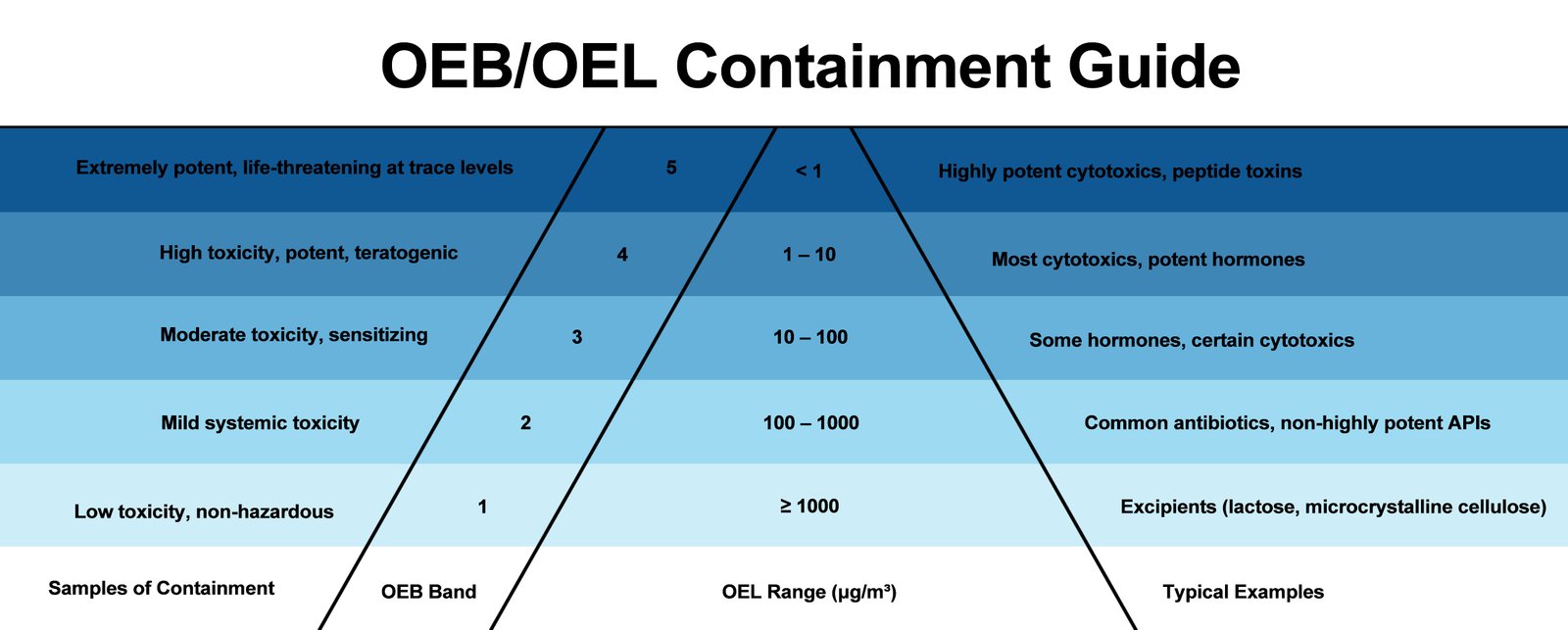
A typical example structure:
| OEB | Typical Exposure Concern |
| OEB 1 | > 1000 µg/m³ (low hazard) |
| OEB 2 | 100–1000 µg/m³ |
| OEB 3 | 10–100 µg/m³ |
| OEB 4 | 1–10 µg/m³ |
| OEB 5 | < 1 µg/m³ (very high hazard) |
*Note: These are only ranges, not limits.
5. Link OEB to Control Decisions
Each OEB directly maps to engineering and handling controls, including containment type, PPE level, room pressure, and segregation. This is one of the main reasons why OEB is used before OEL even exists.
How Are OELs Calculated and Validated?
Unlike OEB, OEL always ends with a number. That number must be measurable in the air. With that said, here’s how OELs are calculated and validated:
1. Identify the Critical Toxicology Endpoint
OEL calculation starts by identifying the most sensitive harmful effect. This could be liver toxicity, lung irritation, reproductive harm, and systemic toxicity.
From studies, scientists identify NOAEL or LOAEL. For example, NOAEL = 5 mg/kg/day.
2. Convert Dose to Human Equivalent
Animal doses are converted to human relevance using body weight and exposure assumptions. This step adjusts for:
- Species differences.
- Exposure duration.
- Absorption differences.
It guarantees that the calculated number is protective for humans, not just for animals.
3. Apply Uncertainty (Safety) Factors
Once the toxicology starting point is identified, it still cannot be used directly in the workplace. Before turning it into an exposure limit, the value must be adjusted to protect real workers. This is where safety factors are applied, including:
- 10x for animal-to-human differences.
- 10x for differences between people.
These are multiplied together to come up with a safe dose using the formula:
Safe Dose = NOAEL (POD) / Total Safety Factor
Example:
- NOAEL = 5 mg/kg/day.
- Total safety factor: 10 x 10 = 100.
Safe Dose = 5/100 = 0.05 mg/kg/day.
4. Convert Dose to Airborne Concentration
The safe dose is converted into an air concentration using breathing rates and workday assumptions.
A simplified formula conceptually looks like:
Safe Air Concentration (mg/m³) = Safe Daily Dose (mg/day) ÷ Air Inhaled per Workday (m³/day).
This produces the final OEL value, such as:
- 10 µg/m³
- 1 µg/m³
- 1 µg/m³
5. Validate the OEL in Real Operations
Once established, the OEL is tested, not assumed. Validation includes personal air sampling, area monitoring, and task-based exposure studies.
Measured results are compared directly to the OEL.
If exposure:
- Below OEL → controls are effective.
- Above OEL → changes are required.
FAQs
2. How do OELs impact the design of a pharmaceutical facility?
Facilities handling low OEL compounds must integrate advanced HVAC systems, airlocks, and pressure differentials to prevent cross-contamination. These designs often prioritize primary containment at the source, such as isolators or restricted access barrier systems (RABS), over secondary room-level measures.
2. Can an OEB be downgraded once more data is available?
Yes, if clinical trials or further toxicity studies show a drug is less hazardous than initially thought, a compound may move from a higher band like OEB 4 to a lower one like OEB 3. This reclassification can significantly reduce operational costs by easing containment requirements.
3. How is air monitoring performed to verify OEL compliance?
Industrial hygienists use personal air sampling pumps attached to workers’ breathing zones to collect particulate matter on filters during specific tasks. These filters undergo laboratory analysis via HPLC or LC-MS to quantify the exact amount of active pharmaceutical ingredient (API) present in the air.
4. Who is responsible for setting OELs within a pharma company?
A multidisciplinary team comprising toxicologists, industrial hygienists, and safety engineers typically collaborates to establish these limits. They must continuously review emerging clinical data to ensure the OEL remains reflective of the most current safety knowledge.
Build for Exposure Risk From Day One
Most exposure problems start when OEB and OEL in pharmaceutical facilities are not considered during design decisions. These concepts are meant to shape how facilities are designed and how equipment is selected.
This is why facility layout, airflow design, and equipment capability cannot be treated as secondary choices.
Now, even though Finetech does not define OEBs or calculate OELs, pharmaceutical solutions must support the exposure strategy built around them. This includes flexible containment options and thoughtful facility planning to adapt as risk profiles change.
Contact our specialists today to discuss facility planning further!
References:
Containment: What is the Difference between OEB and OEL.
Copyright Notice:
You may not reproduce, modify, publish, display, transmit, or in any way exploit any content on this website, or use such content to construct any kind of database without prior express written approval by Finetech Group. For permission to use the content, please contact: info@pharmamachinecn.com
Disclaimer:
The information contained in this article is for general information purposes only. The Company does not guarantee the accuracy, relevance timeliness or completeness of any information, and the Company assumes no responsibility for errors or omission in the content of this article.