English
  Russian
  Turkish
  Spanish
  French
  German
  Japanese
A medicine’s consistency and quality hold the key importance in pharmaceutical manufacturing. While there are many methods to ensure this, but dry granulation has become an essential technique for handling sensitive ingredients.
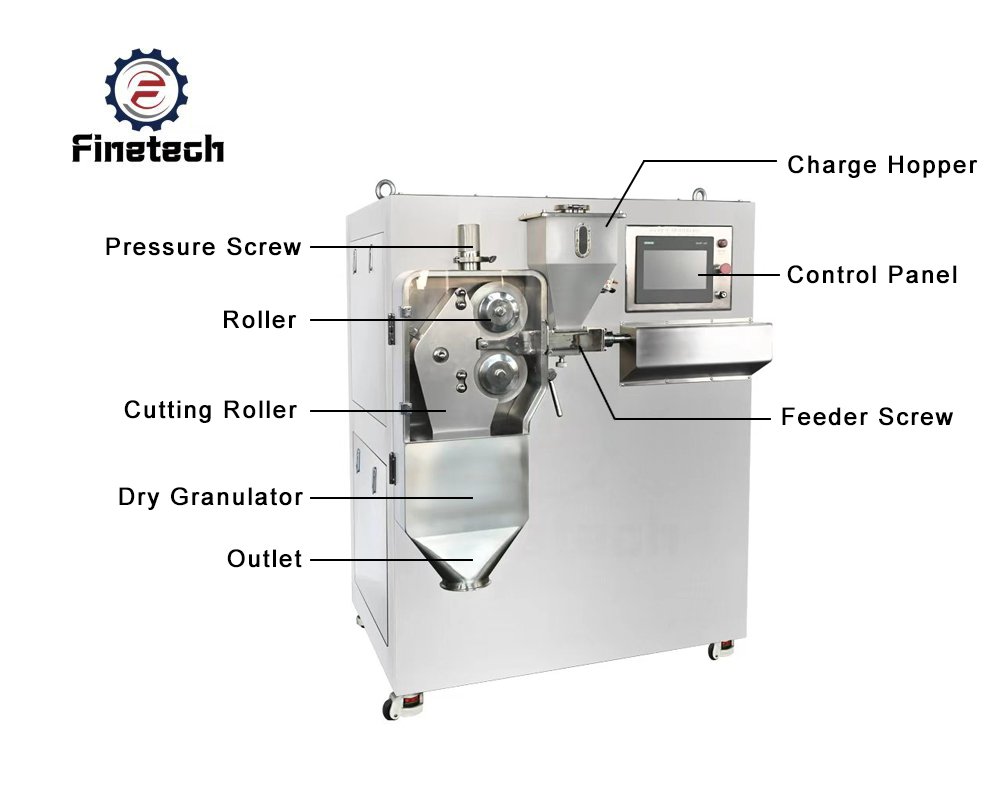
The pharmaceutical roller compactor machine is a key technology enabling this process.
This machine transforms fine, unstable powders into dense, uniform granules without using liquids or heat. It also preserves the integrity of the drug and improves its properties for manufacturing. Let’s learn more about how it works, its components, and key benefits.
What is a Pharmaceutical Roller Compactor?
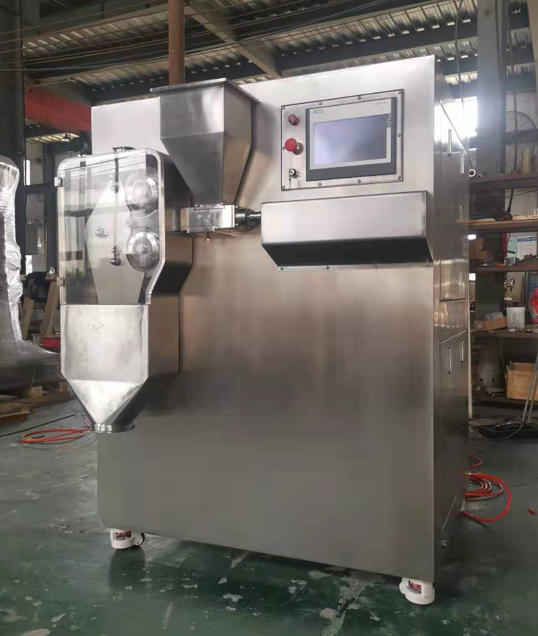
As the name suggests, a pharmaceutical roller compactor is a type of industrial machinery that performs compaction. The machine is an integrated system consisting of three primary units. It compresses powdery materials, such as APIs and excipients, into denser flakes or ribbons without the use of solvents or excessive heat.
This process makes the machine a crucial component in the production of pharmaceuticals that are sensitive to moisture or temperature. It helps manufacturers ensure consistent quality for solid dosage forms.
Components of a Roller Compactor Pharmaceutical
A pharmaceutical roller compactor consists of three main components: a feeding system, a compaction unit, and a size reduction unit. Each component plays a crucial role in ensuring the quality and consistency of the final product. Let’s take a look at them one by one.
1. Feeding System
This is where the process begins. The raw material is loaded into this large funnel-shaped container at the top of the machine. This material or powder is then moved to the rollers through the screw. It’s rotating equipment that ensures a consistent and controlled flow of material.
2. Compaction Unit
This is the core of the roller, where the actual ‘compaction’ takes place. The compaction unit consists of two large, counter-rotating rollers that apply immense pressure to the powder. As the material passes between them, it is squeezed into a solid, cohesive sheet called a ribbon or flake.
3. Size Reduction Unit
After the solid ribbon is formed, it is fed into the size reduction unit. This part of the machine, typically a mill or granulator, breaks the brittle ribbons into smaller, uniform granules. You can adjust the granule size by changing the screen or sieve inside the mill to control the particle size range.
How Does a Pharmaceutical Roller Compactor Work?
A pharmaceutical roller compactor operates continuously through three stages: feeding, compaction, and size reduction, each with a specific function. Here is how the entire process unfolds:
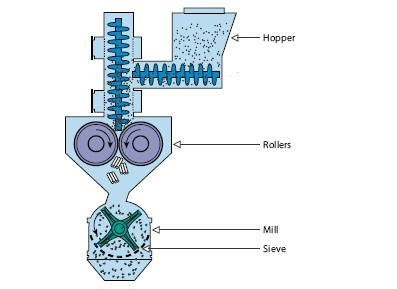
The granulation process inside a roller compactor. Image Source: Pharma Equipments
Step 1: Powder Feeding
The process starts when a dry powder blend is loaded into a hopper. A precise screw feeder then moves the powder from the hopper and forces it down into the compaction unit. The screw also helps remove air from the powder, a process known as deaeration, and increases its density before it reaches the rollers.
Step 2: Compaction into Ribbons
The de-aerated powder is funneled between two large, counter-rotating rollers. These rollers apply immense pressure to squeeze the loose powder into dense, solid sheets known as ribbons or flakes. The pressure applied and the speed of the rollers are carefully controlled to maintain a consistent thickness in ribbons.
Step 3: Milling For Granulation
The brittle ribbon, however, is not the final product. It is immediately fed into a milling unit. This unit uses a rotor and a screen to gently break the flakes into uniform granules of a specific size. The step maximizes the yield of desired granules while minimizing the amount of fine powder.
Step 4: Sizing and Collection
After milling, the granules pass through a screen, which ensures that the final product is within the correct size range. Any particles that are too large or too small are recycled back to the beginning of the process.
Once sizing is done, the granules are collected and then moved to a rotary tablet press machine. Here, the machine punches and compresses them into finished tablets.
Benefits of Pharmaceutical Roller Compactor Machine
A pharmaceutical roller compactor is an invaluable piece of equipment in the modern drug manufacturing process. Its use provides immense benefits, primarily due to its ability to perform dry granulation. Below are some major advantages of roller compaction in the pharmaceutical industry.
1. Suitable for Sensitive Materials
A pharmaceutical roller compactor works as a dry granulation method that doesn’t require any liquid binders or excessive heat. This means it avoids the two primary factors that can degrade sensitive APIs. This process is therefore ideal for life-saving drugs like Atorvastatin calcium or Penicillin, which are highly susceptible to heat and moisture.
When exposed to liquid and high temperatures, these APIs can lose their therapeutic efficiency and degrade. Therefore, it is essential to use a process like roller compaction for their manufacturing, as it avoids these detrimental conditions.
2. Improve Powder Properties
Fine, dusty powder often has poor flow properties, which can lead to inconsistencies in medicines. Roller compaction addresses this by significantly increasing the bulk density of the powders. This process improves their flowability, making the material much easier to handle and compress accurately into pharmaceutical capsules and tablets.
3. Cost and Energy Efficiency
Drug production is an extremely expensive and time-consuming process. The research, development, and clinical trials alone can cost billions of dollars. A roller compactor can help you reduce these costs. It eliminates the need for energy-intensive drying and solvent recovery steps required in wet granulation. This results in a much faster overall processing time, leading to lower production costs and increased throughput.
4. Reduce Dust and Safety Risks
The roller compaction process reduces the amount of airborne dust by binding fine particles into larger, cohesive granules. This creates a much safer and cleaner environment for operators by minimizing the risk of dust inhalation. It also helps to prevent cross-contamination between different products.
Key Features and Benefits of Pharmaceutical Roller Compactor Machine
A pharmaceutical roller compactor is an invaluable piece of equipment in the modern drug manufacturing process. Its use provides immense benefits, primarily due to its ability to perform dry granulation. Below are some major advantages of roller compaction in the pharmaceutical industry.
1. Suitable for Sensitive Materials
A pharmaceutical roller compactor works as a dry granulation method that doesn’t require any liquid binders or excessive heat. This means it avoids the two primary factors that can degrade sensitive APIs. This process is therefore ideal for life-saving drugs like Atorvastatin calcium or Penicillin, which are highly susceptible to heat and moisture.
When exposed to liquid and high temperatures, these APIs can lose their therapeutic efficiency and degrade. Therefore, it is essential to use a process like roller compaction for their manufacturing, as it avoids these detrimental conditions.
2. Improve Powder Properties
Fine, dusty powder often has poor flow properties, which can lead to inconsistencies in medicines. Roller compaction addresses this by significantly increasing the bulk density of the powders. This process improves their flowability, making the material much easier to handle and compress accurately into pharmaceutical capsules and tablets.
3. Cost and Energy Efficiency
Drug production is an extremely expensive and time-consuming process. The research, development, and clinical trials alone can cost billions of dollars. A roller compactor can help you reduce these costs. It eliminates the need for energy-intensive drying and solvent recovery steps required in wet granulation. This results in a much faster overall processing time, leading to lower production costs and increased throughput.
4. Reduce Dust and Safety Risks
The roller compaction process reduces the amount of airborne dust by binding fine particles into larger, cohesive granules. This creates a much safer and cleaner environment for operators by minimizing the risk of dust inhalation. It also helps to prevent cross-contamination between different products.
Final Thoughts On Pharmaceutical Roller Compactor Machine
The pharmaceutical industry is continually moving towards advanced manufacturing solutions to enhance product quality and lower costs. Needless to say, roller compactors are well-suited to this approach. A good-quality roller compactor can be a transformative asset for your pharmaceutical production.
From improving product quality and consistency to reducing energy consumption and overall processing time, its benefits are undeniable.
If you are planning to invest in high-speed granulators, always trust the best. Finetech offers a range of top-tier pharmaceutical machinery solutions. From manufacturing design to installation, training, and free sample proofing, Finetech supports you every step of the way.
Contact us today to learn how our solutions can upgrade your pharmaceutical manufacturing process.
FAQs
1. What are some of the challenges associated with a roller compactor?
While highly beneficial, roller pharmaceutical roller compactors do have some drawbacks. They can produce more fines (small particles), as compared to other granulation methods. Also, some formulations may not be suitable for dry compaction if they lack sufficient cohesive properties to form a proper ribbon. The initial capital cost for the machinery can be high.
2. How is a roller compactor different from a tablet press?
A roller compactor and tablet press serve different purposes. A roller compactor performs dry granulation by turning powder into granules. A tablet press takes those granules and presses them into finished tablets. One is for particle size and density enhancement, while the other is for forming the final dosage shape.
3. What are the quality control checks for the granules produced by a roller compactor?
Common checks include measuring the granule size distribution to ensure the particles are within the correct range. Bulk density and tapped density are measured to confirm that the granules are dense enough for compression. Flowability tests are also performed to make sure the granules will flow consistently into the dies of a tablet press. These checks guarantee the final product meets quality standards.
Copyright Notice:
You may not reproduce, modify, publish, display, transmit, or in any way exploit any content on this website, or use such content to construct any kind of database without prior express written approval by Finetech Group. For permission to use the content, please contact: info@pharmamachinecn.com
Disclaimer:
The information contained in this article is for general information purposes only. The Company does not guarantee the accuracy, relevance timeliness or completeness of any information, and the Company assumes no responsibility for errors or omission in the content of this article.