English
 Russian
 Turkish
 Spanish
 French
 German
 Japanese

Capsule filling machines are used for both food supplements and medicines, but their requirements are not the same. Food vs pharmaceutical grade capsule filling machine options have different materials, filling accuracy, cleaning needs, records, and costs. In this article, we discuss these differences.
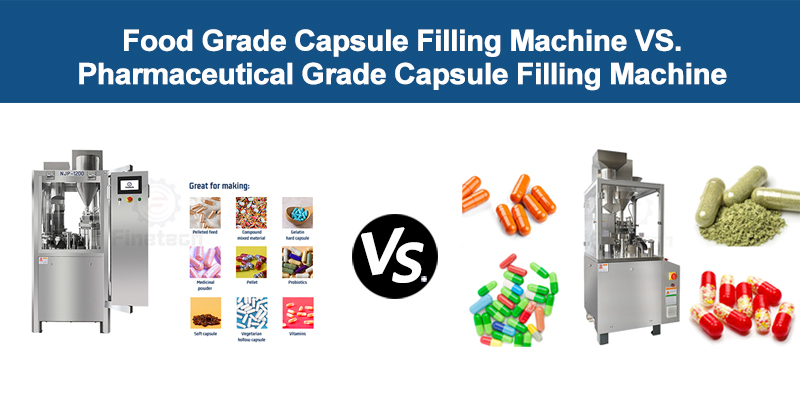
Differences Between Food Grade and Pharmaceutical Grade Capsule Filling Machine
The main food vs pharmaceutical grade capsule filling machine difference is the level of control required. Both machines should fill capsules safely. Pharmaceutical production usually needs tighter accuracy and more detailed control.
Product-Contact Materials
Food-grade machines mostly use 304 stainless steel or approved food contact plastics. Pharmaceutical machines use 316L stainless steel for hoppers and other product-contact areas because it offers better resistance to corrosion. Surfaces of pharmaceutical machinery should not react with or absorb the product.
Filling Accuracy and Dosage Control
Food supplement production does need accurate filling, but the accepted limits depend on the product and local rules.
Pharmaceutical machines will need tighter control, since each capsule contains a measured medicine dose. The dosing system should allow regular calibration and fill-weight checks. Sensors and automatic rejection systems are used in modern machinery to remove capsules that are empty or outside the approved weight range.
Cleaning and Contamination Control
Both machines must be easy to open and clean. Removable hoppers, dosing discs, tamping pins, and capsule trays make it easier to remove powder. Pharmaceutical equipment normally needs stronger control of product residue and cross-contamination. Dust extraction and enclosed filling areas are also used to help control powder movements.
The cleaning steps of pharmaceutical capsule filling machinery are much more precise and thorough, especially when the same machine handles different medicines.
Documentation and Compliance
Food-grade equipment needs cleaning, maintenance, and production records, but no formal protocols.
Pharmaceutical machines will require more detailed recordings for cleaning, calibration, machine use, maintenance, and batch production. These machines must follow the IQ and QP protocols. The equipment may also go through installation and operation checks before routine use. The checks will confirm that the machine is installed correctly and works as expected.
Cost Difference
A pharmaceutical capsule filling machine is going to cost more than a food-grade capsule filling machine. This is because it can hold higher-grade contact materials, tighter dosing controls, dust management validation support, and even detailed data systems.
When you are comparing food vs pharmaceutical grade capsule filling machine differences, your final choice should match the product, required accuracy, production volume, and compliance needs.
| Difference | Food Grade Machine | Pharmaceutical Grade Machine |
| Materials | Uses 304 stainless steel | Uses 316L stainless steel |
| Accuracy | Standard fill control | Tighter dose control |
| Cleaning | Regular cleaning | Stronger cleaning checks |
| Records | Basic production records | Detailed batch records |
| Cost | Usually lower | Usually higher |
Build the Right Capsule Filling Line With Finetech
Every production line has different needs. At Finetech, we provide capsule filling equipment and technical solutions for food supplement and pharmaceutical manufacturers. Our capsule filling line is made for different application industries, including food and cosmetic products.
Share your production needs with our team today, and we will help you choose a suitable capsule filling machine setup for your business. Contact us today!