English
  Russian
  Turkish
  Spanish
  French
  German
  Japanese
Pharmaceutical manufacturers face constant pressure to produce medicines that meet strict quality standards. One key factor that supports reliable drug production is granulation. By converting fine powders into uniform particles, granulation improves how materials behave during mixing, compression, and storage.
Different formulations require different granule structures, and selecting the right type can significantly influence the final product. From modified-release granules to suspended granules, each type functions differently. Their structure enhances the uniformity of the API in formulations, which helps maintain consistent dosage.
This guide covers the key types of granules in pharmaceutical formulations, along with their applications and benefits in drug manufacturing. It also explores granulation techniques used to produce them and how these processes support large-scale production.
What are Pharmaceutical Granules?
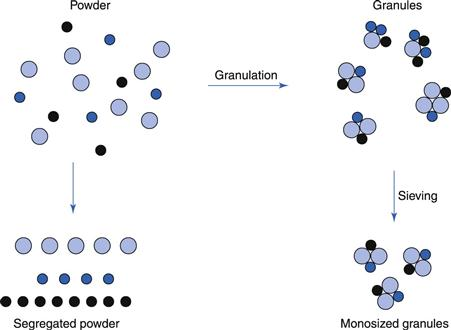
Pharmaceutical granules are aggregates of fine powder particles that form larger, more uniform structures. Their particle size typically ranges from 0.2 to 4 mm. When used as an intermediate product, granules are usually smaller (0.2–0.5 mm). However, when formulated as an oral solid dosage form (OSD), they are larger, generally between 1 and 4 mm.
Granules are produced through a process known as granulation, in which powders are blended and transformed into stable aggregates. Their relatively narrow size distribution and near-spherical shape improve powder flow and content uniformity. In addition, fine particles occupy the void spaces between granules, resulting in better compressibility.
Compared with powders, granules have higher moisture content and greater mechanical strength. These properties reduce dust formation and minimize breakage during manufacturing.
Drugs classified as Biopharmaceutics Classification System (BCS) Class II and Class IV benefit most from granulation, as the process enhances solubility and permeability, thereby improving dissolution rates.
Which Type of Granule Is Right for Your Drug?
The choice of granule type used in drug formulation depends on factors such as drug stability, solubility, and the desired release profile. Here are the four most important types of granules in pharmaceutical formulations:
1. Modified-Release Granules
Modified-release granules are formulated to control the rate, time, and location of drug release after administration. This helps maintain a steady concentration of the medicine in the bloodstream and offers targeted delivery.
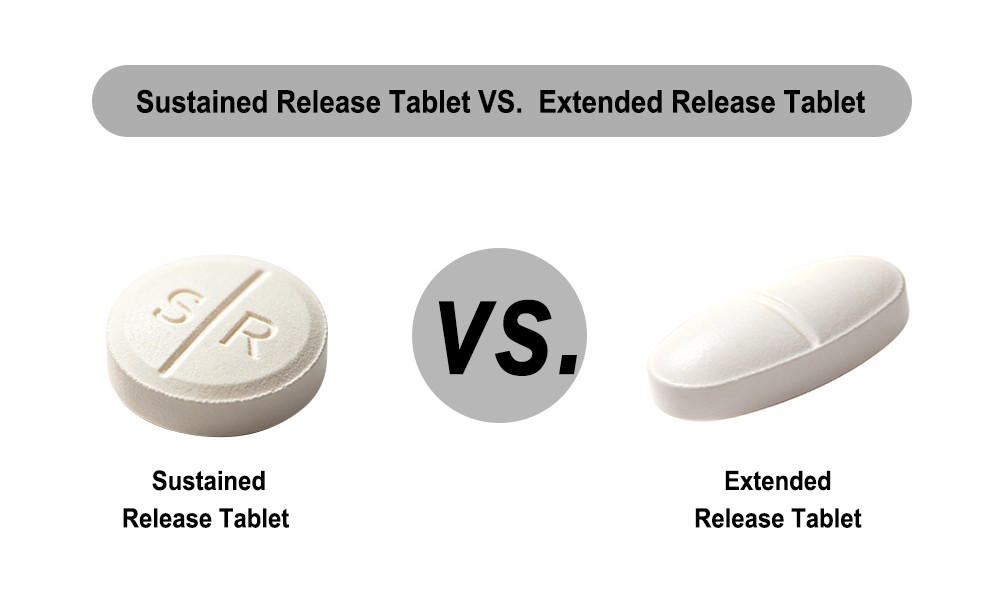
The granules may be coated or uncoated and contain special excipients that modify the drug release. Depending on the release-profile, modified-release granules can be categorized as prolonged-release, delayed-release, extended-release, and sustained-release.
2. Effervescent Granules
When introduced into water, effervescent granules produce carbon dioxide gas, which creates the characteristic fizz. This reaction occurs through the interaction between acidic components and bicarbonate compounds. Commonly used ingredients in these formulations include citric acid, tartaric acid, and sodium bicarbonate.
Additional excipients in the formulation improve the taste and visual appeal. Sweeteners such as sucrose or aspartame, flavouring agents like peppermint oil, and colouring substances like titanium dioxide are frequently added. In most cases, the effervescent reaction and complete disintegration occur within five minutes.
3. Gastro-Resistant Granules
Gastro-resistant granules are designed to withstand the acidic environment of the stomach. They release their contents only after reaching the intestine, where the pH is higher. This delayed-release behavior protects the active pharmaceutical ingredient (API) from acid-induced degradation and reduces irritation of the gastric mucosa.
As a result, these granules are commonly used in formulations containing drugs that are unstable in gastric conditions or harsh on the stomach lining. The gastro-resistant properties are achieved by applying specialized enteric polymer coatings to the granule surface during manufacturing.
Such formulations are widely used in the treatment of digestive disorders, for example, in products containing omeprazole. To ensure optimal therapeutic effect, gastro-resistant granules are typically administered before meals.
4. Suspended Granules
Suspended granules disperse in liquid rather than dissolve completely. When mixed with water, the granules form a suspension in which fine particles remain evenly dispersed throughout the liquid. Thus, suspended granules are commonly used for pediatric medicines, because they’re easier to swallow and improve dose acceptance.
Beyond convenience, suspension granules also enhance drug delivery for poorly soluble compounds. Studies show that oral suspensions often provide higher bioavailability and better stability compared with many other dosage forms.
Top Granulation Methods Every Manufacturer Should Know
Choosing the right granulation method depends on the drug’s physical and chemical properties, as well as production goals. The two most widely used techniques in pharmaceutical manufacturing are dry granulation and wet granulation. Each type offers distinct advantages for tablet and capsule production.
1. Dry Granulation
Dry granulation is used when pharmaceutical ingredients are sensitive to moisture or fail to compress effectively after wet granulation. Instead of liquids or binders, the process relies on mechanical pressure to convert powders into granules.
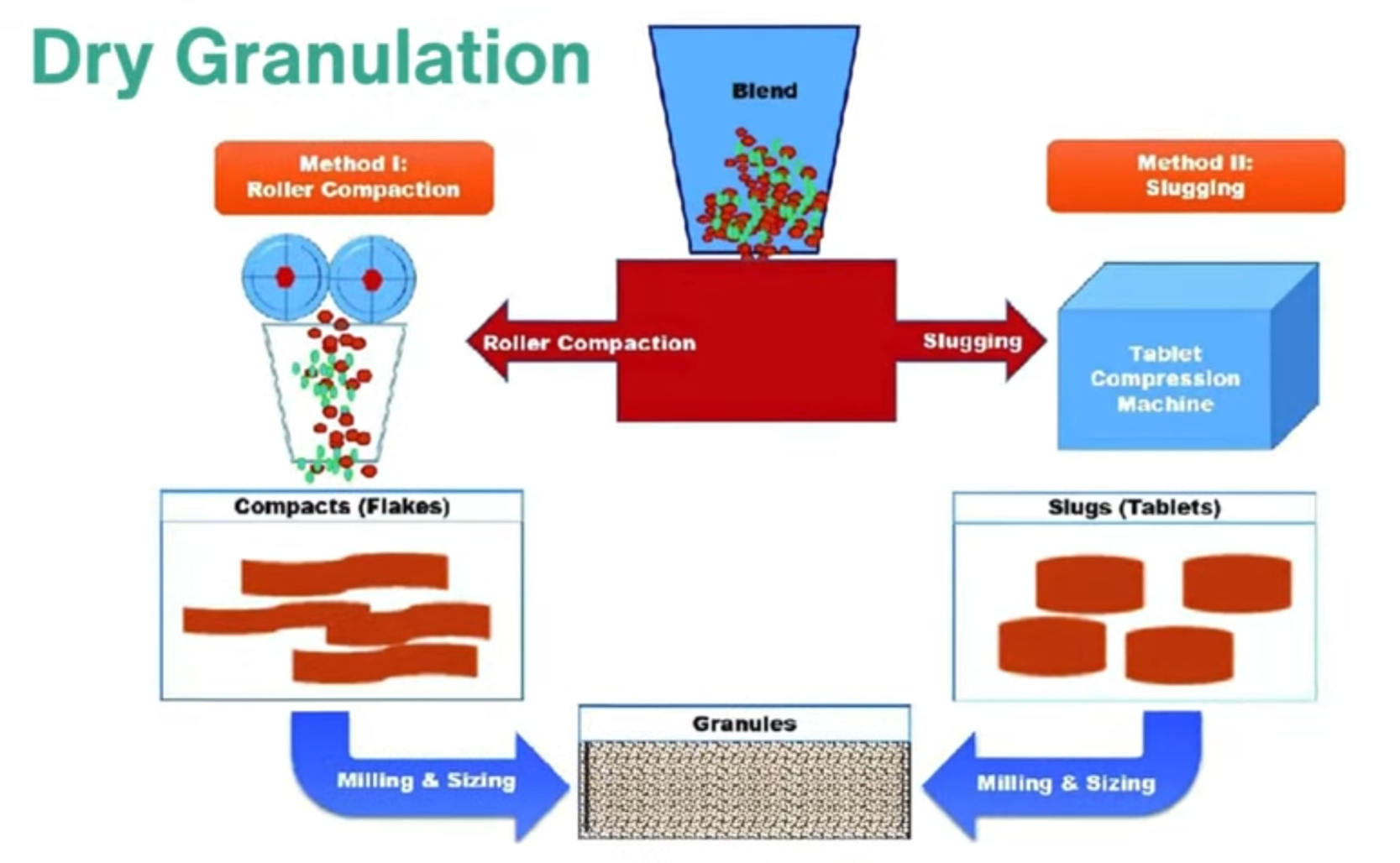
The two most common dry granulation techniques are slugging and roller compaction. In slugging, powders are compressed into large tablets using heavy-duty presses and then milled into granules. Roller compaction, by contrast, applies continuous pressure through rotating rollers to form a solid sheet, which is subsequently broken down into granules.
Recent advancements have introduced pneumatic dry granulation, a modified approach that produces porous, highly compressible granules while minimizing material loss.
2. Wet Granulation
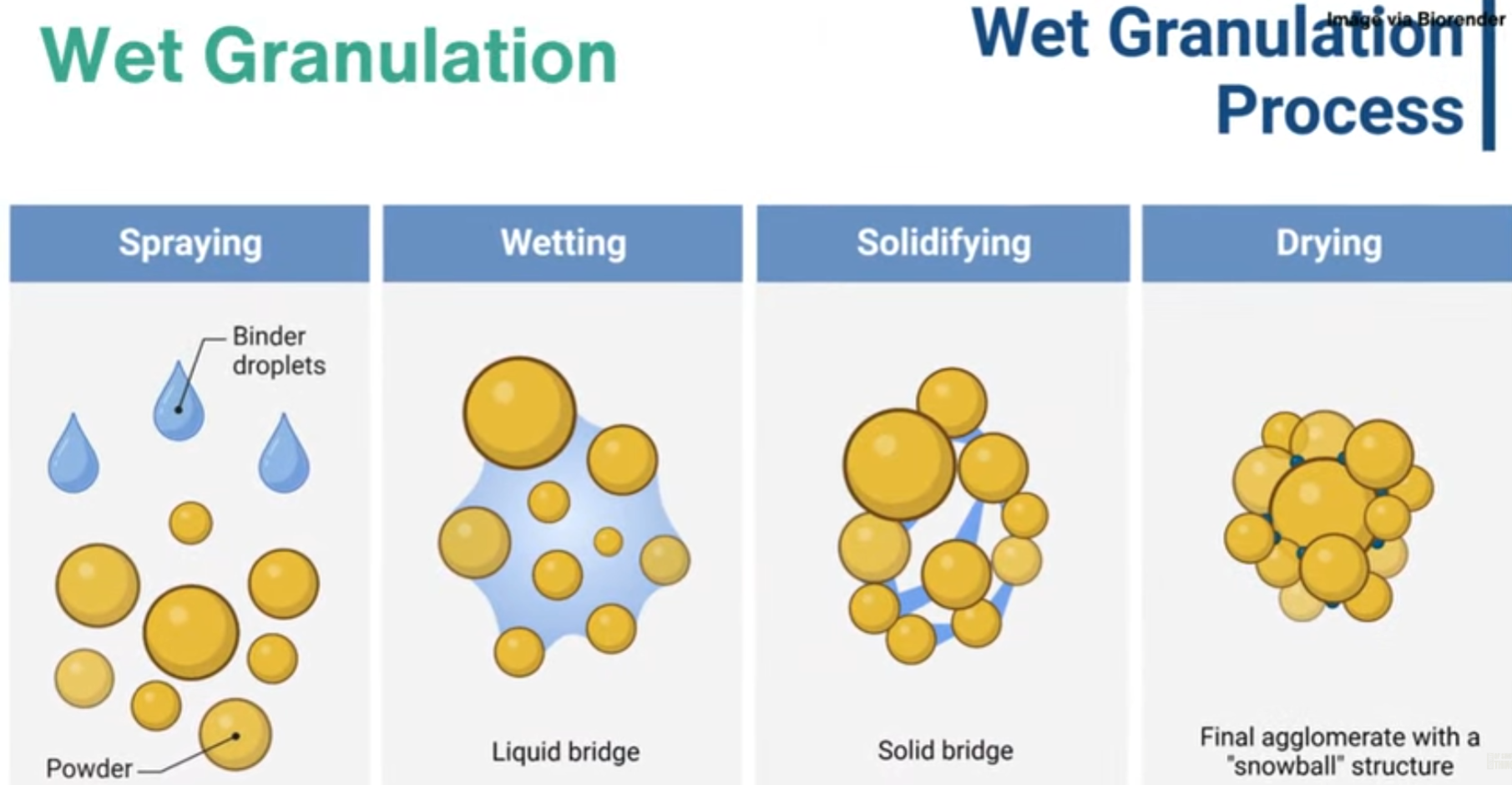
Wet granulation is the most traditional and widely used granulation method in pharmaceutical manufacturing. In this process, a granulating fluid, such as water, ethanol, or isopropanol, along with a liquid binder, is added to a powder blend to promote particle adhesion. This step forms a moist mass that can be shaped into granules.
The wet mass is then passed through a sieve to produce granules of uniform size. After formation, the granules are dried to remove excess moisture. The dried material is subsequently milled and screened to achieve the desired particle size distribution.
Over time, wet granulation has evolved beyond its conventional form. Several advanced variations have been developed, including reverse wet granulation, steam granulation, moisture-activated dry granulation, thermal adhesion granulation, melt granulation, freeze granulation, and foam granulation.
How Granules Make Production Safer, Faster, and More Reliable

Granulation plays a significant role in improving pharmaceutical production. By converting powders into granules, manufacturers create particles that are easier to manage during processing and storage. Here are some key benefits of using granules during pharmaceutical manufacturing:
1. Dust Control
During mixing, transfer, or compression, fine powder particles can become airborne, leading to product loss and safety risks within manufacturing facilities. Granules significantly reduce this problem. Because they are larger and heavier than loose powders, they generate less dust, minimize airborne contamination, and help protect operators.
2. Enhanced Compressibility
Granules compress more efficiently than loose powders during tablet manufacturing. Their structured form allows particles to rearrange and bond under pressure, which results in tablets with greater hardness and improved structural integrity. This also supports consistent tablet weight and accurate dosing, contributing to overall product quality.
3. Increased Flowability
Loose powders often move inconsistently through hoppers and feeding systems due to their fine, irregular particle size. Granules, on the other hand, have smoother surfaces and greater mass, which allows them to flow more uniformly through processing equipment. The steady flow ensures reliable filling of dies, capsules, and packaging units, and helps improve production speed and consistency.
4. Better Stability
Granulation can enhance the stability of sensitive drug substances by incorporating protective coatings or stabilizing excipients during processing. These additions help preserve drug potency and extend the shelf life of the final product. In addition, enteric-coated granules provide targeted protection for acid-sensitive drugs, preventing degradation in low-pH environments such as the stomach.
5. Prevents Segregation and Adhesion
In powder blends, particles of varying sizes or densities can separate during handling, which leads to inconsistent dosing. Granulation solves this by binding ingredients together within each particle. Since granules are larger and more robust than loose powders, they also reduce sticking and picking during tablet compression.
FAQs
1. How does dry granulation differ fundamentally from wet granulation techniques?
Dry methods rely entirely on extreme mechanical compaction to fuse particles, completely avoiding liquid binders and thermal drying. Conversely, wet techniques utilize aqueous or organic solvents to create capillary bridges, yielding superior final tensile strength upon drying.
2. What defines the capillary state in wet granulation thermodynamics?
The capillary state occurs when the liquid binder completely saturates all interstitial voids between primary particles, displacing trapped air. This state maximizes capillary pressure and interfacial forces, providing the ultimate structural integrity prior to thermal drying.
3. What is the primary operational function of fluid bed granulation?
Fluid bed systems suspend cohesive powder beds in a heated, high-velocity airstream while simultaneously atomizing a liquid binder over the floating particles. This technology integrates massing and thermal drying into a single continuous operation, producing highly porous, uniform agglomerates.
4. What specific manufacturing advantages does melt granulation offer?
By utilizing thermoplastic polymers that liquefy between 50°C and 90°C, melt granulation completely eradicates the need for liquid solvents. Upon cooling, the molten binder instantly solidifies into highly robust solid bridges, drastically accelerating production timelines and reducing utility costs.
Elevate Your Pharmaceutical Manufacturing Process
Understanding the different types of granules in pharmaceutical formulations helps manufacturers improve the quality of drug production. The key is to evaluate the formulation goals, drug properties, and production scale before choosing a suitable granulation strategy.
Once the formulation and processing requirements are clear, the next step is selecting equipment that can support those goals. If you’re looking for a reliable pharmaceutical equipment supplier, Finetech is an excellent option.
We offer a range of granulation solutions, including rapid mixer granulators and complete granulation lines for solid dosage production. With capacities ranging from 25 to 1500L, these systems are designed to support different manufacturing scales. Contact our specialists now to choose the best equipment for your facility.
References:
Granulation techniques and technologies: recent progresses.
Exploring granulation in pharmaceuticals: the role of cellulose ethers.
Copyright Notice:
You may not reproduce, modify, publish, display, transmit, or in any way exploit any content on this website, or use such content to construct any kind of database without prior express written approval by Finetech Group. For permission to use the content, please contact: info@pharmamachinecn.com
Disclaimer:
The information contained in this article is for general information purposes only. The Company does not guarantee the accuracy, relevance timeliness or completeness of any information, and the Company assumes no responsibility for errors or omission in the content of this article.