English
  Russian
  Turkish
  Spanish
  French
  German
  Japanese
With over 530 billion capsules produced every year, capsule filling machines operate under one of the most unforgiving tolerances in pharmaceutical manufacturing. A slight shift in dosing accuracy, locking force, or fill uniformity is enough to push a batch outside pharmacopeial limits and trigger costly rejections or compliance failures.
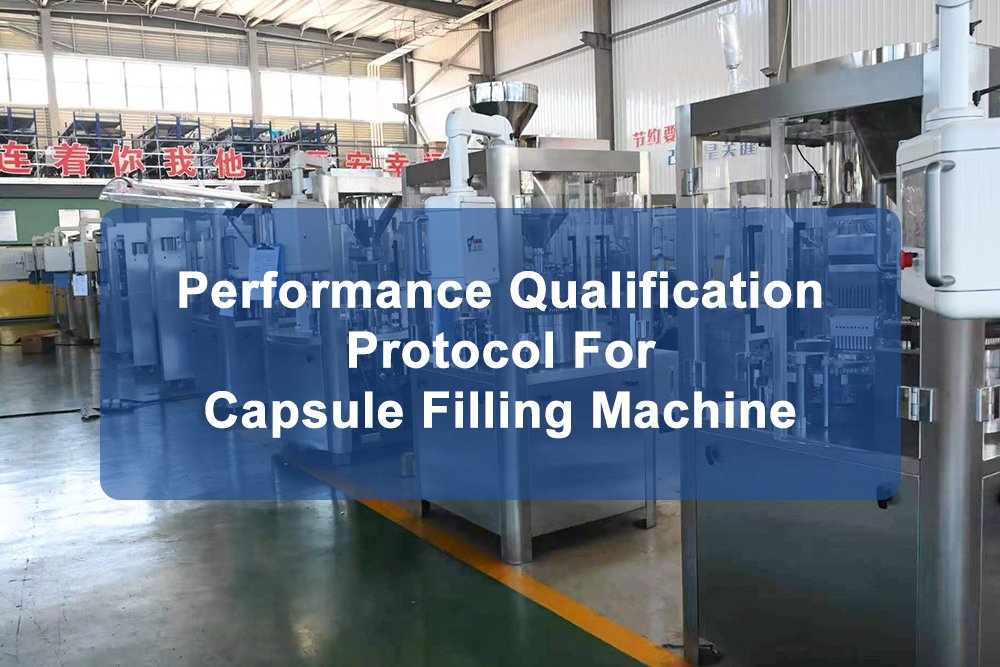
This is exactly where performance qualification (PQ) becomes critical. It doesn’t just confirm that the machine “runs”; it proves, under real operating conditions, that every capsule consistently meets predefined standards for weight variation, mechanical integrity, and release performance in line with GMP expectations.
In this guide, we will break down the performance qualification protocol for capsule filling machines, the key performance indicators, and the step-by-step validation process.
What are PQ Protocols for Capsule Filling Machines?
A performance qualification (PQ) protocol is official, documented evidence that a capsule filling machine consistently operates according to design specifications under normal conditions.
It is a systematic verification that the equipment maintains weight uniformity, filling accuracy, and mechanical stability across varied speeds using actual product or placebo. This validation is achieved through different testing cycles. These tests verify that the filling process consistently produces high-quality, standardized capsules before the machine is released for commercial manufacturing.
KPIs That Determine Capsule Filling Machine Performance
A diligent PQ for capsule filling machines is the primary measurable criterion for GMP compliance and commercial readiness. It has some standard protocols that are typically run at minimum, mean, and maximum operating speeds to challenge the system. Here are the essential KPIs for performance evaluation:
1. Weight Variation
This is the first and the most critical indicator of solid dosing accuracy. Weight variation is a quantitative measure of how accurately the machine fills each shell. Capsules must fall within a predetermined range of the target fill weight. This range is a regulatory standard by the US Pharmacopeia, which is usually permitted within ± 10% for average weights less than 300 mg and ± 7.5% for 300 mg or more, based on the net weight of the contents.
2. Yield Recovery
Yield recovery is the ratio of theoretical output to actual weight collected. It identifies powder loss during the filling process or excessive rejection of shells. High yield indicates a well-calibrated machine and a stable powder blend that does not stick to the mechanical components.
3. Locking Strength
Locking strength ensures capsules are properly locked and not deformed. During high-speed runs, mechanical vibrations can lead to broken or loose caps. This KPI verifies that the closing station applies enough force to engage the locking grooves without crushing the gelatin shell and prevents leakage during packaging.
4. Disintegration and Dissolution
It is an integral laboratory test that confirms the filling process has not altered the drug’s release profile. The standard dissolution rate for immediate-release capsules is typically Q = 75% or 80% of API dissolved within 30 to 45 minutes.
Similarly, disintegration for standard gelatin capsules is generally not more than 30 minutes (or within 15–30 minutes) when tested according to USP <2040> or pharmacopoeial standards. This validation confirms that the compression force used during filling does not create a slug so hard that it fails to release the medication effectively.
Capsule Filling Machine PQ: A Step-by-Step Validation Process
The performance qualification (PQ) process for a capsule filling machine usually spans three consecutive successful batches to establish statistical confidence. Here is the step-by-step breakdown of the qualification phase:
Step 1: Pre-Start Checks
Before initiation, turn on the machine following standard procedures. Start with the verification that the powder blend has been cleared by quality control (QC). The machine environment must maintain specific humidity levels, as excessive moisture can cause gelatin shells to soften and jam, while overly dry air may lead to static issues and brittle shells.
Step 2: Sampling Plan
The sampling plan is a critical step designed to keep each batch uniform from start to finish. Samples are collected at predetermined intervals, typically at the beginning, middle, and end of the production run. This systematic approach is significant because it accounts for potential drift in machine settings or powder density over time.
Step 3: Challenge Tests
Challenge tests subject the machine to worst-case scenarios to define its operational boundaries. This involves testing the equipment at its highest rated speed to observe if increased vibration affects weight accuracy or if the vacuum system can maintain high-speed separation of the shells. If the machine can produce quality capsules at maximum capacity, it proves the stability of the entire system.
Step 4: Data Analysis
Once the runs are complete, a thorough data analysis is conducted. This involves calculating the mean weight, standard deviation, and relative standard deviation (RSD) for all sampled batches. Analysts look for trends or outliers that might indicate a mechanical flaw or a formulation issue that requires adjustment.
Step 5: Final Report
The process concludes with a final report that compiles all test results, deviations, and corrective actions. This document serves as the official validation that the machine is capable of consistent performance, which allows it to be formally released for commercial manufacturing.
FAQs
1. How many batches are needed for capsule filling machine PQ?
Three successful batches are common in industry, but FDA does not set a fixed minimum number for process validation. The number of PQ batches should be justified by product risk, process knowledge, batch size, machine complexity, and the level of evidence needed to prove reproducibility.
2. Can placebo be used for capsule filling machine PQ?
Placebo may be useful for early machine challenge studies, training, or non-product-specific qualification work. For product-specific PQ or process validation, actual commercial blend is usually stronger evidence because powder flow, density, segregation, and fill behavior can change by formulation.
3. Why is PQ required for a capsule filling machine?
PQ is required to show that the machine does more than run mechanically. It must repeatedly produce capsules that meet quality requirements such as fill weight, appearance, locking, and uniformity during actual or representative production conditions.
Upgrade Your Capsule Production Line with High-Precision Equipment
The capsule filling process is a sensitive yet critical operation. A little mechanical drift or inconsistent dosing can compromise patient safety and damage the brand’s integrity. Performance qualification stamps the process with a seal of reliability so that every batch meets the highest pharmaceutical standards.
Investing in rigorous performance qualification protocol for capsule filling machines goes a long way in securing a predictable, high-yield manufacturing environment. Additionally, you should also invest in high-quality capsule filling lines, such as those manufactured by Finetech. We provide advanced capsule filling machines engineered for precision, stability, and regulatory compliance.
Along with the equipment, Finetech supports manufacturers with robust validation documentation, machine installation, and responsive online troubleshooting assistance. Contact our team today and get a customized quote tailored to your production requirements.
Copyright Notice:
You may not reproduce, modify, publish, display, transmit, or in any way exploit any content on this website, or use such content to construct any kind of database without prior express written approval by Finetech Group. For permission to use the content, please contact: info@pharmamachinecn.com
Disclaimer:
The information contained in this article is for general information purposes only. The Company does not guarantee the accuracy, relevance timeliness or completeness of any information, and the Company assumes no responsibility for errors or omission in the content of this article.