English
  Russian
  Turkish
  Spanish
  French
  German
  Japanese
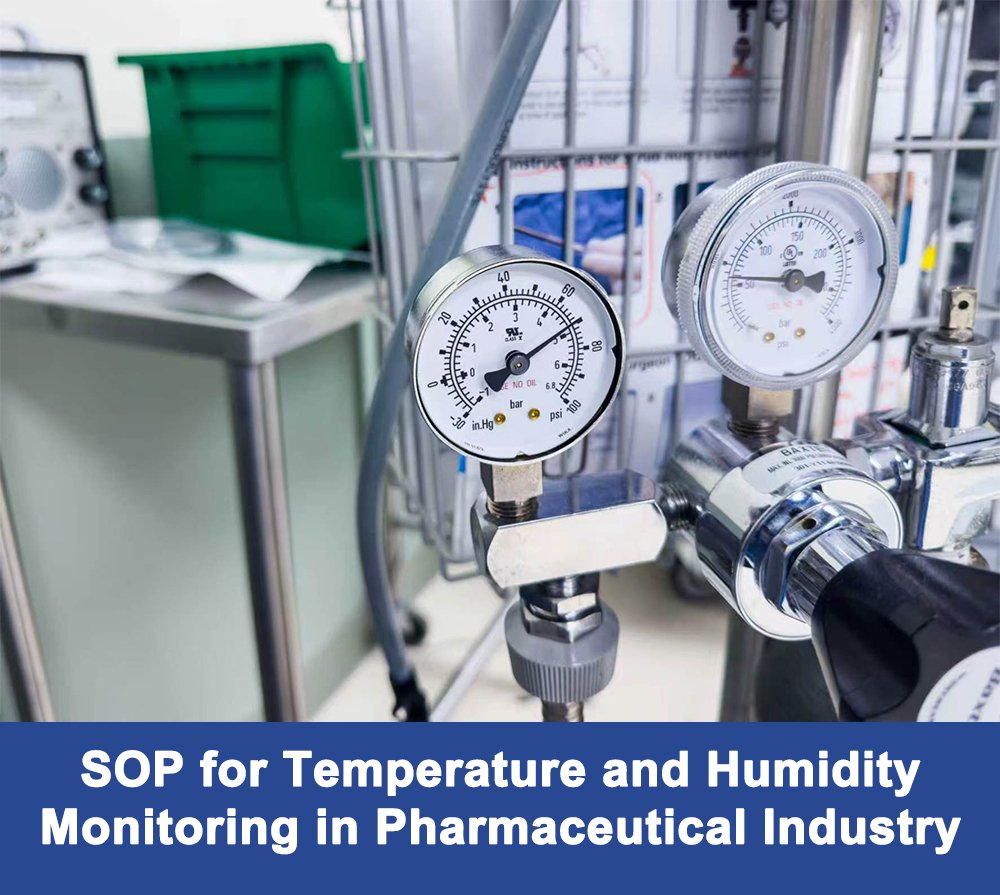
Standard operating procedure of Temperature and Humidity Monitoring in the Pharmaceutical Industry.
1.0 OBJECTIVE:
To define the procedure for routine monitoring, recording, and review of temperature and relative humidity in manufacturing, storage, and laboratory areas across the pharmaceutical plant.
2.0 SCOPE:
This Procedure covers all classified and controlled areas including production halls, raw material stores, finished goods stores, quarantine rooms, cold storage units, laboratories, stability chambers, and air locks where product quality can be affected by environmental conditions.
3.0 RESPONSIBILITY:
Area Operator, QA Officer & Warehouse In-Charge
4.0 ACCOUNTABILITY:
QA Head.
5.0 PROCEDURE:
5.1 Review the daily monitoring schedule at the start of each shift. The schedule lists every location, sensor ID, reading time, and the person on duty for each round.
5.2 Collect the Temperature and Humidity Logbook from the QA office. Each area has its own logbook with pre printed rows for daily entries.
5.3 Check that all calibrated thermohygrometers and digital data loggers are in working condition. Any failed unit must be reported to QA before the monitoring round begins.
5.4 Follow the route map from the QA office through each area in the proper order. The route is designed to limit cross contamination risk between clean and less clean zones.
5.5 Acceptance Limits:
5.5.1 Each area has its own acceptance limits for temperature and humidity. The limits are set based on product stability data and GMP requirements.
5.5.2 Standard limits for common areas are as follows:
5.5.2.1 General production and packing areas: Temperature 20 to 25°C, Relative Humidity (RH) 45 to 65%.
5.5.2.2 Raw material stores and finished goods stores: Temperature below 25°C, RH below 60%.
5.5.2.3 Cold storage (2 to 8°C rooms): Temperature 2 to 8°C, RH not critical but logged for record.
5.5.2.4 Controlled room temperature labs: Temperature 20 to 25°C, RH 30 to 65%.
5.5.2.5 Stability chambers: Set points vary per ICH condition (25°C/60% RH, 30°C/65% RH, 40°C/75% RH).
5.5.3 Tighter limits may apply for specific products or processes. Always follow the limits listed on the area notice board, not the general values above.
5.5.4 An alert limit sits inside the action limit for each area. A reading that crosses the alert limit triggers a watch protocol. A reading that crosses the action limit triggers an excursion report.
5.6 Monitoring Frequency:
5.6.1 Manual readings are taken twice per shift in most areas. The first reading happens within the first hour of the shift. The second reading happens within the last hour of the shift.
5.6.2 High risk areas such as cold rooms and sterile suites need hourly manual checks along with continuous electronic logging.
5.6.3 Stability chambers are logged every 15 minutes by the built in data logger. A manual verification reading is still taken twice per day.
5.6.4 Continuous data loggers in storage areas record at 5 minute intervals around the clock. The data is downloaded weekly for trend review.
5.6.5 Additional readings are required under these trigger conditions:
5.6.5.1 After an HVAC system restart or planned shutdown.
5.6.5.2 During severe weather events that affect building climate control.
5.6.5.3 After any door is left open for more than 10 minutes.
5.6.5.4 When a visible condensation or frost layer forms on surfaces.
5.6.5.5 After maintenance work on any air handling unit.
5.7 Monitoring Instruments:
5.7.1 Wall Mounted Thermohygrometers:
5.7.1.1 Each monitored area has at least one calibrated wall mounted thermohygrometer. The unit displays current temperature and RH on a digital screen.
5.7.1.2 The unit is mounted at a height of 1.5 to 1.8 meters from the floor. This height matches the typical working zone in the area.
5.7.1.3 Keep the unit at least 1 meter away from doors, vents, heat sources, or outside walls. Any of these can give a false local reading.
5.7.1.4 Verify the calibration sticker on each unit during the monitoring round. A unit past its calibration date cannot be used for official readings.
5.7.2 Portable Reference Thermohygrometers:
5.7.2.1 A portable reference unit is carried by the QA officer for spot checks and cross verification against wall units.
5.7.2.2 The portable unit has a stricter calibration schedule and serves as the master reference in any dispute over readings.
5.7.2.3 Allow the portable unit to equilibrate for at least 10 minutes in a new area before you record a reading. Rapid area changes can cause temporary drift.
5.7.2.4 Handle the probe with care. Do not touch the sensor tip. Body heat will raise the temperature reading for several minutes.
5.7.3 Continuous Data Loggers:
5.7.3.1 Data loggers are small battery powered units placed in storage areas to record temperature and RH at fixed intervals.
5.7.3.2 Each logger carries a unique ID that ties it to a specific location. Do not move a logger between areas without a change control form.
5.7.3.3 Download the logger data weekly using the vendor software. Save each download file with the logger ID, location, and date in the file name. The weekly file forms part of the Weekly Data Logger Download Report.
5.7.3.4 Review the downloaded data for any reading that crosses the alert or action limit. Mark each excursion with a start time, end time, and duration.
5.7.3.5 Replace the logger battery when the low battery indicator turns on. A data gap from a dead battery must be reported as a deviation.
5.7.4 Building Management System (BMS) Sensors:
5.7.4.1 The BMS links every HVAC controlled area to a central monitoring station. The station shows live readings from all sensors on a single screen.
5.7.4.2 The BMS sends an automatic alarm to the engineer on duty when any reading crosses an alert or action limit.
5.7.4.3 Cross check the BMS reading against the wall mounted display for each area during the morning round. A gap greater than 1°C or 5% RH needs a service call.
5.7.4.4 Print the Daily BMS Report every day at 8 AM. File the printed report in the daily monitoring binder after QA review.
5.8 Taking a Reading:
5.8.1 Enter the area through the proper air lock and follow the gowning procedure for that zone.
5.8.2 Stand in front of the thermohygrometer without blocking the sensor with your body. Body heat and breath can affect the reading.
5.8.3 Wait 30 seconds for the display to stabilize. Digital units sometimes flicker between two values during a change in area state.
5.8.4 Read the temperature first, then the humidity. Record both values to one decimal place in the logbook row for the current time slot.
5.8.5 Write the sensor ID, the time of reading, and your operator ID next to each value. Every entry must be traceable to a specific sensor and person.
5.8.6 Use only blue or black ink for logbook entries. Never use pencil. Never use correction fluid. Correct any error by drawing a single line through the wrong entry, then write the correct value with your initial and date.
5.8.7 Sign and date the row after the readings are complete. An unsigned row is not considered a valid record.
5.9 Excursion Handling:
5.9.1 An excursion is any reading that falls outside the action limit for the area. Every excursion must be investigated and documented.
5.9.2 On discovery of an excursion, take the steps below in order:
5.9.2.1 Take a second reading using the portable reference unit to rule out a sensor fault.
5.9.2.2 If the second reading also fails, inform QA and the shift supervisor within 15 minutes.
5.9.2.3 Check if any product in the area has been exposed to the out of limit condition. Quarantine any affected product pending QA review.
5.9.2.4 Notify the HVAC engineer to investigate the root cause of the excursion.
5.9.2.5 Continue monitoring at 30 minute intervals until the area returns to within limits.
5.9.3 Record the excursion on the Environmental Excursion Form. The form must capture the date, time, duration, area, sensor ID, reading value, action limit, and product impact.
5.9.4 Submit the form to QA within 24 hours of the event. QA will decide the release status of any affected product based on stability data.
5.9.5 An excursion that extends beyond 4 hours or that affects finished product requires a formal deviation report under the site deviation SOP.
5.10 Calibration of Instruments:
5.10.1 All thermohygrometers and data loggers must be calibrated by an authorized external agency or by the site calibration lab.
5.10.2 The calibration frequency is once every six months for wall mounted units and once every three months for portable reference units.
5.10.3 Data loggers are calibrated at two temperature points (the low and high end of the area operating range) and two humidity points (33% RH and 75% RH matching standard saturated salt references).
5.10.4 An Instrument Calibration Certificate is issued for each instrument. The certificate shows the as found values, the as left values, and any correction factor applied.
5.10.5 Affix a calibration label to each instrument after a successful calibration. The label shows the calibration date, the next due date, and the certificate number.
5.10.6 An instrument that fails calibration is removed from use at once and sent for repair or replacement. A failed calibration may require a retrospective review of data since the last pass.
5.11 Data Review and Trending:
5.11.1 QA reviews every daily logbook entry by the end of the next working day. A signed review confirms that all readings are within limits.
5.11.2 Weekly data logger downloads are plotted on a trend chart for each area. The chart shows the max, min, and average values for each day.
5.11.3 A Monthly Trend Report is prepared by QA. The report flags any area that shows a drift toward the action limits even if no excursion has happened.
5.11.4 The quarterly management review committee examines all Monthly Trend Reports. Systemic issues are assigned owners and target dates for correction.
5.11.5 All temperature and humidity records are retained for a minimum of five years or the product shelf life plus one year, whichever is longer.
5.12 RECORDS:
5.12.1 Temperature and Humidity Logbook.
5.12.2 Daily BMS Report
5.12.3 Weekly Data Logger Download Report.
5.12.4 Environmental Excursion Form.
5.12.5 Instrument Calibration Certificate.
5.12.6 Monthly Trend Report.
6.0 ABBREVIATIONS:
6.1 SOP: Standard Operating Procedure.
6.2 QA: Quality Assurance.
6.3 RH: Relative Humidity.
6.4 HVAC: Heating, Ventilation, and Air Conditioning.
6.5 BMS: Building Management System.
6.6 GMP: Good Manufacturing Practice.
6.7 ICH: International Council for Harmonisation.