English
 Russian
 Turkish
 Spanish
 French
 German
 Japanese

Fluidized bed dryers are used in the pharmaceutical and chemical industries for drying powders and granules. They work by passing hot air through the material so moisture is removed evenly and in less time. The material behaves almost like it is floating, which helps in better drying.
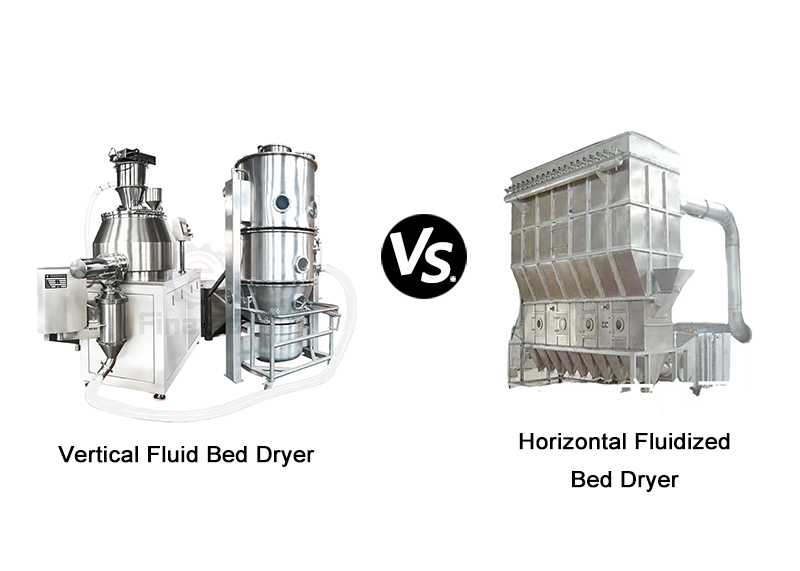
There are two main types of this machine: vertical and horizontal. Both do the same job, but the design and working style are not the same. In this article, we discuss a vertical vs. horizontal fluidized bed dryer.
Vertical vs. Horizontal Fluidized Bed Dryer Difference
When we compare a vertical vs. horizontal fluidized bed dryer, the main difference comes from how the fluidized bed dryers are built and how air moves inside them.
Vertical Design
In a vertical fluidized bed dryer, the structure is upright. The hot air moves from the bottom and pushes the material upward, so it keeps moving during drying.
This design is compact and does not need much floor space. It is used in pharmaceutical plants where batch processing is more common and better control is needed.
Horizontal Design
A horizontal fluidized bed dryer has a long body. The material moves through the chamber while hot air flows across it.
This type is usually used in large production setups. It is better when continuous drying is required and when large quantities need to be handled without stopping.
Air Flow Difference
The airflow is one of the main differences between the two systems. In vertical dryers, air moves upward from the bottom. In horizontal dryers, air moves across the material while it travels through the machine. This changes how fast and evenly drying happens.
Production Style
Vertical systems work in batches. You load material, dry it, then remove it before starting again.
Horizontal systems work in continuous flow. Material keeps moving through the machine, which helps save time in large-scale production.
Space Requirement
Vertical dryers take up less floor space because of their tall design. They are easier to fit in smaller production areas.
Horizontal dryers need more space because of their long layout, but they can handle higher capacity at the same time.
Capacity and Efficiency
Vertical dryers are better for small to medium production, where control matters more. They allow operators to monitor each batch closely and make adjustments when needed.
Horizontal dryers are better for large production where speed and volume are more important. They can handle a continuous flow of material, which helps increase output. This makes them suitable for facilities that need to process large quantities on a regular basis.
| Feature | Vertical Fluidized Bed Dryer | Horizontal Fluidized Bed Dryer |
| Design | Upright structure | Horizontal structure |
| Air Flow | Bottom to top | Across the material |
| Production Style | Batch processing | Continuous processing |
| Space Requirement | Less floor space | More floor space |
| Capacity | Small to medium batches | Large production volumes |
| Best Use | Controlled production | High-volume production |
Which One Will Work Better for Your Company?
The vertical vs. horizontal fluidized bed dryer choice depends on what your production needs are. If your work is small-scale and you want better control over each batch, a vertical fluidized bed dryer is a good fit. It is simple and space-saving.
If your production is large and continuous, a horizontal fluidized bed dryer makes more sense because it handles higher volume without stopping.
Conclusion
Both vertical and horizontal fluidized bed dryers are useful in different situations. They serve the same purpose but in different ways. The right choice depends on your space, production size, and how your process is set up.
Finetech offers high-quality bed dryers designed for different processing needs. Contact our team today to find the best solution for your facility and production goals.