English
 Russian
 Turkish
 Spanish
 French
 German
 Japanese

The difference between horizontal and vertical cartoning machines is not just which direction the product travels. It determines what products you can run, how fast your line operates, and how easily your team can manage changeovers.
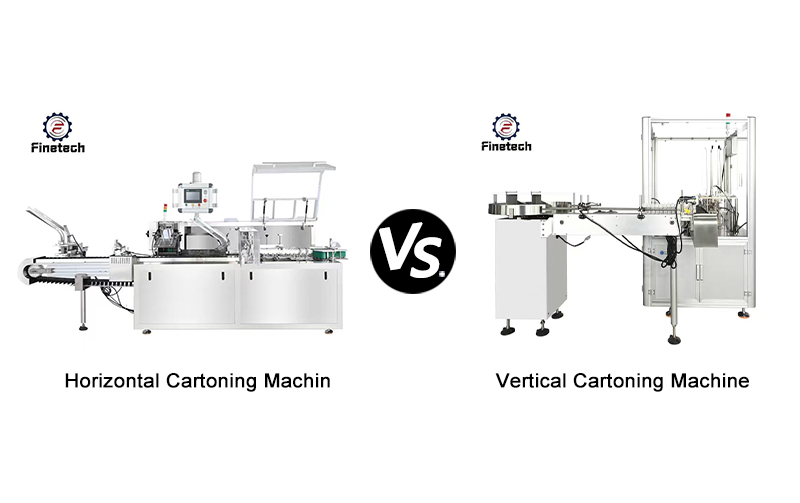
So, in this guide, we will break down what’s different between the two cartoning machines to help you make the right call.
Horizontal vs Vertical Cartoning Machine: Side by Side
Here’s a side-by-side comparison of things that are different between horizontal and vertical cartoning machines:
| Factor | Horizontal Cartoning Machine | Vertical Cartoning Machine |
| Loading Method | Side-to-end loading | Top loading |
| Product Orientation | Horizontal throughout | Vertical, gravity-assisted |
| Speed | 50 to 400+ cartons per minute | 30 to 200 cartons per minute |
| Footprint | Larger and linear layout | Compact and upright |
| Product Suitability | Blister packs, tubes, bottles, and sachets | Pouches, bags, jars, and irregular shapes |
| Changeover Time | Longer and more complex | Faster and simpler |
| Automation Level | High. Integrates easily with upstream lines | Moderate to high |
| Maintenance Complexity | Moderate to high | Low to moderate |
| Cost | Higher | Lower to moderate |
| Best For | High volume and continuous production | Multi-SKU, flexible, and compact operations |
Let’s discuss these factors in detail.
1. Loading Method
The most fundamental difference is how each machine loads the product. Horizontal cartoning machines insert products from the side or end, keeping them in a horizontal position throughout the entire process.
This makes them ideal for rigid, flat, or pre-packaged products that can be pushed or guided into a carton without tilting.
Vertical machines load from the top, using gravity to drop or place products directly into an open carton below. It suits products that are difficult to side-load, particularly pouches, bags, and irregularly shaped items.
2. Speed and Output
Vertical cartoning machines can typically operate at higher speeds for lightweight products that can be quickly dropped into cartons. Meanwhile, horizontal machines offer greater precision in product placement and higher sustained speeds for heavier items.
In practice, high-end horizontal machines support speeds of 400 or more cartons per minute on continuous production lines. Vertical machines are highly capable but generally peak lower, suitable for moderate-volume operations.
3. Footprint and Facility Planning
Horizontal machines follow a linear layout, meaning they require significant floor length to accommodate the full process flow. In contrast, vertical machines stack functions upward rather than outward, resulting in a smaller floor footprint.
For pharmaceutical facilities where floor space is limited, or production cells need to remain compact, a vertical machine is the more practical fit.
4. Changeover Flexibility
Vertical machines usually have faster changeover, making them well suited to operations that run multiple small batches daily.
Horizontal machines, on the other hand, deliver better long-term output consistency on lines that run the same product continuously. If your operation switches formats regularly, vertical wins. However, if your line runs on product at a high volume, horizontal is the preferred choice.
5. Cost Comparison
Entry-level and semi-automatic vertical cartoning machines start around $8,000 to $30,000, while fully automatic models range from $30,000 to $100,000+. Their simpler product loading systems and smaller footprint help keep costs lower.
In comparison, horizontal cartoning machines require a larger investment. Entry-level automatic systems start around $30,000 to $60,000. Meanwhile, high-speed pharmaceutical and food-grade models can exceed $150,000 to $500,000+.
Applications of Horizontal and Vertical Cartoning Machines
The best choice depends on the type of product you are packaging and your production environment. Here are the applications of both of these cartoning machines:
Vertical Cartoning Machine

Vertical cartoners are commonly used for products that can be loaded directly from the top of the carton. These machines work particularly well with loose, granular, powdered, or free-flowing products.
Common applications include:
- Coffee capsules and K-Cups.
- Sachets and pouches.
- Powder products.
- Frozen foods.
- Confectionary items.
- Hardware components.
- Smaller consumer goods.
Horizontal Cartoning Machine

Unlike vertical cartoners, horizontal cartoning machines are designed for products that need controlled insertion into a carton while maintaining operation. The most common applications of this machine are:
- Pharmaceutical blister packs.
- Medicine bottles.
- Cosmetics and skincare products.
- Toothpaste tubes.
- Food trays.
- Bakery products.
- Medical devices.
- Consumer packaged goods.
These machines are useful when products require precise positioning, leaflet insertion, batch coding, serialization, or tamper-evident packaging.
Ready to Choose the Right Cartoning Solution?
Ultimately, the difference between horizontal and vertical cartoning machines comes down to your product characteristics and requirements. The right choice is simply the one that matches your packaging process.
If you’ve already identified the cartoning machine type that best fits your operation, Finetech can help.
We offer both horizontal and vertical cartoning machines. In addition, you can buy a range of packaging equipment from us, including product filling and sealing, cartoning, case packaging, and end-of-line packaging.
Get in touch with Finetech today to get the machine you want!