English
  Russian
  Turkish
  Spanish
  French
  German
  Japanese
The need for accurate particle size control plays a crucial role in achieving pharmaceutical manufacturing excellence. Achieving consistent micronization directly dictates drug performance, affecting absorption, stability, and dosing accuracy across all solid dosage forms.
A pharmaceutical ball mill is a specialized grinder that is used to reduce and blend materials to the required ultra-fine consistency. It works on a dynamic principle of impact and attrition to ensure the active pharmaceutical ingredients and excipients meet strict quality standards. More than just grinding, it is an advanced engineering support for therapeutic efficacy.
Keep reading this guide to fully understand the working of the ball mill in pharmacy, its components, and the benefits for your business.
What is a Ball Mill?
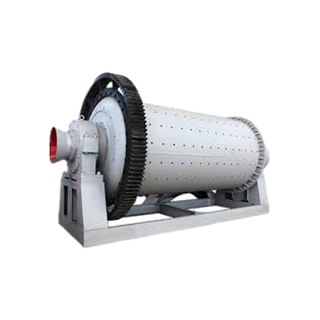
A ball mill, also known as a pebble mill or tumbling mill, is a versatile grinding machine used in the pharmaceutical industry. Its primary function is to reduce the particle size of active pharmaceutical ingredients (APIs) and excipients into a fine, consistent product.
Unlike a universal crusher, which handles initial coarse size reduction, the ball mill performs the final stage of ultra-fine grinding.
The mill consists of a rotating cylindrical shell, partially filled with metallic or ceramic grinding balls. As the cylinder rotates, the balls tumble, collide, and break down the material into finer particles.
Ball mills are also extensively used in various sectors, including mining, ceramics, and cement production. This widespread application due to their robust design, high efficiency, and ability to handle both wet and dry processes.
Three Key Components of a Ball Mill Machine
A ball mill machine is typically composed of three main components: the cylinder (or drum), the grinding balls (media), and the drive system. These work together with secondary parts, such as the feed and discharge mechanism, to maintain continuous particle size reduction. Below is a detailed description of how each of these essential components works.
1. Cylinder
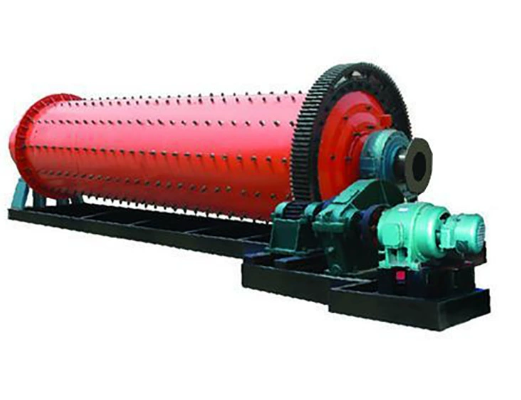
This is the main rotating body of the mill, which is usually constructed of stainless steel or alloy steel. The material to be crushed is fed through a hollow opening, often a trunnion, at one end, and the final product is discharged through a similar trunnion at the opposite end.
The interior of the cylinder is lined with durable materials, such as manganese steel, rubber, or ceramic plates. It is done to protect it from excessive abrasion and wear caused by the grinding balls.
2. Grinding Balls
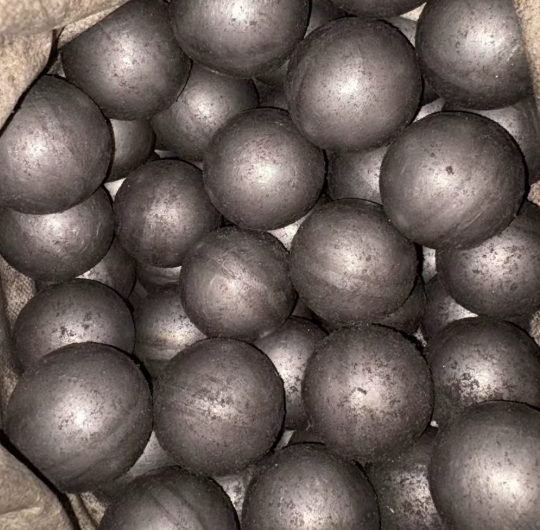
Grinding balls or grinding media are the active working elements that provide the mechanical force. The diameter of the grinding balls ranges from 1 to 5 inches, depending upon the mill size and the target particle fineness.
They are made of high-density, wear-resistant materials such as stainless steel, chrome steel, or various ceramics like alumina or zirconia. Use of these materials is extremely critical in pharmaceutical applications to minimize the risk of product contamination.
3. Drive System
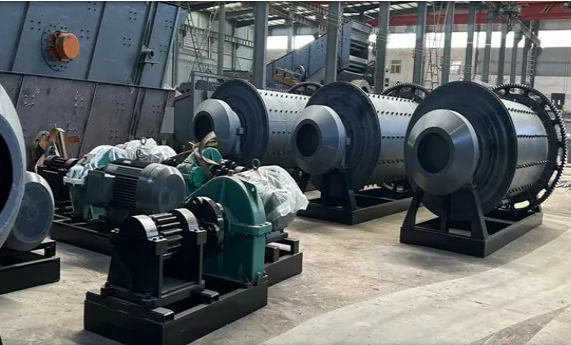
The drive system is the mechanical part that ignites and controls the rotational motion of the mill cylinder. It includes an electric motor, a gearbox used to reduce the motor’s high speed, and a large ring gear that is bolted directly to the cylinder to rotate the entire drum.
Working Principle of a Ball Mill (How Does It Work)
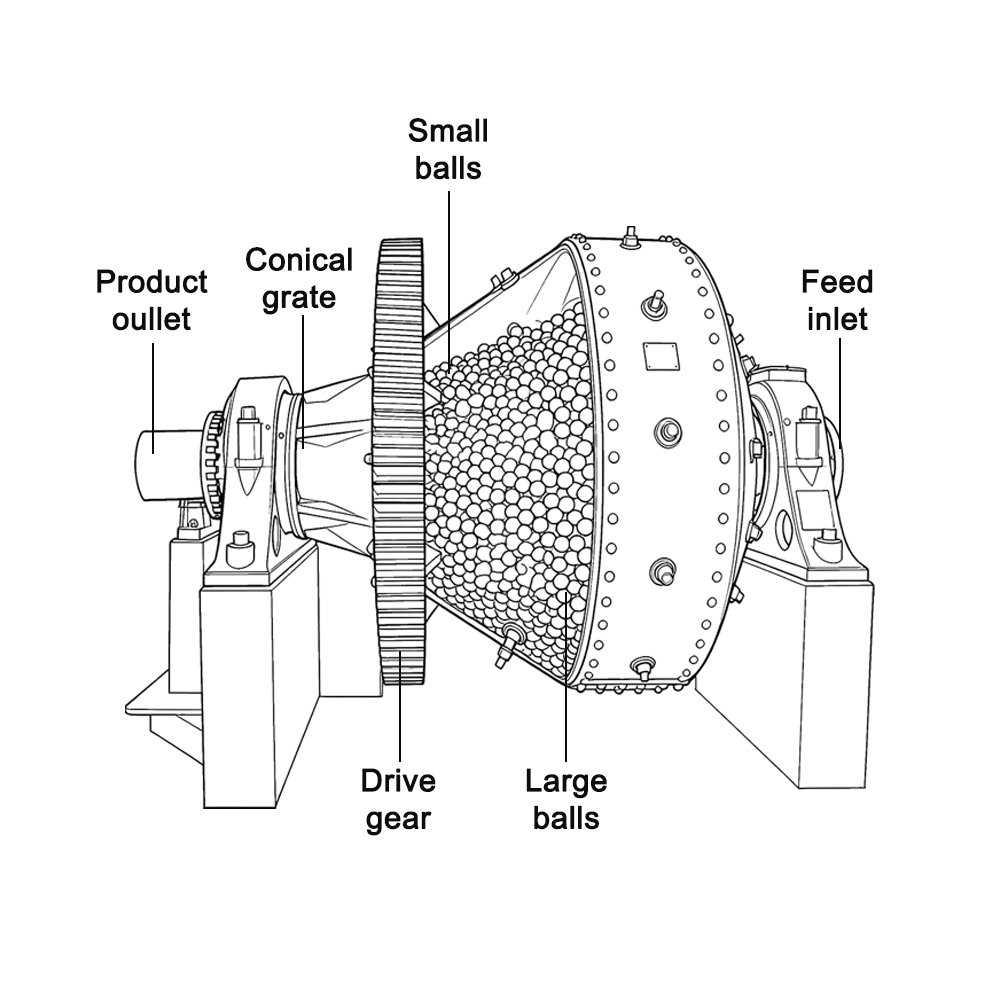
The working of a ball mill is a sophisticated process that involves the accurate control of rotational speed and gravitational force.
In short, it works on two main mechanical actions: impact and attrition. They work together to reduce large starting particles into a final, uniform, ultra-fine powder suitable for pharmaceutical use.
Factor #1: Impact
Impact is the major force for the initial breaking down of larger particles. As the cylinder rotates, the grinding balls are carried up along the wall to a certain height. Then, gravity pulls them down, causing them to free-fall with considerable kinetic energy. The force of the falling balls directly strikes the material particles inside the mill and breaks them into smaller pieces.
The process yields the best results when the mill operates slightly below its critical speed. This allows a portion of the grinding balls to achieve a free fall rather than being pinned to the cylinder wall by centrifugal force.
Factor #2: Attrition
Attrition is responsible for further reducing the smaller particles into very fine and smooth particles. It happens when the particles are crushed and rubbed between the rolling and sliding balls, and also the mill’s internal lining. The constant friction creates a powerful grinding effect that reduces the size of the particles even more, almost into a fine powder.
Working of Ball Mill in Pharmacy: Step-by-Step Process
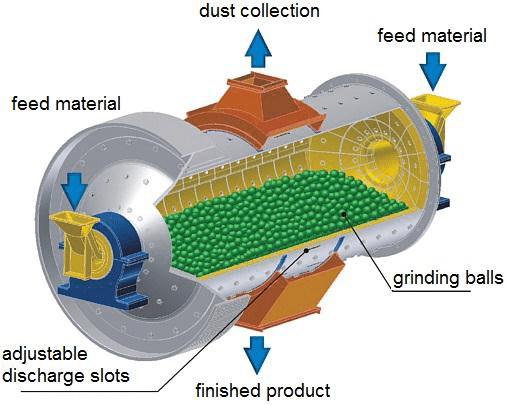
The operation of a ball mill in pharmaceutical manufacturing is a cyclical process that converts coarse materials into fine powder. Here is a step-by-step process of the ball mill operation:
Step #1: Feeding The Material
A feeding system or hopper feeds the APIs or raw materials into the cylinder. The material should occupy about 50–60% of the cylinder’s total volume for optimal operation.
Step #2: Rotation and Ball Action
A fixed number of grinding balls is placed inside the cylinder, which is then sealed, and the mill starts rotating via the drive system. Studies often suggest a speed near 190 RPM for efficient grinding. This range is considered optimal because it maximizes the free-fall action of the balls and creates the best particle reduction.
Step #3: Grinding
As the cylinder rotates, the balls are lifted and then fall from near the top of the shell onto the material below. This impact, along with the attrition, reduces the size of the solid particles to the desired fineness.
Step #4: Discharge
The ground product is discharged from the mill through a discharge port at a 30° angle. At the same time, new material is continuously fed in for a continuous grinding cycle, allowing for large batches to be processed. This finely processed powder is then transferred for further processing to be incorporated in different types of pills, tablets, and capsules.
Key Features and Benefits of Ball Mill in Pharmacy
Ball mills are highly specialized equipment used in tablet manufacturing and the preparation of various other dosage forms. Let’s take a look at some of its key features and benefits in the pharmaceutical sector.
1. Wet and Dry Operation
Ball mills are versatile equipment that can be used for grinding both dry powders and wet materials (slurries or suspensions). Wet milling is often used for heat-sensitive drugs. The liquid medium plays a crucial role in helping to dissipate the heat generated during the grinding process. This heat management allows the mill to achieve finer particle sizes with greater consistency.
2. Enclosed System
The milling process happens within a sealed cylindrical chamber. It protects sensitive APIs from oxidation, moisture exposure, and external contamination. This is extremely important for both API quality and operator safety, especially when handling potent or toxic compounds, such as certain chemotherapy agents or hormonal drugs.
3. Ultra-Fine Particle Size
One of the biggest benefits of a ball mill is its ability to produce extremely fine particles. The size reduction increases the total surface area of the drug and improves the dissolution rate of poorly water-soluble APIs. This leads to improved absorption of APIs in the body, thereby enhancing the therapeutic effect of the drug.
4. Uniform Distribution of APIs
The intensive mixing action of the balls ensures the uniform distribution of APIs even in the most low-dose formulations. The uniformity guarantees that every final tablet or capsule contains the accurate dosage. Achieving this consistency ensures both patient safety and overall quality of the pharmaceutical product.
FAQs
1. How does ball size influence milling efficiency?
Larger balls break coarse particles, while smaller balls produce fine particles. A mixture of sizes offers balanced grinding efficiency and particle distribution.
2. What types of materials can be processed in a ball mill?
Ball mills handle pharmaceutical powders, pigments, crystals, minerals, and solid APIs that require micronization or uniform particle size distribution.
3. How does temperature influence ball mill performance?
High temperatures can cause material degradation or melting. Controlled cooling and intermittent milling are used to minimize thermal effects during processing.
Choose Uniformity and Safety In Every Single Dose
The ball mill is a powerful engineering tool that can transform your production capacity and give you more opportunities to innovate in drug formulation. However, it is heavy equipment and might require a substantial capital investment.
When selecting a mill, you must carefully consider the material being ground, the mill’s structural factors, and the operating conditions. Along with these technical requirements, it is crucial to partner with a trusted provider such as Finetech.
We have been supplying pharmaceutical machinery to over 60 countries for more than 30 years. Our product range covers pharmaceutical manufacturing equipment such as universal crushers, filling machines, and other processing systems, as well as eco-friendly packaging machine lines.
Contact our technical team to explore how we can optimize your micronization process.