English
  Russian
  Turkish
  Spanish
  French
  German
  Japanese
For the pharma and biotech industry, vial washing machines are non-negotiable. These machines don’t just clean vials; they sterilize, protect product quality, and ensure patient safety. The entire process prevents ruined batches, recalls, and regulatory non-compliance. That’s why companies invest heavily in high-quality vial washers.
The numbers speak for themselves. In the US alone, the vial washing and filling machines market was valued at USD 154.02 million in 2024.
If you’re also here to learn about vial washing machines, the blog is your go-to resource. You’ll learn what a vial washing machine is, how it works, the main types, and the key factors to consider when choosing one, so your production stays safe and fully compliant.
What a Vial Washing Machine Does
A vial washing machine, in the simplest terms, is the dishwasher of the pharma and biotech industry. Its main purpose is to clean glass vials and ampoules thoroughly before they’re filled with medicines or vaccines.
These glasses aren’t the usual ones we see in residential use. Instead, they’re specifically manufactured from either glass or medical-grade plastic. Glass vials are made from Borosilicate Glass (Type I), Soda-Lime Glass (Type II), or Soda-Lime Glass (Type III).
Plastic vials, on the other hand, are produced using polymers such as Polypropylene (PP), Polyethylene (PE), Polystyrene (PS), Polycarbonate (PC), and other advanced plastics.
To clean these vials, the washing machine follows a precise process. It starts with a rinse using purified water, followed by a second rinse with Water for Injection (WFI). The vials are then purged with filtered compressed air, given a final WFI rinse, and finished with sterile air drying.
Types of Vial Washing Machines Explained
In the pharmaceutical and biotech industry, vial washing machines are broadly classified into three types: rotary, linear, and ultrasonic. Each type uses a distinct mechanism to achieve precise and reliable vial cleaning.
These machines are also available in two modes of operation: fully automatic and semi-automatic. Here’s a brief overview of the main types along with their modes of operation.
1. Rotary Vial Washing Machine
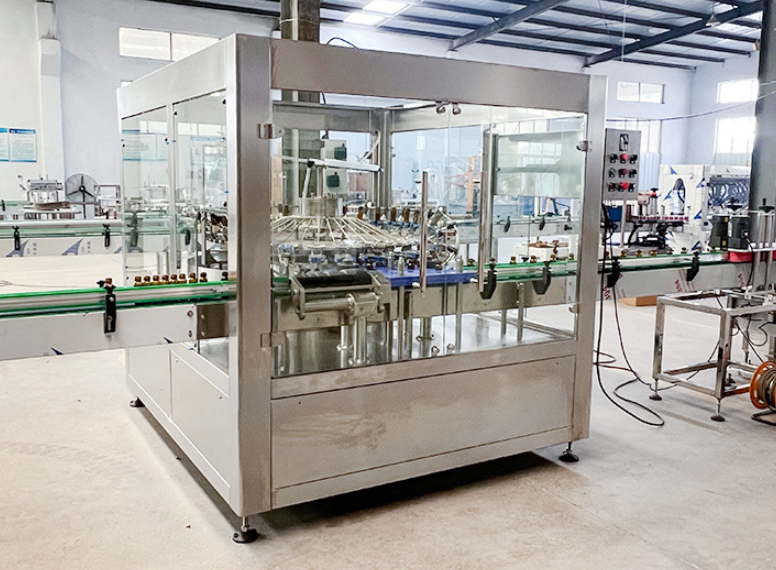
Like all vial washing machines, rotary machines follow a systematic cleaning process, but they do so using a rotating mechanism. The vials are placed on a circular turntable or carousel that continuously rotates and guides them through different cleaning stages, such as rinsing, purging, and drying.
2. Linear Vial Washing Machine
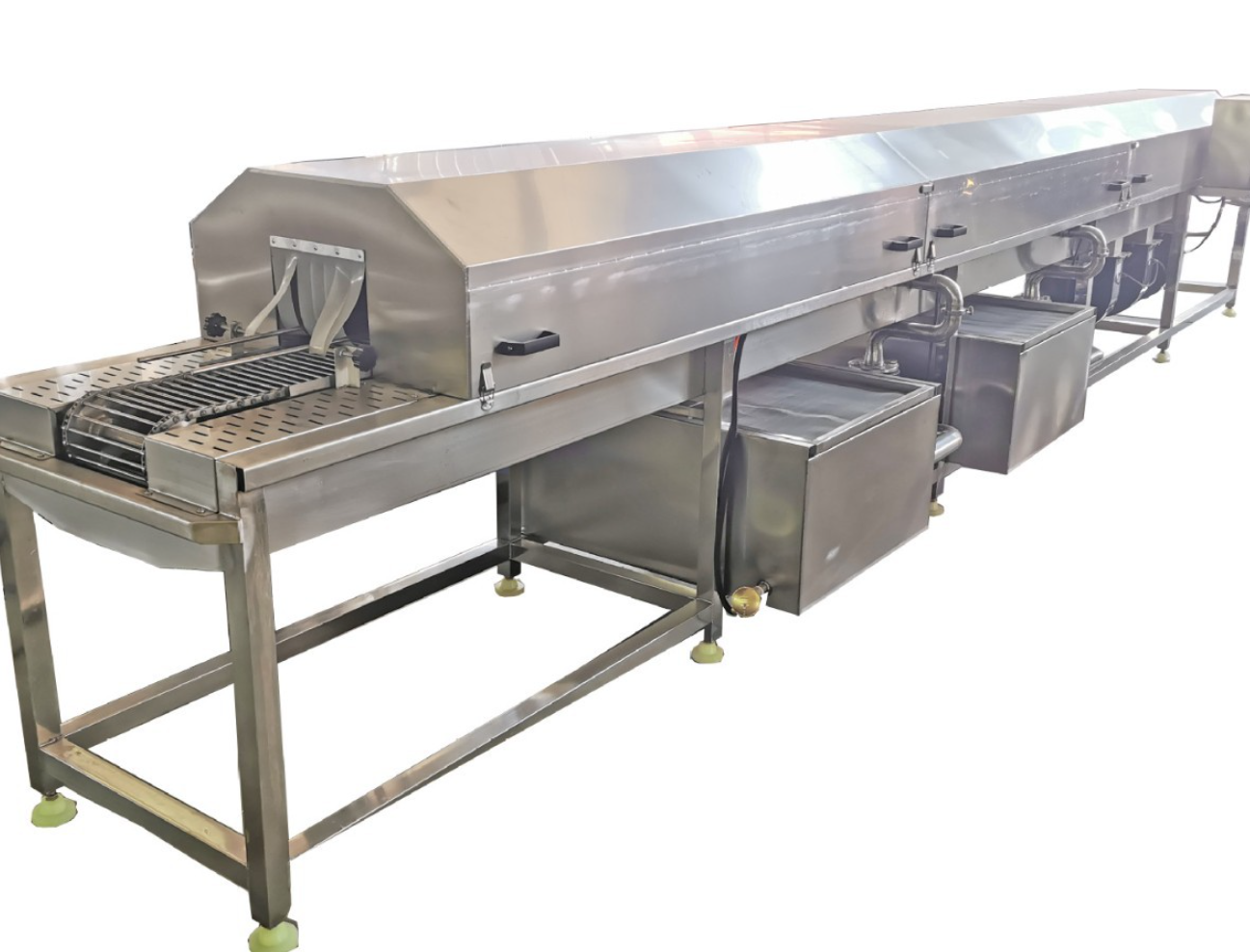
Linear vial washing machines perform the same essential task of cleaning vials, but instead of a rotating carousel, they use a straight, linear conveyor system.
The vials are placed on one end of the machine and travel in a straight line through various washing stations. Along the way, they undergo multiple steps such as water rinsing, air purging, and drying before reaching the discharge end.
3. Ultrasonic Vial Washing Machine
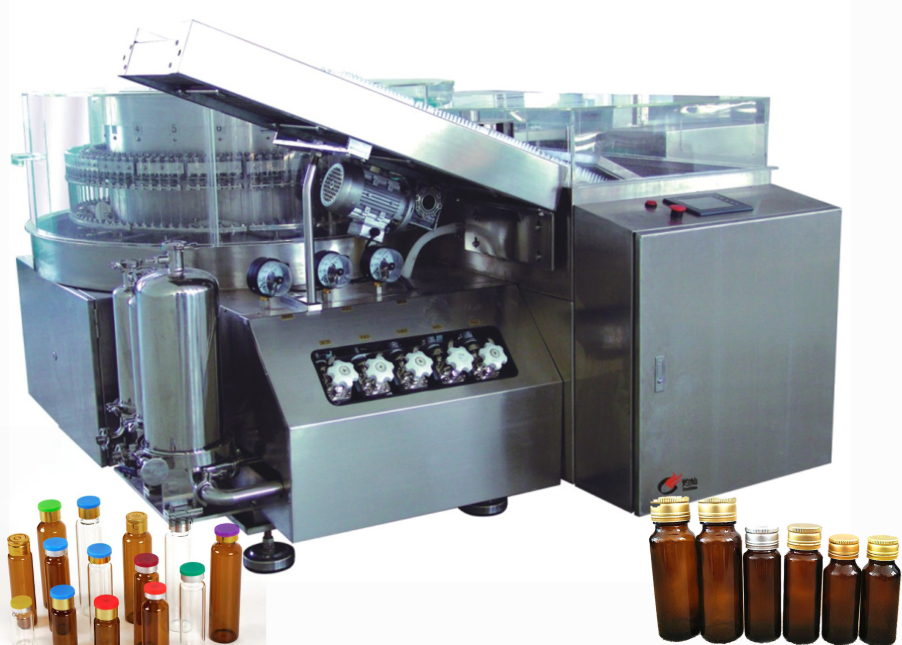
Ultrasonic vial washing machines work quite differently from rotary and linear models. Rather than relying solely on water jets or air purging, they use ultrasonic waves to clean the vials. Ultrasound means frequencies above 20,000 Hz that create microscopic cavitation bubbles in the cleaning liquid.
These bubbles form and collapse rapidly. The resulting intense localized pressure and temperature changes dislodge contaminants, residues, and particles from the inner surfaces of the vials.
Operating Modes in Vial Washing Machines
Now that you understand the types of vial washing machines, it’s time to know about the operating modes. All the types we’ve discussed above, rotary, linear, and ultrasonic, operate in the two modes: automatic and semi-automatic machines.
1. Fully Automatic Vial Washing Machine
A fully automatic vial washing machine, as the name suggests, operates with minimal human intervention. These machines are designed for large-scale pharmaceutical production where high speed, precision, and consistency are critical. Vials are automatically loaded, washed through multiple rinsing and air-purging cycles, and then discharged for sterilization or filling.
2. Semi-Automatic Vial Washing Machine
Semi-automatic vial washing machines are partly automated and partly dependent on manual operation. For example, processes such as rinsing, air purging, and drying are usually automated, while operators are responsible for loading and unloading the vials. Because of this manual involvement, they are not recommended for large-scale operations.
What to Consider Before Choosing a Vial Washer
When it comes to choosing pharmaceutical equipment such as a vial washer, there are many factors to consider. However, we recommend a simple 3-rule approach. In short, the machine is evaluated based on three key parameters that determine its suitability for production needs and long-term performance. Here’s how it works:
Parameter #1: Production Requirements & Machine Capacity
The first step is to meet with your production facility manager and discuss the requirements in detail. You need to understand the expected production volume, vial sizes, and handling requirements. Once these details are clear, consider the future growth factor and the additional cleaning capacity you may need down the line.
Next, select several vial washing machines that can meet both your current needs and anticipated future demands.
Parameter #2: Ease of Operation
As you now have a list of machines suited for your current and future needs, it’s time to evaluate which one is the easiest to operate. Focus on factors like the user interface, types of machines, simplicity of controls, and how easily operators can adjust settings or switch between different vial sizes.
This is also the stage to decide between a fully automatic and a semi-automatic machine. Although both have their advantages, a fully automatic machine is the better choice if you anticipate higher cleaning volumes for vial washing.
Parameter #3: Cleaning Performance & Maintenance
The third and most important parameter is whether the investment is truly worth it. This can be assessed by comparing the machines’ cleaning performance and the quality and consistency of the wash. Moreover, it’s also critical to consider the ongoing maintenance cost in contrast to the machine’s purchase price and long-term performance.
How Maintenance Impacts Costs |
Imagine you have two options: Machine A ($50,000) and Machine B ($55,000), both with the same performance. At first glance, Machine A seems like the better choice, but that ignores hidden maintenance costs. Over 5 years:
Although Machine B costs more upfront, its lower maintenance makes it the more profitable choice in the long run. |
The best is to choose a machine that balances high cleaning performance with low maintenance requirements.
FAQs
1. Can vial washers handle different vial sizes?
Yes, most machines include adjustable settings or change parts to accommodate multiple vial diameters and heights.
2. What kind of water is used for washing vials?
Typically, purified water (PW) and water for injection (WFI) are used, followed by filtered compressed air for drying.
3. What are common challenges in vial washing?
Issues like nozzle clogging, uneven washing, or vial breakage can occur if the machine is not properly maintained or calibrated.
More Pharma Machinery for End-to-End Production
A vial washing machine is one of the most crucial equipment for pharmaceutical businesses. Without it, vials can’t be properly cleaned or sterilized that puts product quality, patient safety, and regulatory compliance at serious risk.
This is why investing in high-quality vial washers and other essential pharmaceutical machines is non-negotiable (and we’ve been providing that for over 30 years). Our machines are CE and ISO certified and trusted by clients in 60+ countries.
That means you get reliable, compliant, and high-performance machines that keep your production line running safely, regardless of its scale.
Book a consultation today at FineTech to find the right solution for your production needs.