English
 Russian
 Turkish
 Spanish
 French
 German
 Japanese

If you are trying to decide between a commercial vs. an industrial powder blender, you are likely past the basics. What you now need to know is which type fits your production volume, compliance requirements, and budget.
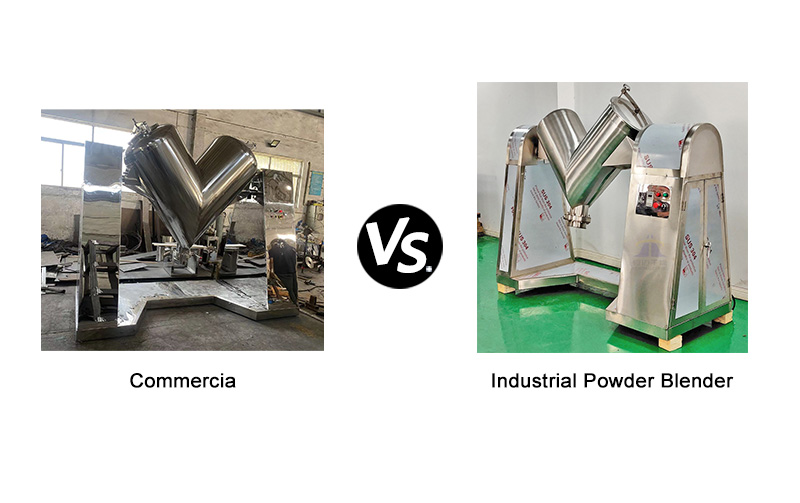
All this is exactly what our guide covers. Mixing and blending equipment accounts for the largest share of the powder processing market at 27.3%.
You see that the demand is there, and there are plenty of options as well. The only thing left is deciding which one you should buy: a commercial or an industrial powder blender. For that, read the article to the end, and you’ll have your answer.
Commercial vs. Industrial Powder Blender: Key Differences
Before diving into the details, here is a clear snapshot of how the two compare across every major factor:
| Factor | Commercial Powder Blender | Industrial Powder Blender |
| Capacity | 5 to 500 litres | 500 to 10,000+ litres |
| Throughput | Low to medium | High to ultra-high |
| Frame Material | Stainless steel (304) | Stainless steel (316) |
| Automation Level | Semi-automatic to automatic | Fully automatic |
| Control Systems | Basic PLC or manual | Advanced PLC, SCADA, HMI |
| GMP Compliance | Optional | Standard equipment |
| Regulatory Documentation | Basic | Full IQ/OQ/PQ validation |
| Best For | Food, cosmetics, and nutraceuticals | Pharma, chemicals, and advanced materials |
| Footprint | Compact | Large dedicated floor space |
Let’s discuss these differences in detail now:
1. Capacity and Throughput
Commercial powder blenders are designed for small to mid-range batch production. They handle volumes comfortably between 5 and 500 litres, making them practical for operations where batch sizes are moderate.
Commercial powder blenders operate at a fundamentally different scale, handling from 500 litres up to tens of thousands of litres per batch. They are built for high-volume production environments where downtime is costly.
2. Build Quality and Materials
316 stainless steel is the standard for industrial blenders. It is chosen for its superior corrosion resistance, durability under aggressive conditions, and suitability for pharmaceutical and chemical environments.
Commercial blenders, comparatively, are built from 304 stainless steel. This build quality meets food-grade and general manufacturing requirements and is more than sufficient for non-regulated applications.
3. Automation and Control Systems
Full automation is standard on industrial blenders. Advanced PLC systems, HMI touchscreens, and SCADA integration for real-time monitoring and data logging are built in rather than optional.
For regulated industries, this level of process control is a compliance requirement. Commercial blenders, however, range from manual to semi-automatic with basic PLC controls that require minimal technical training. It suits smaller teams and less complex production environments.
4. Compliance and Regulatory Standards
For pharmaceutical and chemical manufacturers, this is where the decision is often made for them. Industrial blenders are built to GMP standards and come with full validation documentation, including IQ, OQ, and PQ protocols to meet FDA, EMA, and other regulatory requirements.
On the other hand, using a commercial blender in a GMP-regulated environment is a compliance risk. For food, cosmetics, and nutraceutical applications, commercial blenders meet the required standards without the additional cost.
Cost Comparison: Commercial vs. Industrial Powder Blender
The price gap between the two blenders is rather significant, but reflects a difference in engineering and long-term performance. An industrial blender is not an overpriced commercial one. It is a different class of equipment built for a different class of demand.
Here’s the difference in pricing between the two blenders:
| Machine Type | Commercial | Industrial |
| Entry-Level | $3,000 – $15,000 | $30,000 – $80,000 |
| Mid-Range | $15,000 – $40,000 | $80,000 – $200,000 |
| High-End / Custom | $40,000 – $80,000 | $200,000 – $500,000+ |
| Installation and Commissioning | Usually included | Additional cost |
| Validation Documentation | Not typically required | $5,000 – $20,000+ additional |
Which One Does Your Industry Actually Need?
To get the right blender, you need to understand what your industry demands in terms of compliance, contamination control, and production consistency. The right answer for each of the following industries includes:
1. Pharmaceuticals
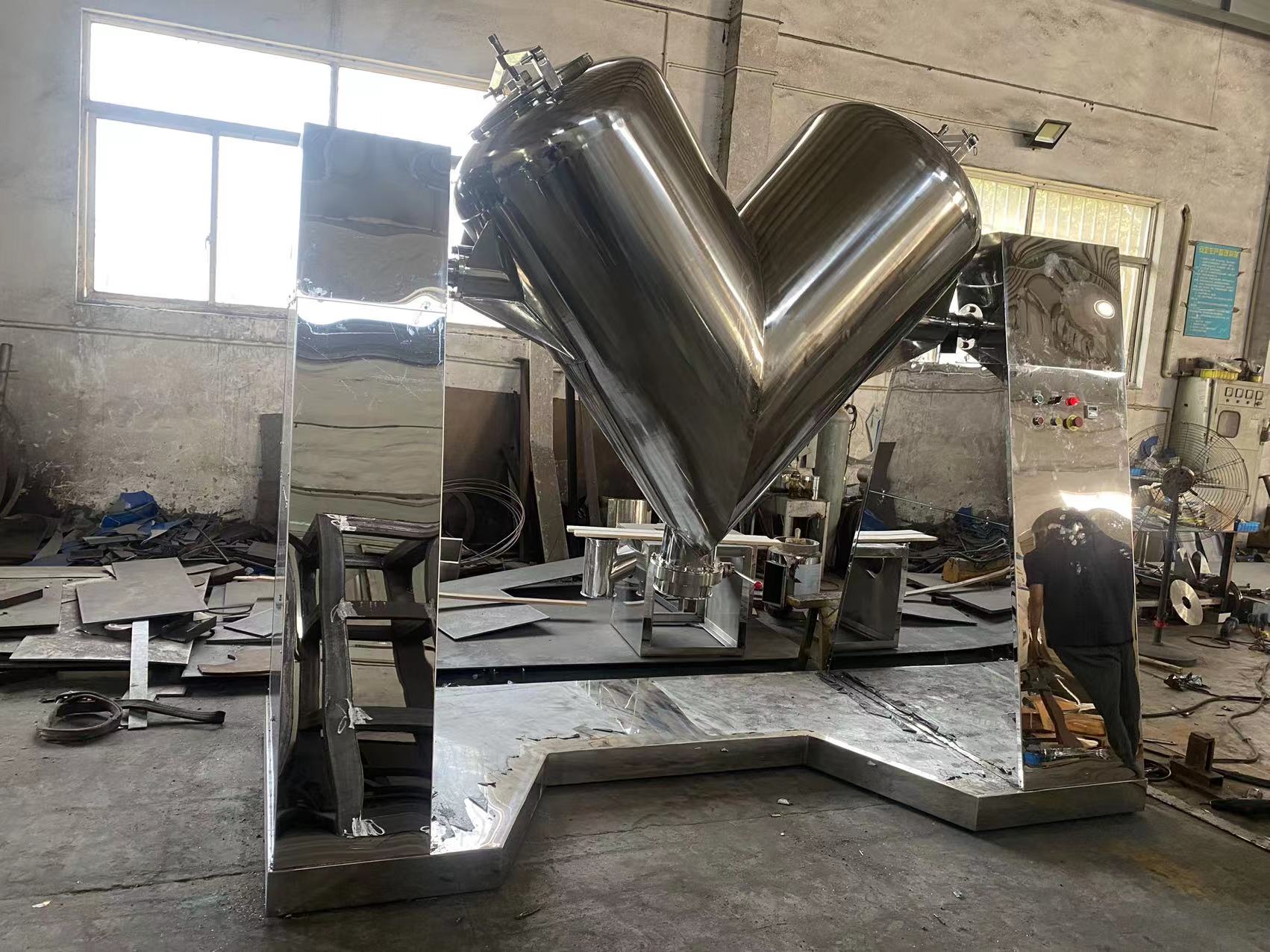
It is industrial, without exception. Pharmaceutical powder blending is subject to strict GMP requirements, batch traceability, and full process validation.
Every blend must be consistent, documented, and reproducible across every production run. The control systems, material standards, and validation documentation that come with an industrial blender are the baseline.
2. Food and Beverage
For most food and beverage applications, a commercial powder blender is the right fit. Production volumes are typically moderate, regulatory requirements are less stringent than pharma, and the flexibility of a commercial machine suits the frequent product changeovers.
High-volume food manufacturers running continuous production lines may find an industrial blender more appropriate, but for the majority, a commercial is sufficient.
3. Nutraceuticals and Supplements
This sector sits between food and pharmaceutical in terms of regulatory demands, and the right choice depends on your target market.
If your facility holds or is working toward GMP certification, an industrial blender is the safer long-term investment. For smaller operations not yet subject to those requirements, a commercial blender covers the need.
4. Chemicals and Agrochemicals
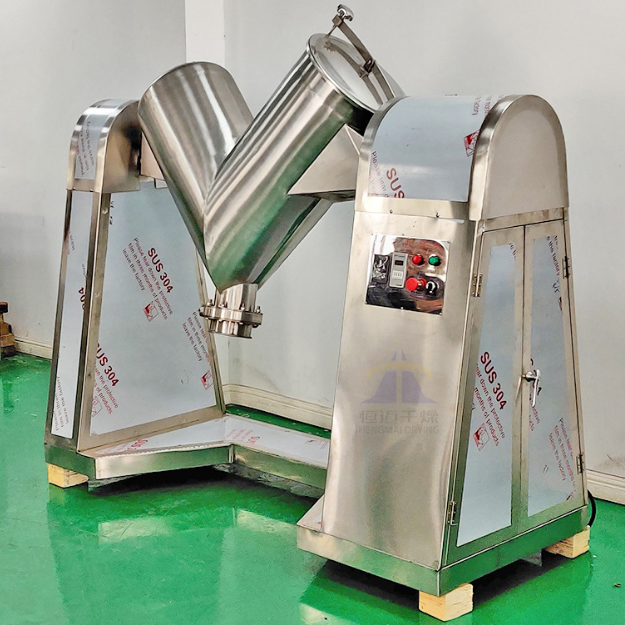
Industrial blenders are the standard here. Chemical and agrochemical powders are often abrasive, corrosive, or hazardous, demanding the 316 stainless steel construction and sealed systems.
The scale of production in this sector also typically exceeds what commercial blenders are designed to handle consistently over long production runs.
5. Cosmetics and Personal Care
A commercial powder blender works well for most cosmetics and personal care manufacturers. Batch sizes in this sector are usually small, and the regulatory requirements do not demand the same level of validation as pharmaceutical manufacturing.
If you produce medicated or regulated cosmetic products for the US or EU, it is worth checking whether GMP-compliant equipment is required before making a decision.
How to Choose Based on Your Production Scale
The type of industry you work in only gives you a starting point for which machine to choose. What actually finalizes the machine you should get is your production scale. An easy way to determine that is one of the following:
1. Small to Mid Batch Operations
If your batches run between 5 and 500 litres and production is not continuous, a commercial powder blender is almost always the right call.
It covers the output requirement and fits the available floor space. For businesses at this stage, overspending on an industrial machine rarely pays off.
2. High Volume Continuous Production
When your operation runs large batches back-to-back with minimal downtime between runs, a commercial blender will become a bottleneck fast.
Industrial powder blenders are built for exactly this environment. They handle larger volumes per batch, maintain consistent blend quality over long production runs, and are engineered to operate continuously.
3. Multi-Product Facilities
Facilities that run multiple formulations or switch between products regularly need a blender that is easy to clean, quick to reconfigure, and consistent across different materials. This is where the decision gets more nuanced.
Commercial blenders offer more flexibility and easier changeovers at a lower cost. However, industrial blenders, particularly those with CIP systems and automated controls, handle multi-product environments well but at a significantly higher investment.
FAQs
1. Is an industrial powder blender always more accurate than a commercial powder blender?
Not necessarily. Blend accuracy depends on factors such as mixer design, fill level, ingredient characteristics, mixing time, and process validation. A properly configured commercial blender can outperform a poorly operated industrial machine for smaller batches.
2. Which type of blender handles difficult powder formulations better?
Industrial powder blenders generally perform better with challenging formulations involving fine powders, cohesive materials, multiple ingredients, or strict uniformity requirements because they often offer more advanced mixing technologies and process controls.
3. How important is fill level when comparing commercial and industrial blenders?
Extremely important. Overfilling or underfilling any blender can negatively impact mixing performance. Many blending problems attributed to equipment selection are actually caused by operating outside the recommended fill range.
4. How much future growth should be considered when selecting a blender?
Many equipment experts recommend planning for at least three to five years of expected production growth. Buying equipment based solely on current demand often leads to costly upgrades sooner than expected.
Need an Industrial Powder Blender? Finetech Has It
At the end, choosing between a commercial or industrial powder blender comes down to your production scale, compliance requirements, and where your operation is headed. Getting this right saves you from many costly issues.
If your operation calls for an industrial powder blender, Finetech has you covered.
We have over 30 years of experience supplying GMP-compliant equipment to manufacturers across more than 100 countries. Our industrial powder mixing machines are built to standards your production environment demands.
Get in touch with our team and let us help you find the right option!