English
 Russian
 Turkish
 Spanish
 French
 German
 Japanese

Choosing between PVC, ALU, and ALU-ALU blister packaging is one of the most consequential decisions in pharmaceutical packaging. Get it wrong, and you are looking at stability failures, regulatory pushback, or packaging costs that make no sense.
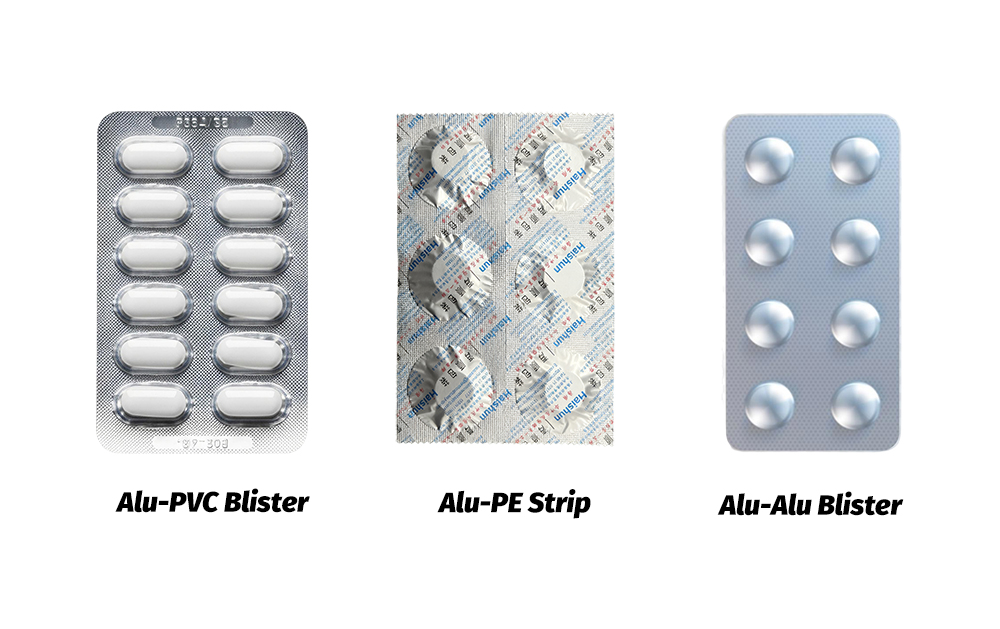
To help you make the decision right, we will break down all three technologies, how they differ, what they cost, and which machine each one requires.
What Is PVC, ALU, and ALU-ALU Blister Packaging?
Before comparing the three, here is what each technology actually is:
| Technology | Forming Film | Lidding | Forming Process | Transparency |
| PVC | PVC, PVDC, or PET film | Aluminium foil | Thermoforming | Transparent |
| ALU | Aluminum foil | Aluminium foil | Thermoforming | Opaque |
| ALU-ALU | OPA/ALU/PVC cold-form laminate | Aluminium foil | Cold forming | Opaque |
PVC blister packaging uses a clear plastic film as the base, thermoformed into cavities using heat and vacuum, then sealed with aluminum lidding foil. In contrast, ALU blister packaging uses aluminum foil for both the forming base and the lidding.
Lastly, the ALU-ALU blister packaging uses a multi-layer cold-form laminate consisting of OPA, aluminum, and PVC for the base, sealed with aluminum lidding. Unlike PVC and ALU, it is not thermoformed.
PVC vs ALU vs ALU-ALU: Side by Side Comparison
Let’s go over the three technologies side by side:
| Factor | PVC | ALU | ALU-ALU |
| Forming Process | Thermoforming | Thermoforming | Cold Forming |
| Moisture Barrier | Low to moderate | Moderate to high | Complete |
| Oxygen Barrier | Low | Moderate | Complete |
| Light Barrier | None | Full | Full |
| Transparency | Transparent | Opaque | Opaque |
| Material Cost | Low | Moderate | High |
| Machine Required | Standard thermoforming | Standard thermoforming | Dedicated cold-form machine |
| Pack Size | Compact | Compact | Larger due to draft angle |
| Best For | Standard oral solids | Moderate sensitivity products | Highly sensitive formulations |
| Shelf Life | Standard | Extended | Maximum |
| Regulatory Use | General pharma | General to regulated pharma | Regulated and high-value pharma |
*Thermoformed blisters, which cover both PVC and ALU formats, account for 72.45% of the blister packaging market. This shows the widespread adoption driven by lower material costs and high-speed production compatibility.
1. Moisture and Barrier Protection
PVC offers the lowest barrier performance of the three. It allows some moisture and oxygen transmission, which is acceptable for stable oral solid products but unsuitable for moisture-sensitive formulations.
ALU improves on this significantly, offering a stronger barrier due to the aluminum forming film, but still has minor gaps at the edges. Only the ALU-ALU delivers complete barrier protection against moisture, oxygen, and light with zero transmission.
2. Product Visibility
Among the three, PVC is the only transparent format. It allows patients and quality inspectors to see the product inside the cavity. ALU and ALU-ALU are fully opaque.
For products requiring light protection, opacity is a benefit. However, for products where visual inspection at the point of dispensing matters, PVC has a clear practical advantage.
3. Material and Production Cost
PVC is the most cost-effective format by a significant margin. PVC-based plastic films commanded a 50.72% revenue share of the pharmaceutical blister packaging market in 2025, primarily due to their compatibility with high-speed packaging lines.
Here, ALU sits in the mid-range, while ALU-ALU carries the highest material cost. Additionally, it requires larger pack dimensions due to the cold-forming process.
4. Forming Process
ALU and PVC are both thermoformed using heat and vacuum or pressure. Many standard blister packaging machines handle both formats with tooling and setting adjustments.
On the other hand, ALU-ALU requires a dedicated cold-form machine that shapes the laminate using mechanical pressure at room temperature without heat. This is a critical distinction for manufacturers planning to run multiple formats on a single line.
5. Secondary Packaging
Unlike ALU-ALU, PVC and ALU produce compact blister cards with sharper cavity angles. The former’s cold-forming requires a larger draft angle on each cavity, which increases the overall pack footprint.
For the same number of tablets, an ALU-ALU pack will be physically larger than a PVC equivalent. This increases carton size and secondary packaging costs.
Which Format is Right For Your Products?
The right format comes down to three things: how sensitive your product is to moisture, oxygen, and light; what market you are selling into; and what your budget allows. Here are a few points you can keep in mind:
PVC is sufficient for stable oral solid products that do not have strict moisture or light sensitivity requirements. If your product passes stability testing under standard conditions and is destined for markets without temperature challenges.
ALU is the better call when your product has moderate sensitivity to moisture or light but does not require the full barrier performance of cold-form packaging. It sits between PVC and ALU-ALU in both cost and protection.
ALU-ALU is non-negotiable when your product is highly sensitive to moisture, oxygen, or light, or when you are packaging for ICH Zone IVb markets. It is also the expected format for high-value, controlled, or hygroscopic medications.
Build Your Blister Packaging Line With Finetech
PVC / ALU / ALU-ALU blister packaging technology differences will help you make the right decision. And once you’ve made that decision, the next step is finding the right machine to produce it.
That is where Finetech comes in.
We supply blister packaging machines for all three formats. You’ll find standard thermoforming machines for PVC and ALU production, and dedicated cold-form machines for ALU-ALU packaging.
Whichever you need, you can trust Finetech with it!
📧 info@pharmamachinecn.com
📞 +86 15382537883