English
  Russian
  Turkish
  Spanish
  French
  German
  Japanese
Wondering why some pharmaceutical processes stay in control while others fail only after the batch is complete?
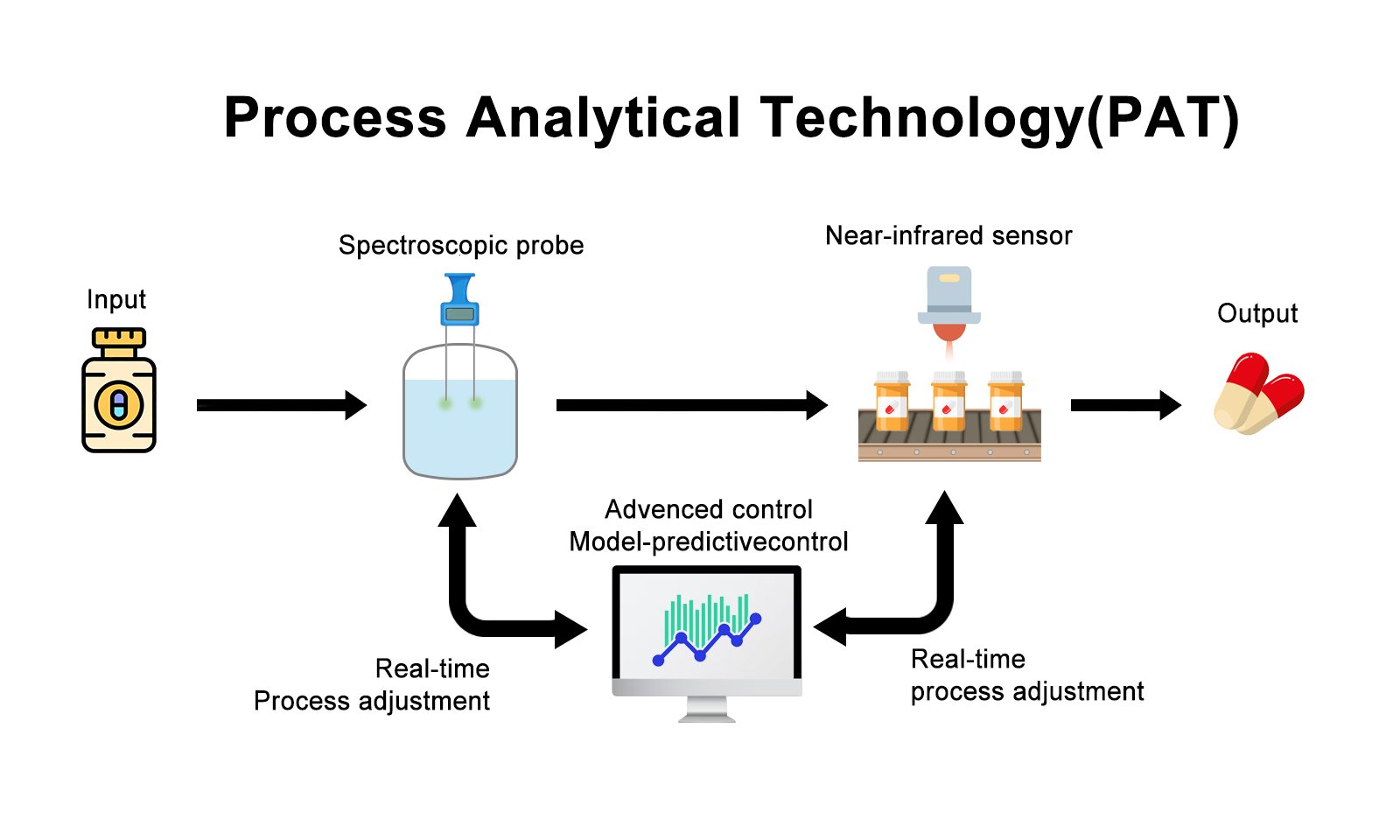
For many facilities, the answer lies in the level of visibility they have during manufacturing. Process Analytical Technology (PAT) in the pharmaceutical industry shifts quality control from end-product testing to real-time process understanding.
Rather than reacting to failures, manufacturers detect variability as it happens and correct it before it becomes a compliance or quality issue. To help you stay compliant, we’ll explain everything you need to know about PAT and how it supports compliant manufacturing.
What Is Process Analytical Technology in the Pharmaceutical Industry?
Process Analytical Technology (PAT) is a framework used in pharmaceutical manufacturing to analyze, monitor, and control production processes in real time. It moves quality assurance away from relying only on end-product testing and towards building quality.
Regulators formally recognized and encouraged this approach when the U.S. FDA issued its Process Analytical Technology guidance in 2004.
Since then, PAT has become closely tied to Quality by Design (QbD) and modern pharmaceutical manufacturing strategies.
Key Components of a PAT Framework
A PAT framework is not a single tool or instrument. It is a combination of technologies, systems, and practices. All these work together to give manufacturers real-time visibility and control over their processes.
These key components include:
1. Process Monitoring Tools
Process monitoring tools are the foundation of any PAT system. These tools measure critical process parameters and material attributes while the process is running. Depending on the application, monitoring can be in-line, on-line, and at-line.
Common monitoring targets include moisture content, blend uniformity, particle size, temperature, and coating thickness.
2. Analytical Measurement Technologies
PAT relies on analytical technologies that can generate fast, reliable data without interrupting production. These technologies are selected based on the process and the quality attribute being monitored.
The goal is not to replace traditional laboratory testing, but to complement it with real-time insight.
3. Data Management Systems
Data collected through PAT tools must be captured, stored, and managed in a controlled way. This is handled through data acquisition systems that integrate with manufacturing equipment and control platforms.
Moreover, data management systems must guarantee secure data storage, proper access controls, audit trails, and traceability.
4. Data Analysis and Process Models
Raw data alone is usually not enough. This is where PAT frameworks include data analysis tools and process models that help interpret the data. These models identify relationships between process parameters and product quality.
By using statistical and multivariate analysis, manufacturers gain process understanding, not just measurements.
How PAT Works in Pharmaceutical Manufacturing
If you’re looking to use Process Analytical Technology in the pharmaceutical industry, here’s how you can do it step by step:
Step 1: Define What You Must Control
First, identify the quality attributes that affect your final product. Do not try to monitor everything. Just focus on what actually matters. These include blend uniformity, moisture content, or coating thickness.
Once you define these attributes, link them to the critical process parameters that influence them. If you do not know what you are trying to control, PAT will not help you.
Step 2: Place PAT Sensors Where the Process Changes
Install PAT tools inside or directly above the process, not downstream in the laboratory. Also, use spectroscopy probes, near-infrared sensors, or other suitable tools at points where material properties change.
Your goal is to see the process as it happens, not after the batch is complete.
Step 3: Collect Data Continuously
Configure your system to collect data continuously during manufacturing. Avoid single-point or end-of-step measurements. Continuous data allows you to detect trends before they become deviations.
Make sure your data acquisition system is validated, secure, and traceable. If the data cannot support GMP decisions, it has no operational value.
Step 4: Analyze the Data in Real Time
Do not store data solely for later review. Set up real-time analysis so the system immediately tells you whether the process is within acceptable limits.
Use predefined ranges based on development and validation work. When the process approaches those limits, you need to know right away.
Step 5: Act on the Data Immediately
When the system detects variability, respond accordingly. Either:
- Adjust process parameters automatically, or
- Alert operators to take corrective action
Do not wait for quality review meetings. PAT is meant to prevent problems, not document them after the fact.
Step 6: Keep the Process within Control Until Output
As long as real-time data confirms the process is stable, allow the material to continue toward the final product output. This gives you much higher confidence in the quality of each prepared batch.
If your process is controlled throughout manufacturing, you reduce the need for rework, investigation, and unnecessary batch rejection.
Step 7: Validate Everything You Rely On
Validate your PAT tools, data models, and control strategies just as you would any other GMP system. If you rely on the data to make decisions, it must be proven accurate and reliable.
Train your operators to understand what the data means and how to respond. Just remember, the system will not work if the people do not trust it. They will simply ignore it.
Common PAT Tools and Technologies Used in Pharma
Below are the most commonly used PAT tools in pharmaceutical manufacturing. These tools are selected because they can generate fast, reliable data during the process, without stopping production.
- Near-Infrared (NIR) Spectroscopy: Helps check moisture levels and ingredient uniformity during blending, granulation, or drying without stopping the process.
- Raman Spectroscopy: Used to confirm chemical composition and API distribution when more detailed identification is needed.
- Focused Beam Reflectance Measurement (FBRM): Tracks changes in particle size and count during granulation or crystallization as the process runs.
- UV-Visible Spectroscopy: Measures concentration and consistency in liquid processes where light-based analysis is suitable.
- Acoustic and Vibration Sensors: Pick up changes in mixing behavior or equipment movement that may signal process instability.
- Temperature and Pressure Sensors: Show how thermal and pressure conditions shift during production, allowing timely adjustments to maintain control.
Benefits of Implementing PAT in Pharmaceutical Facilities
Here are the benefits of implementing PAT in your pharmaceutical facility.
1. Better Process Understanding
PAT helps you understand how your process actually behaves. By monitoring critical parameters in real time, teams can see how raw materials, equipment settings, and environmental conditions interact during manufacturing.
2. More Consistent Product Quality
When processes stay within defined limits during manufacturing, product quality becomes more consistent. PAT allows you to detect variability early and correct it before it affects the final product. This reduces batch failures and quality investigations.
3. Reduced Waste and Rework
By identifying problems while the process is still running, PAT helps prevent material loss. Batches are less likely to be rejected or reworked because issues are corrected early. It directly reduces waste, lowers production costs, and improves overall process yield.
4. Stronger Regulatory Compliance
Regulators support PAT because it demonstrates active process control and scientific understanding. Facilities that use PAT can better justify process limits, changes, and control strategies during inspections.
FAQs
1. How does PAT differ from traditional Quality Control (QC)?
Traditional QC operates on an “end-point” philosophy, where a batch is tested only after completion, risking the loss of the entire lot if it fails. PAT shifts this paradigm to real-time monitoring, allowing for immediate process adjustments that prevent deviations before they result in waste.
2. How is Near-Infrared (NIR) Spectroscopy used as a PAT tool?
NIR is a non-destructive analytical technique used for real-time monitoring of blend uniformity, moisture content, and chemical identification. By shining light through a sample and measuring the absorbance, NIR provides chemical signatures without requiring manual sampling or stopping the production line.
3. What is the primary goal of PAT in pharma?
The main goal is to maintain final product quality by measuring critical quality attributes (CQAs) in real time.Instead of waiting days for lab results after a batch is finished, PAT allows manufacturers to understand and control the process while it is still happening.
4. What are the primary regulatory benefits of implementing PAT?
Regulatory bodies like the FDA and EMA encourage PAT because it demonstrates a deep scientific understanding of the manufacturing process. Companies using PAT often benefit from more flexible regulatory oversight and a reduced risk of product recalls or “Warning Letters.”
Get Your Facility Ready for PAT Framework
Process Analytical Technology in the pharmaceutical industry delivers value only when applied to well-designed manufacturing processes. However, without a reliable production setup, even the best PAT strategy will struggle to deliver meaningful results.
Before implementation, you need the right setup. This includes tablet presses, capsule-filling machines, capsule/tablet-counting machines, packaging lines, and more. The best company for this is Finetech.
With over 30 years of experience and GMP-focused design, Finetech helps facilities establish the strong operational foundation needed for modern manufacturing.
Contact us if you’re ready to take the next steps!
References:
- Process analytical technology-Wiki.
- Process Analytical Technology (PAT).
- Process Analytical Technology Tools for Monitoring.
- Process Analytical Technology – an overview.
Copyright Notice:
You may not reproduce, modify, publish, display, transmit, or in any way exploit any content on this website, or use such content to construct any kind of database without prior express written approval by Finetech Group. For permission to use the content, please contact: info@pharmamachinecn.com
Disclaimer:
The information contained in this article is for general information purposes only. The Company does not guarantee the accuracy, relevance timeliness or completeness of any information, and the Company assumes no responsibility for errors or omission in the content of this article.