English
  Russian
  Turkish
  Spanish
  French
  German
  Japanese
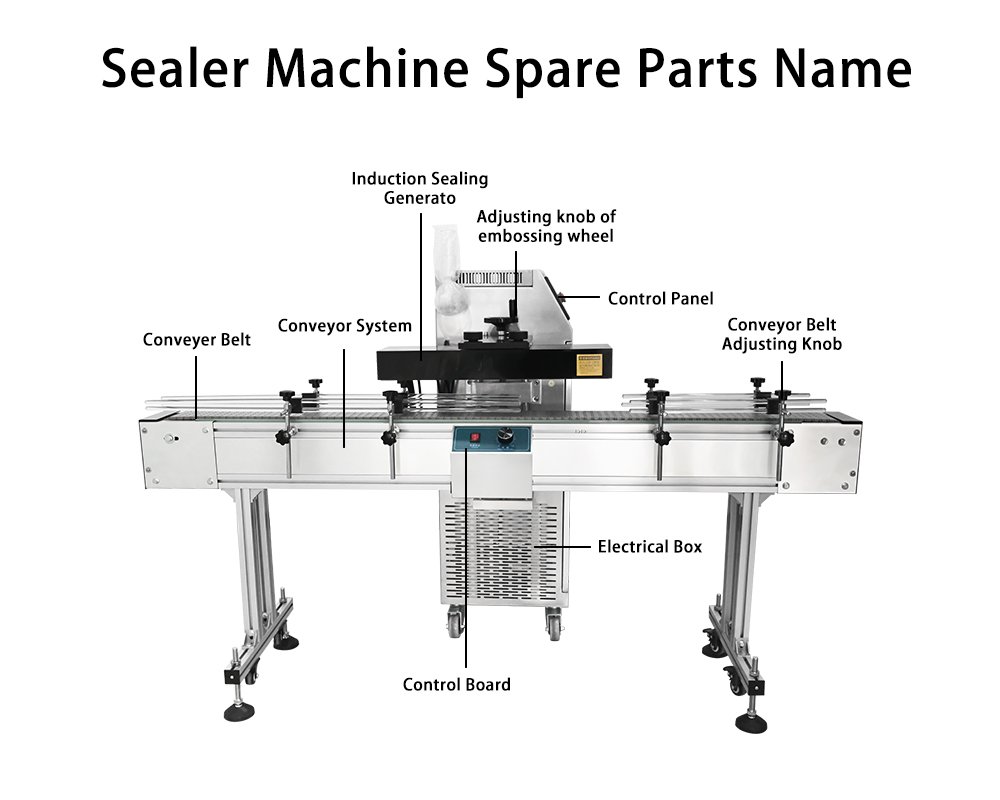
Run a sealer machine long enough and stuff wears out. Knowing the sealer machine spare parts name for each component means you order the right thing the first time instead of guessing and wasting a day.
1. Heating Elements
The heating element is what makes the seal happen. It gets hot, melts the film layers together, and that’s your seal. These burn out on every sealer eventually.
Impulse sealers use a thin nichrome wire or ribbon stretched across the bar. It only heats up when you press the arm down. Constant heat sealers keep the element hot the whole time the machine is running, which wears them out faster.
A failed element gives you no seal, or a seal with gaps where the wire snapped. Sometimes it’s obvious. Other times the element looks fine but has lost enough resistance that it can’t reach temperature anymore. You just get weak seals that pull apart.
Most manufacturers sell element kits. Element, Teflon covers, and tape all in one box. Swap the whole set at once and you’re back running in about ten minutes.
Watch the element width when you order. A 2mm element gives you a different seal width than a 5mm. Wrong width and the seal works but won’t meet your packaging spec. Easy mistake to avoid if you check before you buy.
2. PTFE Covers and Teflon Tape
Between the heating element and the material you’re sealing, there’s a PTFE fabric cover and some Teflon tape. They stop melted plastic from sticking to the bar.
Both wear through. You’ll see scorch marks first, then thin spots, then holes. Once a cover has a hole in it, film sticks directly to the element and you get ugly, uneven seals. Worst case, the element gets damaged.
Covers and tape are cheap. Couple bucks. Takes a few minutes to change them. There’s really no reason to let them get shredded before swapping in fresh ones.
How fast they wear depends on temp and material. Running thick laminated pouches at high heat? You’ll go through covers fast. Thin poly bags at lower settings? They’ll last weeks.
3. Silicone Rubber Pads
The pad sits across from the element on the opposite jaw. It cushions the seal and spreads pressure across the full width.
These flatten out. They get grooves. The rubber hardens from heat exposure. And when any of that happens, pressure across the seal gets uneven. Parts of the seal press hard while other parts barely touch. Result? Leaky seals, even though your element and temp are fine.
Match the width and hardness to what the machine came with. Too soft and pressure drops. Too hard and the pad won’t conform around thicker materials or multi-layer films. Some people try flipping a worn pad to get more life out of it. Works sometimes, but if the rubber has hardened from heat, both sides are equally bad.
4. Sealing Bars and Jaws
Sealing bars are the metal surfaces that clamp together to form the seal. Some are smooth. Some have serrations that give the seal extra grip and texture.
They wear down. Serrations go flat. Burnt-on plastic that didn’t get cleaned off scores the surface. Once the bar is pitted or grooved, your seals come out inconsistent no matter what else you adjust.
Band sealers chew through bars faster because product runs through nonstop. Budget accordingly if you’re doing any kind of volume. Some bars can be flipped over so you get double the life before replacing. Worth checking.
Clean them regularly. A brass brush after each shift keeps residue from building up and damaging the surface. Takes two minutes and saves you from buying new bars ahead of schedule.
5. Temperature Controllers and Thermostats
Simpler machines use a dial thermostat. Turn it and hope the number on the knob matches reality. Newer machines use a digital PID controller that’s more precise.
Dial thermostats drift. What says 150 on the knob could be 170 at the jaw. And you won’t notice until seals start looking wrong or product starts scorching. The tricky part is everything on the machine looks normal while this is happening.
Digital controllers fail differently. Screen goes blank, readings bounce around, or it stops responding.
Before you replace any controller, check the thermocouple sensor first. Bad sensor feeding garbage data to a good controller looks exactly like a bad controller. Grab a handheld thermometer, check the jaw temp yourself, and compare it to the screen. Takes five minutes. Saves a lot of money.
6. Timers and Electronic Controls
Impulse sealers need a timer to control how long the element stays on each cycle. Too short and the seal is weak. Too long and you melt right through the bag.
Most use solid-state timers with an indicator light. Light comes on during the cycle. Doesn’t come on? Could be the timer. Could also be the fuse or the outlet. Check both of those before you order a new timer.
Transformers step voltage down to the element on some models. When one goes, the element barely heats or doesn’t heat at all. Machines with digital control boards are a different deal. If one component on the board dies, you sometimes have to replace the whole thing. Annoying, but boards last a long time so it rarely comes up.
7. Microswitches
Small part. Big headaches when it fails. The machine won’t respond when you close the arm, and everyone assumes it’s a major electrical problem. Usually it’s a $3 microswitch.
The switch triggers when the arm closes. Worn out or slightly out of position and it won’t start the cycle. Hand sealers have a metal tab that pushes the switch plunger. Bend that tab a tiny bit and sometimes that’s all it takes. Foot sealers have a bolt instead. Vibration backs the bolt off and the switch stops getting pushed far enough.
If you’ve adjusted the tab or bolt and the switch still won’t trigger, the switch itself is done. They have a rated number of cycles and once they hit it, they just stop clicking over. Stock spare switches. The time people spend troubleshooting a “dead” sealer that just needs a new switch is the real cost.
8. Fuses
Fuses are probably the most overlooked sealer machine spare parts. Machine goes down, someone panics, and meanwhile it’s a blown fuse that takes 30 seconds to swap.
Most sealers use one or two glass tube fuses. Power surge or a short in the element circuit pops them. Nothing complicated.
Just make sure you’ve got the right amp rating. Throwing in whatever fuse happens to be in the junk drawer because it fits physically is a bad move. Higher rating won’t protect the circuit and the next thing that fails will be something expensive.
Some people don’t even know where the fuse is on their machine. Find it before you need it. Usually behind a small panel or inside the housing near the power cord.
9. Springs and Tension Mechanisms
A lot of sealers use springs in the jaw mechanism. The spring is what pulls the arm back open after you release it, or what holds tension between the upper and lower bars.
Springs weaken. They lose their pull. When that happens on a hand sealer, the arm doesn’t snap back like it should, or worse, it doesn’t hold enough clamping pressure during the seal cycle. You end up pressing harder to compensate, which wears out other parts faster.
Band sealers have springs and tension adjusters that keep the belts pulled tight against the sealing zone. A weak spring lets the belt sag and bags slip through without good contact.
That shows up as seals that are fine on one side and weak on the other, or bags that come through at an angle.
10. Rollers and Guide Wheels
Band sealers and continuous sealers have rollers that move bags through the machine. Some guide the belt. Others press the material against the sealing surface. A few just keep things tracking straight.
Bearings inside rollers wear out and the roller stops spinning freely. Instead of rolling, it drags. That scuffs the bag material and can cause jams. Rubber-coated rollers lose their coating or develop flat spots from sitting in one position too long when the machine is off.
Spin each roller by hand during downtime. Should turn smooth with no grinding or catching. If it doesn’t, swap it. Cheap fix now versus a jam and wasted product later.
Guide wheels keep the bag centered as it moves through. If one gets sticky or warped, bags drift to one side and the seal lands off-center.
Not a hard fix. Usually just popping the old one off and dropping in a new one. But figuring out that the guide wheel is the problem in the first place takes longer than the actual repair.
11. Drive Belts and Transport Bands
Band sealers and continuous sealers use belts to pull bags through the sealing zone at a steady speed. There are two kinds: the sealing bands (PTFE-coated loops that contact the bag) and the drive belts (rubber belts connected to the motor).
Sealing bands stretch, crack, lose their non-stick coating, and pick up melted plastic. Replace them on a regular schedule. Waiting until one breaks mid-run means downtime plus a mess to clean up.
Drive belts wear differently. They slip when they’re loose or glazed. A slipping drive belt means bag speed varies, which means some seals get too much heat and others don’t get enough.
Check belt tension before blaming the belt. A loose tensioner wastes a perfectly good belt. And pulleys wear too, so look at those while you’re in there.
Band speed affects seal quality directly. If the belt is dragging even slightly, bags spend longer in the heat zone and you’ll see scorching or over-sealed edges. Speed that’s too fast gives you undercooked seals that peel apart.
12. Cutting Blades
Not every sealer has a cutter built in, but plenty do. The blade sits between or right next to the jaws and separates bags after sealing.
They dull. You get partial cuts, ragged edges, and bags that stick together and jam the machine. Band sealer cutters sit right after the cooling section. If bags aren’t separating clean at that point, look at the blade first.
Get the right blade for your model. Don’t try to make something close enough work. It won’t.
A dull blade also stresses the mechanism that drives it. You might not notice right away, but the extra force needed to push a dull blade through film wears out the actuator or linkage faster.
What to Keep on Hand
Most manufacturers sell spare parts kits. Elements, PTFE covers, tape. That handles the majority of what goes wrong day to day.
On top of that, keep a couple fuses, a silicone pad, and a timer if your machine uses one. Microswitches too since they’re tiny and cheap.
Stick the machine’s model number on the outside of the parts box with a marker so nobody has to go looking for it when something fails at a bad time.