English
  Russian
  Turkish
  Spanish
  French
  German
  Japanese
Standard operating procedure of Disaster Management in the Pharmaceutical Industry.
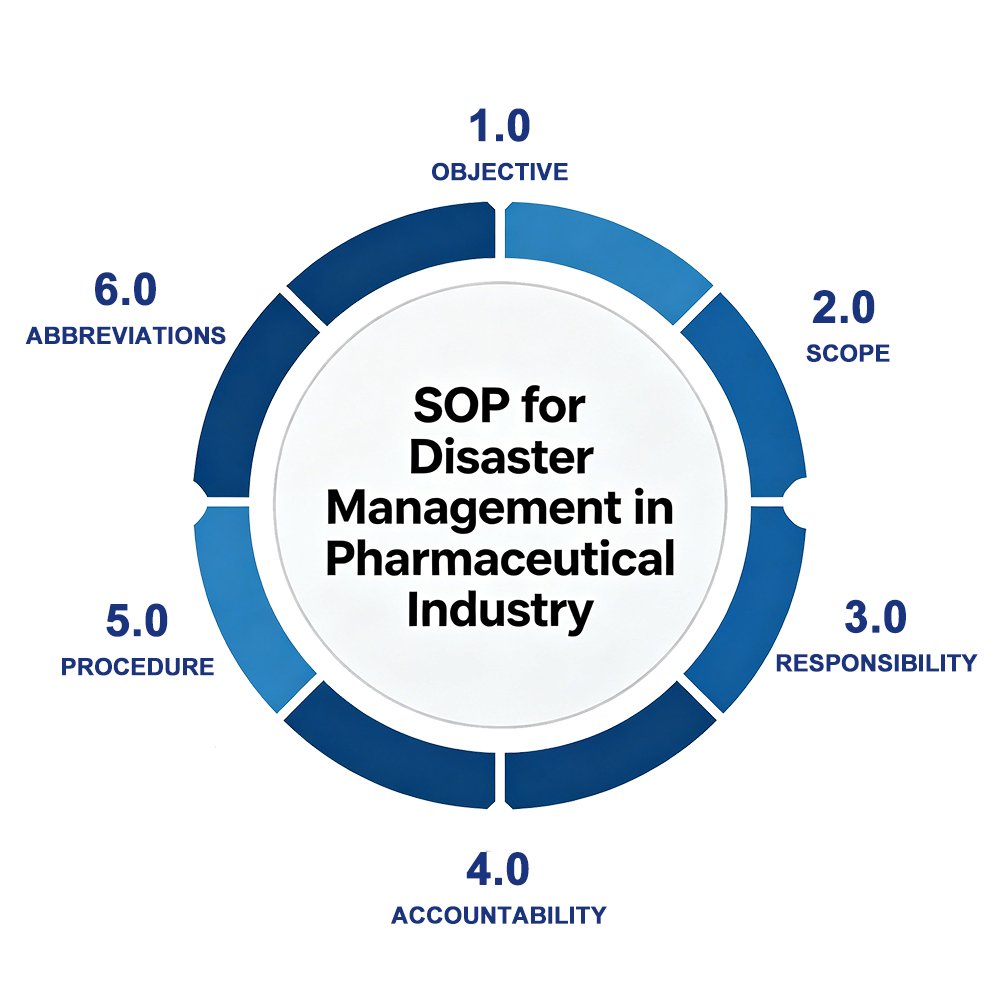
1.0 OBJECTIVE:
To set out the procedure for getting ready, responding, and recovering after any disaster event at the pharmaceutical plant. The procedure keeps staff safe, protects product quality, and gets normal work running again as fast as possible.
2.0 SCOPE:
This Procedure covers every person, product, raw material, piece of equipment, and building at the manufacturing site. It also covers outside events that knock site operations off track even when the damage itself is beyond the fence.
3.0 RESPONSIBILITY:
Emergency Response Team, Department Heads & Site Security.
4.0 ACCOUNTABILITY:
Plant Head & Emergency Response Coordinator.
5.0 PROCEDURE:
5.1 The plant keeps a Disaster Management Plan that covers every hazard known at the site. The Emergency Response Team goes through the plan once a year and updates anything that no longer matches how the site actually runs.
5.2 Every employee sits through a basic disaster response session during induction. A shorter refresher is run once a year for all staff, and the Emergency Response Team gets extra hands on drills on top of that. Whoever attends signs the Training Attendance Sheet at the end of the session.
5.3 The emergency contact numbers for the local fire brigade, police, hospital, and utility providers go up on the wall next to every exit. Security also keeps a printed copy at the main gate so these numbers are at hand when the phone system is down.
5.4 Whoever notices a disaster event first must raise the alarm without delay. Use the nearest fire alarm point if one is within reach. If not, call the security desk on the emergency extension.
5.5 Disaster Categories:
5.5.1 Events in the Disaster Management Plan fall into three broad buckets. Each bucket has its own response protocol with steps built around that specific hazard.
5.5.2 The three categories are listed below:
5.5.2.1 Natural disasters: earthquakes, floods, cyclones, heavy rain, and extreme heat events that hit the plant site or the surrounding area.
5.5.2.2 Technological disasters: fires, explosions, chemical spills, utility failures, boiler bursts, solvent leaks, and major breakdowns of production equipment.
5.5.2.3 Biological and security disasters: a pandemic outbreak, food poisoning traced to the canteen, an intruder attack, a bomb threat, or deliberate sabotage of the water supply.
5.5.3 Every event also gets an impact level on a scale of one to three. A Level 1 event is local and stays inside one area. Level 2 reaches more than one area but does not pull in the full site. A Level 3 event hits the whole site or brings in outside emergency services.
5.5.4 What the impact level means in practice is the level of response that follows. Level 3 is the trigger for full site evacuation. It is also the trigger for firing up the Business Continuity Plan.
5.6 Emergency Response Team:
5.6.1 The Emergency Response Team pulls trained staff from every department. When a disaster hits, this team leads the response on the ground.
5.6.2 Team structure looks like this:
5.6.2.1 An Emergency Response Coordinator who runs the team as overall leader.
5.6.2.2 A Fire Marshal assigned to each production block, to the warehouse, and to every office building.
5.6.2.3 First Aid Officers posted across the departments, with quick access to the first aid room.
5.6.2.4 Evacuation Wardens whose job during an event is to guide staff to the assembly points.
5.6.2.5 A Spill Response Team that handles chemical and biological spill events.
5.6.2.6 A Communications Officer. This role owns every internal and external message sent out during an event.
5.6.3 When an event is live, every team member puts on a brightly colored armband or vest. The color lets other staff and outside responders pick out the team members at a glance.
5.6.4 The team gets together once a quarter to review readiness. The agenda covers drill results, equipment status, and any lessons pulled from real events since the last quarterly meeting.
5.7 Raising the Alarm:
5.7.1 Anyone who spots a disaster event must raise the alarm on the spot. A delay of even a few minutes can push a Level 1 event all the way up to Level 3.
5.7.2 Fire, smoke, or an explosion means hit the nearest fire alarm point. The alarm signal carries to every area of the plant within 10 seconds.
5.7.3 For events where a fire alarm is not the right call, such as a chemical spill or a gas leak, dial the security desk on the emergency extension. Security will then sound the alarm that matches the event type.
5.7.4 Three distinct alarm tones are used at the plant:
5.7.4.1 Continuous tone: fire, explosion, or any other Level 3 event that calls for immediate full site evacuation.
5.7.4.2 Intermittent tone: a chemical release. Staff shelter in place inside a sealed area and wait for the all clear.
5.7.4.3 Short repeating tone: all clear. Normal operations can resume.
5.7.5 Never silence any alarm without approval from the Emergency Response Coordinator. A silenced alarm can make other staff think the event is over when it is still very much active.
5.8 Evacuation Procedure:
5.8.1 When the continuous evacuation tone sounds, everyone in the building stops what they are doing and heads for the nearest emergency exit. Do not waste time going back for personal items, product, or paperwork.
5.8.2 Evacuation Wardens shepherd staff along the pre marked evacuation routes. The routes are drawn on the evacuation map posted in every room.
5.8.3 Three assembly points serve the plant:
5.8.3.1 Assembly Point A: the open ground in front of the main gate. Staff from the production block and the quality control lab gather here.
5.8.3.2 Assembly Point B: the car park behind the canteen. This point serves warehouse and utilities staff.
5.8.3.3 Assembly Point C: the grass area near the back gate. Administration staff and visitors head here.
5.8.4 Each Evacuation Warden brings along a copy of the department attendance sheet. Attendance is taken at the assembly point within five minutes of arrival.
5.8.5 A missing person must be reported to the Emergency Response Coordinator right away. From there, the Coordinator calls on whether a search and rescue attempt is safe to make.
5.8.6 Nobody walks back into the building until the Coordinator gives the all clear. That all clear can only come once emergency services confirm the site is safe.
5.9 Product and Material Protection:
5.9.1 Safety of people comes first during an active disaster. Material safety sits one rank below that. Never put yourself in harm’s way to save product or equipment.
5.9.2 For Level 1 and Level 2 events where no full evacuation is called, the area operator runs through the quick steps below before stepping out of the immediate zone. Skip these steps during a Level 3 full evacuation and get out at once per 5.8.1.
5.9.2.1 Close any open product containers and hoppers. This keeps smoke, water, or dust from getting in.
5.9.2.2 Switch off equipment that could overheat or spill if left unattended.
5.9.2.3 Pull fire doors and compartment doors shut to slow the spread of smoke and water. Remember to always wear PPE while doing so.
5.9.3 Cold chain products demand special care when the power is out. Shift them across to the backup cold storage room, which runs off the emergency generator.
5.9.4 Once the event is over, QA walks through and inspects every product that was on site during the disaster. Anything exposed to smoke, water, heat, or chemical fumes gets quarantined pending further review.
5.9.5 A material that lived through a disaster event cannot be released without a full root cause and impact analysis behind it. The analysis goes on file as part of the Disaster Impact Report.
5.10 Specific Hazard Responses:
5.10.1 Fire or Explosion:
5.10.1.1 Only reach for the nearest fire extinguisher when the fire is small and the exit behind you is clear. Anything bigger than a waste bin should not be tackled.
5.10.1.2 The extinguisher type has to match the fire class. Water for paper and wood. Foam for solvents. Carbon dioxide for electrical fires. Dry powder for metal fires.
5.10.1.3 When leaving a room where fire has broken out, pull the door closed behind you. A shut door can slow fire spread by 10 to 15 minutes.
5.10.2 Chemical or Solvent Spill:
5.10.2.1 Clear the area of anyone not on the Spill Response Team. Block off access with safety cones or hazard tape.
5.10.2.2 Work out which chemical has been spilled. Check the drum label or look it up in the product batch record. The Safety Data Sheet tells you the right spill control method to use.
5.10.2.3 Grab the correct spill kit and put on full PPE (chemical resistant gloves, splash goggles, and a respirator). Absorbent granules handle solvents. Neutralizer suits acids and alkalis. Bio absorbent is for biological fluids.
5.10.2.4 Once the spill is contained, run the exhaust system to ventilate the area. Do not step back inside until air quality readings return to safe limits.
5.10.3 Flood or Water Ingress:
5.10.3.1 Cut the electrical supply to any area where water has made it to floor level. Do this at the main panel before the water spreads further.
5.10.3.2 Move product off the lowest shelves to higher levels. Moisture sensitive materials come first.
5.10.3.3 Stack sandbags or drop water barriers at the main entry doors to slow further water ingress.
5.10.4 Power Failure:
5.10.4.1 When mains power drops, the diesel generator kicks in automatically within 30 seconds. Check that critical loads such as cold chain, HVAC, and emergency lights come back up.
5.10.4.2 Generator fails to start? Notify the utilities team right away. Cold chain products have to be shifted onto a dry ice backup within 30 minutes.
5.10.4.3 Stop any active process that depends on uninterrupted power. A half filled batch might end up needing rework or flat out rejection after an unplanned pause.
5.11 Communication During the Event:
5.11.1 Every message during a disaster event goes through the Communications Officer. That role is the single voice of the plant while the event is active.
5.11.2 Internal messages ride on the public address system, department radios, and SMS alerts. Each of these systems gets a test run once a month to make sure it works when needed.
5.11.3 When it comes to regulators, customers, or the press, external communication sticks to the approved statement templates. No staff member puts out an unapproved public statement while an event is live.
5.11.4 Any event that affects product quality or patient safety has to be reported to the regulatory authority within 24 hours. The Disaster Notification Letter template is used for this notification.
5.11.5 Once the event is closed, all staff are briefed in person. The briefing walks through what happened, what was done about it, and what to expect over the coming days.
5.12 Business Continuity and Recovery:
5.12.1 A Level 3 event kicks off the site Business Continuity Plan. The plan spells out how critical operations keep running while the main site gets back on its feet.
5.12.2 Damage assessment and staff welfare are the focus of the first 24 hours. The Emergency Response Coordinator leads a site walkthrough together with Engineering, QA, and Security.
5.12.3 A Damage Assessment Report has to be ready within 48 hours. It captures every area affected, the extent of damage in each, and a recovery time estimate for each area.
5.12.4 Production cannot restart until QA issues a formal clearance for each area. The clearance confirms that the area, the equipment, and any stored material are safe to put back in use.
5.12.5 When recovery time stretches past seven days, the backup arrangements for critical product supply kick in. Contract manufacturing sites are the usual backup and are listed in the Business Continuity Plan.
5.12.6 Keep the Disaster Impact Report updated as recovery moves forward. The report is not closed until the very last corrective action has been verified.
5.13 Drills and Training:
5.13.1 Fire drills are run once every six months for every shift at the plant. A drill tests the alarm system and the evacuation procedure together.
5.13.2 Once a year, a full site disaster drill takes place. For that drill, the team picks a scenario from the Disaster Management Plan and runs through a simulated event.
5.13.3 The Emergency Response Team observes every drill. Any gap that turns up goes into the Drill Observation Report, with a named owner and a target date for the fix.
5.13.4 Where a staff member fails to follow the evacuation route during a drill, that person gets one to one retraining within seven days.
5.13.5 Drill participation counts towards the annual performance review. It is not optional for any employee.
5.14 RECORDS:
5.14.1 Disaster Management Plan.
5.14.2 Business Continuity Plan.
5.14.3 Disaster Impact Report.
5.14.4 Disaster Notification Letter.
5.14.5 Damage Assessment Report.
5.14.6 Drill Observation Report.
5.14.7 Training Attendance Sheet.
6.0 ABBREVIATIONS:
6.1 SOP: Standard Operating Procedure.
6.2 QA: Quality Assurance.
6.3 HVAC: Heating, Ventilation, and Air Conditioning.
6.4 SMS: Short Message Service.
6.5 PPE: Personal Protective Equipment.