English
  Russian
  Turkish
  Spanish
  French
  German
  Japanese
Modern pharmaceutical industries are redefining the manual labor involved in traditional packaging. In this sector, packaging is less about visual appeal and more about safety and compliance with regulatory standards. Therefore, it’s essential to opt for cartoning machines and automate your pharma packaging process to enhance efficiency and minimize human error.
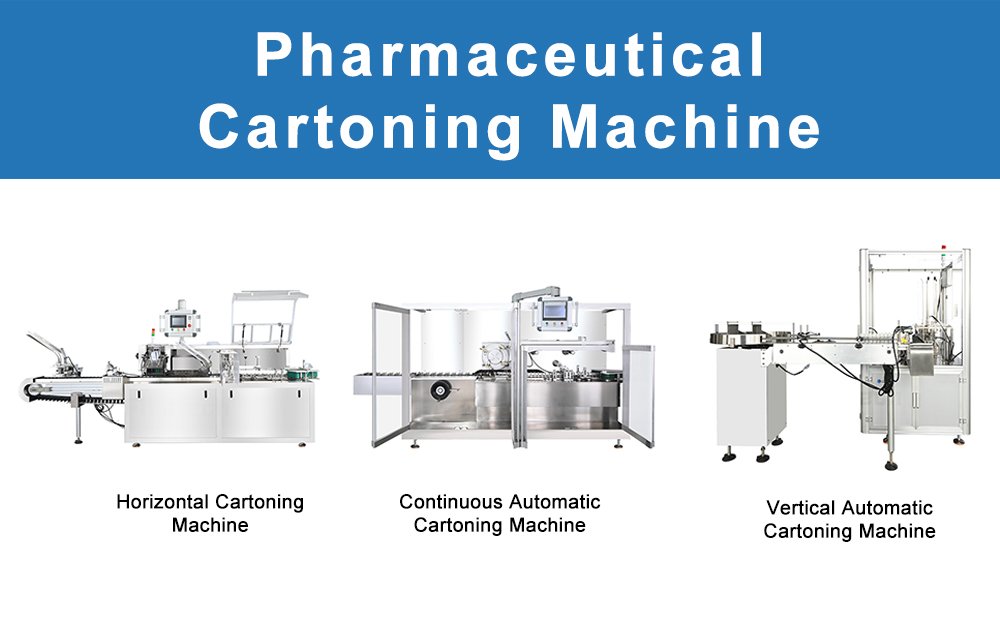
But the type of cartoning machine you choose should align with your product range, production scale, and packaging requirements. This blog will cover 5 types of cartoning machines used in the pharmaceutical industry to help you make informed decisions and choose well based on your unique needs.
Quick Comparison: Which Cartoning Machine Is Right for You?
| Cartoning Machine | Packaging Capacity (Carton Per Minute) | Approximate Cost | Best for |
| Horizontal Cartoner | 30-400 | $15,000 – $100,000 | ′ Versatile packaging forms ′ Bulk, multi-packing items |
| Vertical Cartoner | 45-200 | $9,000 – $100,000 | Small footprint Diverse, fragile product range |
| Pick and Place Cartoner | 80 | $5,000 – $100,000 | Varied packaging and products Flexible, small batch production lines |
| Wrap-Around Cartoner | 200 | $8,000 – $70,000+ | Primary packaging Random product orientations |
The 5 Types of Cartoning Machines Used in the Pharmaceutical Industry
The cartoning machine market in the pharma sector will expand to USD 2.34 billion by 2032. This growth is due to the rising need for automation to meet market demand and boost productivity by cutting manual labor. Below, we will discuss 5 types of cartoning machines used in the pharmaceutical industry, so you get a head start before stepping into the market for purchase.
1. Horizontal Cartoners (End Loaders)
A horizontal cartoner is a premium industry apparatus used to load products in cartons from a horizontal direction. The automated system picks a flat carton (from a stack of cartons), erects it into a 3D shape, and pushes blisters, vials, patient leaflets, sachets, and other such items into the carton from one end. For this reason, it is also called a side loader or end loader.

The machine also has a built-in system for folding and sealing the open flaps of cartons using mechanical pressure or hot melt adhesive. After successful cartoning, the machine runs a quick integrity check and separates the poor quality packages from accepted cartons. Several types are available in the market that differ based on their operation and functionality.
Continuous Motion Cartoners: These automatic cartoners don’t stop mid-insertion and are best suited for high-volume production lines, handling over 100 cartons per minute.
Intermittent Motion Cartoners: Cartoners pause for loading, making them suitable for batch-scale packaging of larger products with a 60-carton capacity per minute.
Semi-Automated Cartoners: As the machine only automates carton assembly and sealing, it is economical for small-scale production lines. Products need manual placement into cartons.
2. Vertical Cartoners (Top Loaders)
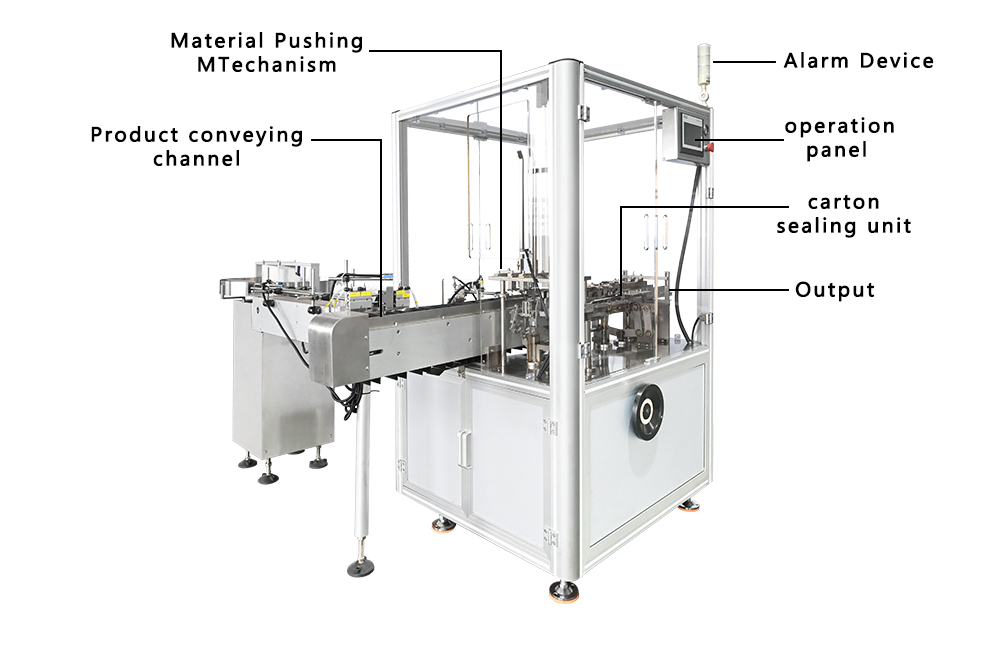
Vertical cartoners insert pharma products from above in open-top carton boxes. It picks, assembles, and loads the cartons in a vertical direction, hence also named top loaders. In this cutting-edge equipment, gravitational force assists the packaging process. Therefore, it is ideal for loading loose and lightweight items such as bulk powders, granules, and tablets.
If your manufacturing facility has less space, the biggest benefit of investing in a vertical cartoning machine is its compact upright design. Facilities that need frequent shifts between product shapes and sizes can also leverage the simple yet flexible design of vertical-style cartoners. Different operational models exist for top loaders in the pharma packaging industry.
Manual Load Cartoners: It requires low capital investment in the beginning compared to fully automated machines. However, the need for manual labor can increase costs in the longer run.
Continuous Motion Turret Cartoners: These automatic vertical cartoners run on continuous, high speed with a capacity to pack 30-80 cartons per minute.
Intermittent Motion Cartoners: Good choice for batches, the intermittent vertical cartoner offers rapid changeover with the same capacity as its continuous motion counterpart.
Delta 3 Integrated Cartoners: These delta or arm-style cartoning machines employ robotic arms to organize and insert disordered items into cartons with swift precision.
3. Robotic (Pick and Place) Cartoners
These delta or arm-style cartoning machines use robotic arms to pick and place randomly oriented items and sort them into cartons with great speed and accuracy. It increases efficiency for robust manufacturing lines while also reducing packaging defects by imprinting batch tracking information (expiry dates, control numbers) on all products.
The system automates the quality assurance after loading, checking for proper orientation and correct labels. Robotics-integrated machines are a wise investment for pharma packaging as they can minimize 50% labor costs based on Pharmaceutical Commerce Reports. Available in both horizontal and vertical technologies, these pick and place cartoners have several modifications.
Spider Robot Cartoners: These top loaders have three to four robot arms to enhance product loading speed into cartons.
Articulated Arm Cartoners: It utilizes a six-axis robotic system, designed for complex and heavy-duty packaging of different product orientations.
Vision-Guided Cartoners: Such cartoners use advanced cameras to detect randomly oriented items and insert them into cartons from the top.
SCARA Robot Cartoners: Handling 50 cartons per minute, SCARA provides sub-millimeter level packaging precision. It is appropriate for small-scale operations and smaller components.
4. Wrap-Around (WA) Cartoners
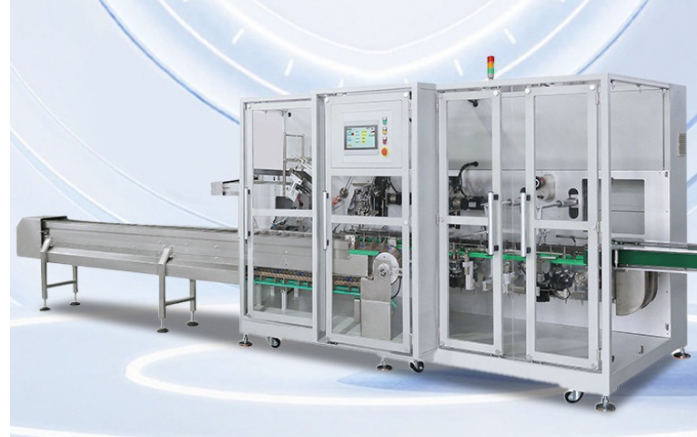
This unique cartoning technology wraps a blank cardboard sheet around the pre-packed items and seals them with a firm protective layer for efficiency. The product loading can be manual or automatic, depending on the cartoner type. These cartoners can manage pharmaceutical items like syringes, tablets, and capsules, ensuring compliance with safety and regulatory standards.
They reduce the use of packaging material, making them a sustainable choice for the pharmaceutical industry. Based on motion style, WA cartoners can be continuous or intermittent (stop-and-go) loaders. However, many other options are market-ready based on their function.
Case WA Packers: This agile cartoner erects, forms, and seals the corrugated sheets around items in a single run.
Sleeve WA Cartoners: Sleeve cartoners wrap a cardboard sleeve around products, which makes them ready for secondary packaging.
Robotic WA Cartoners: These use vision-guided systems to place products into cartons, followed by a wrap-around packaging.
5. Specialized Automated Cartoners
As one of the most popular types of cartoning machines, automated cartoners dominate the pharmaceutical industry in horizontal and vertical styles, as well as continuous-motion and intermittent-motion models. However, with evolving technology, many specialized versions of automated cartoners have begun to dominate the market.
For example, an index motion automated cartoner is closely related to intermittent motion automated cartoning. It begins indexing only after it detects the product or item to be packed, instead of following a fixed stop-and-go cycle. These machines are also customizable based on specific facility and packaging needs.
How to Find the Right Cartoning Machine for Your Business?
The following key factors are non-negotiable when selecting a cartoner for a pharmaceutical packaging line.
1. Product Type
Choose rapid changeover features for varied items and vertical cartoners if the product range is free-flowing and fragile.
2. Speed
The speed of your cartoning machine should match your production scale. High-speed cartoners offer 100-400 CPM, while low-speed machines are below 50 CPM.
3. Space Requirement
Select designs that require minimal footprint for installation if you have space restrictions in your manufacturing facility.
4. GMP Compliance
Machines should meet Good Manufacturing Practice (GMP) standards that include material hygiene, automated inspection, and documentation.
FAQs
1. What is a pharmaceutical cartoning machine?
A pharmaceutical cartoning machine forms flat carton blanks, inserts the product and leaflet, then closes the carton for secondary packaging. It usually sits after blister packing, bottle filling, tube filling, sachet packing, or pouching. In pharma lines, it also supports product protection, traceability, label control, and packaging consistency.
2. Which cartoning machine is best for blister packs?
A horizontal automatic cartoner is usually best for blister packs because blisters can be stacked, counted, pushed sideways, and paired with folded leaflets. It also integrates well with blister packaging machines and vision inspection systems. For high-volume blister lines, continuous-motion horizontal cartoners are often preferred.
3. What products can pharmaceutical cartoning machines pack?
They can pack blister strips, bottles, vials, ampoules, tubes, sachets, trays, pouches, inhalers, and medical device kits. Many machines can also insert folded leaflets, apply codes, reject faulty cartons, and connect with serialization systems. The product type determines the feeder, carton style, closing method, and inspection setup.
4. How fast are pharmaceutical cartoning machines?
Speed depends on machine type, product shape, carton size, leaflet complexity, inspection setup, and operator skill. Some blister cartoners run around tens to hundreds of cartons per minute, while high-speed continuous systems can go much higher in suitable applications. Published supplier ranges show blister cartoners around 40 to 160 cartons per minute and some continuous side-load systems up to several hundred cartons per minute.
Turn Your Idea Into a Working Facility
To start a small-scale pharmaceutical manufacturing business, do the right things from the beginning. Missing even one area can slow your progress or cause problems later in the manufacturing process.
If you are struggling to set up a compliant facility or design a production line, you need expert help. And you can get that from Finetech.
We offer pharmaceutical turnkey solutions, production line design, and pharmaceutical equipment based on your product type, capacity, and budget. Rather than dealing with separate vendors, you get everything aligned from the start.
Contact Finetech today for further assistance!
Copyright Notice:
You may not reproduce, modify, publish, display, transmit, or in any way exploit any content on this website, or use such content to construct any kind of database without prior express written approval by Finetech Group. For permission to use the content, please contact: info@pharmamachinecn.com
Disclaimer:
The information contained in this article is for general information purposes only. The Company does not guarantee the accuracy, relevance, timeliness or completeness of any information, and the Company assumes no responsibility for errors or omission in the content of this article.