English
  Russian
  Turkish
  Spanish
  French
  German
  Japanese
A
Agitators (Hopper Agitators)
Agitators mount inside the hopper or tank and keep the product mixed and flowing. Without them, thick stuff like sauces and lotions settles or bridges and stops feeding. Anchor style, paddle style, and propeller style are the most common types.
Motors driving them burn out from the constant load, especially with heavy products. Shaft seals leak. Blades wear thin. Stainless steel is standard for food and pharma. Check the shaft seal regularly because a leaking agitator seal means product where it shouldn’t be.
Air Regulators and FRL Units
The FRL, which stands for filter-regulator-lubricator, sits on the compressed air supply line feeding the machine. It cleans the air, sets the pressure, and adds a fine mist of oil for lubrication.
Dirty or wet air kills pneumatic parts fast. Solenoid valves stick. Cylinders corrode. The filter element inside the FRL unit clogs over time and needs to be swapped out. Most people set it and forget it, which is exactly the wrong approach.
Auger Screws
The auger is the helical screw inside the filling tube that spins to push a set amount of powder into each container. Pitch, diameter, and flight design all determine how much drops per turn.
Stainless steel for food and pharma, sometimes coated for sticky powders. Flights wear down and fill accuracy drifts. When the drift gets past your tolerance you need a fresh one. They come in all sizes matched to specific filler models.
Some powders are brutal on augers. Anything abrasive like spice blends with salt or sugar will eat through flights faster than you’d expect.
B
Bearings
Show up everywhere. Conveyor rollers, pump shafts, turntable drives, auger support points. Standard deep groove ball bearings handle most jobs. Sizes like 6001, 6003, 6005 cover a lot of machines.
Sealed bearings last longer in wet or dusty environments. Open bearings need grease on a schedule. Either way they wear out eventually. Listen for rumbling or grinding during production. That noise means the bearing is telling you something and you should listen.
Belts (Conveyor and Drive Belts)
Conveyor belts move bottles and containers through the filling line. Drive belts transfer power from motors to pumps, augers, and other moving parts. Flat belts, V-belts, and timing belts all show up depending on the machine.
Conveyor belts stretch and crack. Drive belts slip when they wear. Timing belts skip teeth. All of them cause problems when they fail. Keep the right sizes on the shelf and check tension regularly.
Bottle Guides and Rails
These are the guide rails and lane guides that keep bottles lined up and moving straight through the filling station. Stainless steel or food-grade plastic depending on the machine. They take a beating from bottles bumping into them all day.
Bent or loose guides mean bottles go sideways. Jammed bottles mean the line stops. Adjustable designs let you switch between bottle sizes. Wear points are the mounting brackets and the rail ends where bottles hit hardest.
C
Cam Followers
Cam followers ride on cam tracks in rotary filling machines. They control the motion of pistons, valves, and nozzle lifts as the turret rotates. Bearings inside them handle the load.
When a cam follower seizes or flattens, the motion it controls goes wrong. Fill accuracy drops or valves don’t open right. Replace them when you feel roughness or see flat spots.
Check Valves
Check valves let liquid flow one way and block it from going back. In piston fillers they control the draw and discharge cycle. On the draw stroke the inlet check opens and the outlet closes. On the push stroke it flips.
They foul with thick products or anything with particles. When a check valve sticks, fill accuracy goes out the window. Ball check valves are common for thin liquids. Swing checks and spring checks show up too.
Keep a full set of rebuild kits. The seats and balls wear, and even a tiny amount of wear causes dripping and inconsistent fills.
Conveyor Chains and Links
Chain conveyors move containers through the filling line. Individual links wear and stretch over time, which throws off timing with other stations downstream. Stainless steel chains are standard for food and beverage.
Master links make field repairs possible. But once a chain stretches past spec the whole thing needs replacing. Running a stretched chain wears sprockets faster and makes the problem compound on itself.
Cylinders (Piston Filling Cylinders)
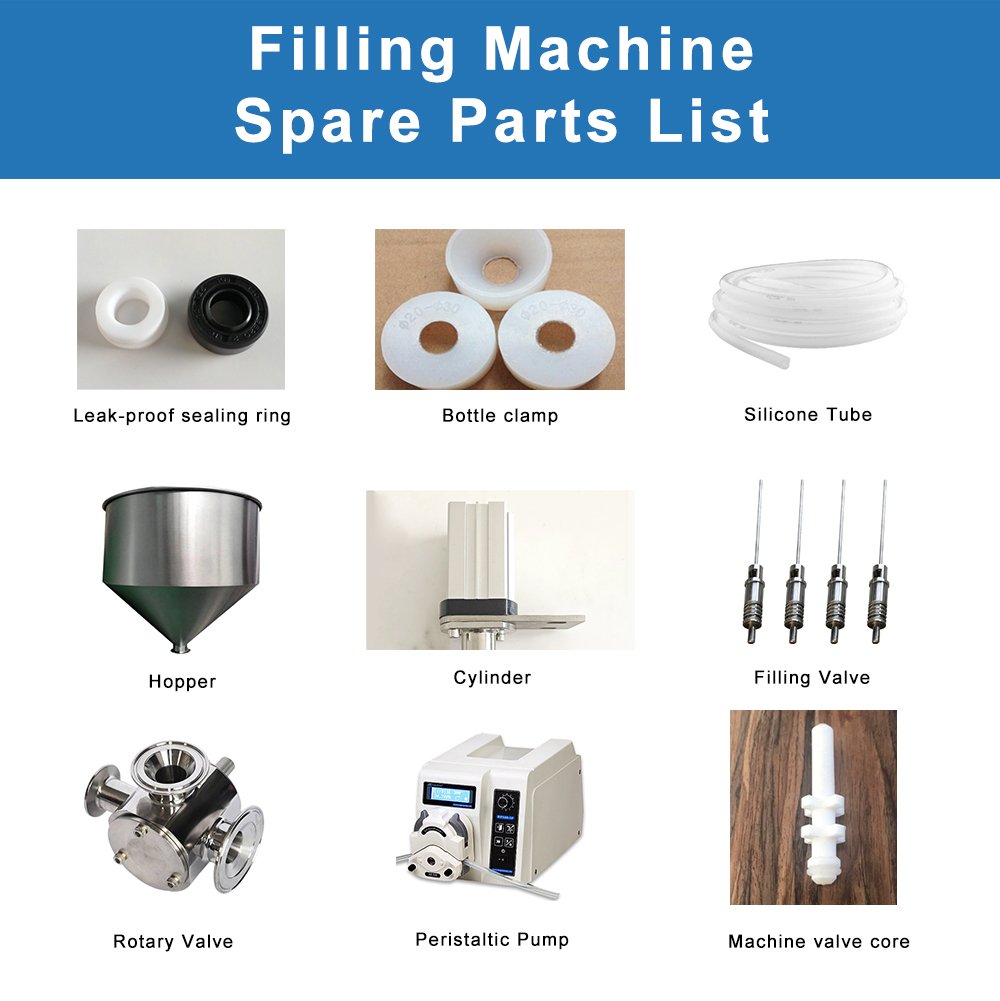
The cylinder is the tube the piston slides through. Its internal volume determines how much product gets dispensed per stroke. Bore finish has to be mirror smooth for the seals to work right.
Scratches or scoring inside the bore mean product leaks past the piston seals. Once the bore is damaged you either hone it back to spec or replace the whole thing. Stainless steel 316L is standard for corrosion resistance. Different bore sizes give different fill ranges, typically up to a 10:1 ratio for a given cylinder.
D
Diving Nozzle Mechanisms
Diving nozzles drop down into the container before the fill starts, then rise as product flows in. This reduces foaming and splashing. The mechanism is usually pneumatic with guide rods.
Seals on the guide rods wear and the nozzle starts drifting or wobbling. Air cylinder seals go too. When the dive isn’t smooth you get foam and messy fills. Not complicated to fix but easy to ignore until it’s a real problem.
Drip Trays
Sits under the nozzle area catching any drips or overflow between fills. Stainless steel. Simple part. Easy to forget about.
But a dirty or overflowing drip tray is a hygiene issue and a slip hazard. Some have drain ports. Others you just pull out and dump. Either way they need cleaning on a schedule. Keep a spare if yours gets dented or corroded.
E
Emergency Stop Switches
E-stops are big red mushroom buttons that kill power to the machine instantly. Every filling machine has at least one. They’re a safety requirement, not optional.
They do wear out from being pushed. The contact block inside fails and the switch stops working. Test them regularly. A non-functional E-stop is a serious safety violation. Spare contact blocks are cheap.
Encoders (Rotary and Linear)
Encoders measure position and speed. On filling machines they track turntable rotation, piston stroke, and conveyor speed. The PLC uses this data to keep everything in sync.
If an encoder fails the machine loses its sense of where things are. Fills happen at the wrong time. Bottles pile up. Optical encoders are precise but dust-sensitive. Magnetic types handle harsh environments better. Keep a spare of each type the machine uses.
F
Fill Nozzles
Nozzles deliver product from the filler into the container. Straight-down types for free-flowing liquids. Diving nozzles for foam control. Bottom-up fill nozzles for viscous products. Positive shut-off nozzles for drip prevention.
Material is usually 316 stainless. Nozzle tips wear from product contact especially with abrasive slurries. O-rings inside the shut-off mechanism need periodic replacement. A dripping nozzle means product on the sealing area of bottles and messy labels.
Different container openings need different nozzle sizes. Most machines let you swap nozzle tips quickly. Stock the sizes you run most often and a few spare O-ring kits.
Flow Meters
Flow meters measure product volume passing through the line. In flow meter fillers they’re the primary metering device. The PLC reads the flow count and shuts off the valve when the target volume is hit.
Magnetic flow meters, Coriolis meters, and oval gear meters each have their strengths. Mag meters handle thin conductive liquids. Coriolis measures mass flow. Oval gear works well for viscous stuff.
Calibration drifts over time. When fills start coming up short or heavy, recalibrate before you start swapping parts.
Funnels and Collectors
Funnels guide product from the auger or metering device into the container opening. Collector funnels catch overspill and route it back. Stainless steel, food grade, easy to clean.
They get clogged with sticky products. Dented funnels don’t seat right and you lose product. Keep spares of each size especially if you run multiple container formats.
G
Gaskets and Seals
Gaskets seal the joints between pipes, hoppers, valves, and filling heads. O-rings, tri-clamp gaskets, and flat gaskets are everywhere on a filling line. Most are food-grade silicone, EPDM, Viton, or PTFE.
They harden, crack, and compress over time. A leaking gasket can mean product dripping where you can’t see it, which is both waste and a sanitation issue. Swap them on a schedule not just when they fail.
Tri-clamp gaskets in particular deserve attention. They’re the quick-connect seals used throughout sanitary piping. A bad one leaks product or lets air in. Keep a box of each size.
Color-coded gaskets help here too. Different colors for different materials so the operator grabs the right one by sight. EPDM is usually black, silicone is white or blue, Viton is brown. One wrong gasket in an acid product line can dissolve in hours and contaminate a whole batch.
Gear Pumps
Gear pumps use interlocking gears to trap and move product. Common on filling machines that handle oils, syrups, and other medium-viscosity liquids. Each fill head typically has its own pump.
The gears wear over time and the fit loosens. When that happens fill accuracy drops because product slips back through the gap. Bearing failure is the other common issue. Rebuilt gear pump assemblies are available for most models and cost less than brand new.
H
Hoppers
The hopper holds bulk product and gravity-feeds it to the filling system. Sizes range from a few gallons on benchtop units to hundreds of gallons on production lines.
Stainless steel 304 or 316 is standard. Welded seams need to be smooth and free of crevices for cleaning. Heated hoppers keep products like chocolate or wax at the right viscosity. Level sensors inside signal the system to refill from a bulk tank.
Hopper lids keep contaminants out and are often required for food safety audits. A cracked or warped lid is a compliance issue, not just an annoyance.
Hoses and Tubing
Product hoses connect the supply tank to the hopper and the filler to the nozzles. Food-grade silicone, reinforced PVC, and braided stainless are common materials.
They crack, kink, and degrade from product exposure over time. Peristaltic fillers rely entirely on the tube for pumping action and the tube is a true wear part. Replace on a set schedule not when it bursts.
Make sure any replacement hose meets the same food or pharma grade rating as the original. Wrong material means failed audits or contamination.
I
Induction Sealers (Foil Sealer Parts)
Induction sealers bond a foil liner to the bottle opening after filling. The sealing head, coil, and power supply are the main parts. Coils burn out from heat. Power supply boards fail from electrical stress.
Sealing head caps and conveyor guides wear from constant bottle contact. Foil alignment guides need to be straight or you get lopsided seals. Not every filling line has one of these but those that do know the headaches when it acts up.
L
Level Sensors
Level sensors sit inside hoppers and tanks and tell the control system how much product is left. Float switches, capacitive sensors, and ultrasonic types all show up depending on the product and accuracy needed.
Float switches stick. Capacitive sensors drift from buildup on the probe. Ultrasonic types lose accuracy with foamy products. When the sensor lies to the PLC the hopper runs empty mid-fill and you get short fills or air pockets.
Clean the sensors regularly and keep spares. A bad level sensor doesn’t always throw an alarm. Sometimes it just quietly causes problems that take a while to trace back.
Load Cells
Load cells are the weight sensors under the container platform on gravimetric fillers. They measure the weight of product going into each container in real time. The PLC uses their signal to stop the fill at the right weight.
Accuracy matters here. A load cell drifting even a fraction of a percent means overfills or underfills across your whole run. Overloading them or banging heavy containers onto the platform shortens their life. Recalibrate on a fixed schedule.
M
Motors (Servo, Stepper, and Gear)
Main drive motors, pump motors, auger motors, turntable motors, conveyor motors. A filling line has a lot of them. Servos for precision jobs. Steppers for simpler positioning. Gear motors for brute torque.
When a motor dies, that station dies. Some are standard catalog items. Others are specific to the machine maker and take weeks to get. Find out which category yours fall into and stock spares for the hard-to-get ones.
Check motor mounts and couplings during maintenance rounds. A loose coupling causes vibration that damages bearings and shortens motor life. Five minutes of checking can save thousands in repairs.
N
Nozzle O-Rings and Seals
Every nozzle has internal seals that keep product from leaking past the shut-off point. O-rings, quad rings, and PTFE seals are standard. They sit in grooves machined into the nozzle body and press against moving parts.
Product wears them down. Acidic products eat certain rubber compounds. Hot products accelerate degradation. When a seal goes you get dripping between fills and messy bottle necks.
Keep a full kit for every nozzle type on your line. Note the material spec. Silicone, Viton, EPDM, and PTFE all serve different product types. Wrong material in the wrong product and you’ll be replacing it again in a week.
Color coding helps. Some shops mark each seal bag with the nozzle position it belongs to. Takes the confusion out of changeover especially when you’re running multiple nozzle sizes on the same machine.
P
Piston Seals (V-Rings, O-Rings, Cup Seals)
These seal the piston inside the cylinder on volumetric piston fillers. They have to be tight enough to prevent product bypass but not so tight that they create excessive friction.
Teflon V-rings are common. So are food-grade O-rings and cup seals. They wear from the constant back-and-forth motion. When they start leaking, fill volumes drop and product ends up behind the piston where it shouldn’t be.
Material compatibility matters. Some products attack certain seal compounds. Check with the seal supplier if you’re filling anything unusual.
Swap them on a fixed schedule based on run hours rather than waiting for symptoms. By the time you notice leaking the seal is already well past done and product has been getting behind the piston for a while.
PLCs and Controllers
The PLC runs the fill sequence, reads sensors, controls valves and motors, and monitors everything. HMI touchscreens let operators adjust settings. Common brands: Siemens, Allen-Bradley, Omron, Mitsubishi, Delta.
Always back up the program. A dead PLC without a backup means reprogramming the whole machine from scratch. Some shops keep a spare PLC loaded and ready.
HMI screens crack or fail from heat. A spare loaded with the current config is cheap protection against a bad week.
Pneumatic Cylinders
Air cylinders power nozzle dive mechanisms, valve actuators, bottle stops, container clamps, and more on filling machines. Standard bore sizes from SMC, Festo, Airtac.
Worn seals cause sluggish or incomplete motion. Rods get scored from dirty air or lack of lubrication. When a cylinder acts up, check the air quality first. Dirty air is the number one killer of pneumatic parts on any filling line.
Proximity Sensors
Detect the presence of bottles at fill stations without touching them. Inductive types sense metal caps. Capacitive types sense the bottle itself. Photoelectric types use light beams.
They get bumped out of alignment by bottles. Dirty lenses reduce range. When one stops working the machine either fills an empty space or skips a bottle. Both are waste. Spare sensors and a 5-minute alignment check during shift changes prevent most issues.
Pumps (Gear, Lobe, Peristaltic, Piston)
The pump moves product from tank to nozzle. Different types for different products. Gear pumps for oils and syrups. Lobe pumps for thick creams with particles. Peristaltic pumps for sanitary applications where you want zero product contact with pump internals. Piston pumps for high-accuracy volumetric fills.
Each type has its own wear parts. Gear pumps wear at the gear faces. Lobe pumps need new rotors and seals. Peristaltic pumps eat through tubing. Piston pumps need cylinder seals and valve rebuilds.
Know which type you have and stock its specific wear kit. A generic parts order for “pump parts” will get you nowhere.
Pump speed and pressure also affect wear rate. Running a pump hard all day shortens its life versus running it at 70 percent capacity. If you can size up slightly on the pump, the lower stress pays off in longer intervals between rebuilds.
R
Rotary Valves
Rotary valves sit between the hopper and the piston cylinder on rotary-valve piston fillers. The valve rotates 90 degrees to switch between draw and discharge. On draw it connects hopper to cylinder. On discharge it connects cylinder to nozzle.
They handle thick products and particulates better than check valves because the bore can be hollowed out wide. Wear points are the valve faces and the body bore. When they wear, product leaks between strokes and fill accuracy suffers.
Rebuilding involves lapping the valve face back to a smooth flat surface. New O-rings on the valve body complete the job. If the bore is scored beyond repair, replace the whole assembly.
These valves are what make piston fillers work with chunky products like salsa, jam, and thick sauces. Without a rotary valve you’re stuck using check valves, which clog on anything chunky. So keeping this part in good shape isn’t optional if that’s your product type.
S
Sensors (Assorted)
Temperature sensors on heated hoppers and jacketed tanks. Pressure sensors on pump lines. Speed sensors on conveyors and turntables. Every one of them is a data point the PLC relies on.
When a sensor gives bad data the PLC makes bad decisions. Fills at the wrong temp. Pump pressure out of range. Conveyor speed off. Troubleshooting sensor issues starts with checking wiring and connections before swapping the sensor itself.
Solenoid Valves
Control air flow to pneumatic cylinders and sometimes product flow in certain filling systems. Standard 5-port 2-position types for air, plus specialty food-grade types for product lines.
They stick, leak, and burn out coils. Dirty air accelerates all three problems. A good FRL unit upstream helps but doesn’t eliminate wear. Note port size and coil voltage when ordering replacements. Wrong voltage on the coil is a fast way to fry a brand new valve.
Star Wheels and Guide Screws
Star wheels index bottles into position on rotary fillers. Guide screws (also called timing screws or worm screws) space bottles evenly as they enter the filler. Both need to match the bottle diameter exactly.
Different bottles mean different star wheels and screws. Changeover parts need to be stored carefully because dings and nicks cause jams. Wear points are the pocket edges on star wheels and the flights on guide screws. Plastic types wear faster than stainless but are gentler on glass bottles.
T
Tri-Clamp Fittings and Ferrules
Standard sanitary connections throughout the product path on any food or pharma filling line. Stainless steel ferrules welded to pipe ends, held together by a clamp with a gasket between.
The ferrule faces can get scratched or dented from repeated assembly. Damaged faces mean leaks even with a new gasket. Clamps wear at the hinge and tightening nut. Keep spare clamps, gaskets, and a few ferrules on hand. They’re cheap insurance against leaks in the product path.
Tubing (Peristaltic Pump Tubing)
On peristaltic fillers the tubing IS the pump. Rollers squeeze it to move product forward. The tube is the only part touching product, which makes cleanup and changeover dead simple.
But the tube wears out from all that squeezing. Wall thickness decreases, fill volume changes, and eventually the tube ruptures. Silicone tubing for most applications. Norprene or Pharmed for chemical resistance. Know the tube ID, wall thickness, and material and keep plenty on hand.
Change tubes on a fixed schedule based on run hours. Don’t wait for a blowout. A burst tube during production means product everywhere and a thorough cleanup before you can restart.
Some operators mark the install date right on the tube with a permanent marker. Simple trick but it takes the guesswork out of knowing when it’s due for a change.
Turntable Parts
Loading turntables feed empty containers into the line. Accumulating turntables collect filled ones at the exit. Both use a rotating disc with a guide rail and a variable speed motor.
Disc surface wears smooth and bottles start slipping instead of feeding. Guide rail brackets loosen. Drive belts stretch. Motor brushes wear on older DC types. None of it is complex to fix but all of it causes stoppages if ignored.
V
Valves (Product Path Valves)
Ball valves, butterfly valves, pinch valves, and diaphragm valves all show up in filling machine plumbing. They control product flow between tank, hopper, pump, and nozzle.
Seats wear and seals degrade from product contact. Ball valves lose their seal when the seats compress. Butterfly valves get buildup on the disc edge. Pinch valves need new sleeves when the rubber wears through.
Sanitary valves with tri-clamp connections are standard for food and pharma. Always replace with the same grade and material. A downgrade in valve material can cause contamination or corrosion issues that are far more expensive than the valve.
VFDs (Variable Frequency Drives)
VFDs control the speed of AC motors on conveyors, pumps, and turntables. They convert fixed-frequency power to variable frequency, letting you dial in exact speeds.
Heat is the main enemy. VFDs mounted in hot enclosures without good airflow fail early. Capacitors inside dry out over time and the drive becomes unstable. When a VFD fails the motor it controls either stops dead or runs at full speed. Neither is good.
Keep cooling fans and filters clean. If you have a critical drive, keep a programmed spare on the shelf.
Write down the parameter settings before they’re needed. VFDs have dozens of configurable parameters and if you have to set up a new one from scratch without records it’s a frustrating guessing game. Some newer drives let you copy settings to a memory card, which makes spares almost plug and play.
W
Wear Strips
Plastic or stainless strips along conveyor rails and guide surfaces that bottles slide against. They take the friction so the main frame doesn’t.
UHMW polyethylene is the go-to material. It wears slowly and has a low friction coefficient. When it wears down bottles start hanging up and jamming. Replacement is usually just unscrewing the old strip and bolting in a new one.
Cheap part. Big impact when it’s worn out.