English
 Russian
 Turkish
 Spanish
 French
 German
 Japanese

A blister packaging line that is not maintained is a production problem waiting to happen. Seal failures, contamination, misaligned tooling, and unexpected breakdowns rarely come out of nowhere.

They build up gradually through skipped cleaning cycles and overlooked wear. To make sure that doesn’t happen to you, we will cover the daily maintenance and cleaning methods of blister equipment in the sections ahead.
Master Maintenance Schedule
For anyone looking for a maintenance schedule they can follow to keep their blister equipment working perfectly, follow this master maintenance schedule.
| Task | Frequency | Component | Method |
| Clean product contact areas | Daily after every shift | Hopper, guide rails, discharge channel, and forming plate | Lint-free cloth and 75% ethanol |
| Clean movable parts | Daily after every shift | Forming plate, punching knife, and anilox plate | Soft cloth and air blow |
| Inspect sealing temperature | Daily before production | Sealing plate and heating elements | Temperature gauge check |
| Check alignment | Daily before production | Forming tools, sealing plates, and cutting mechanism | Visual and manual inspection |
| Clean forming mold and sealing roller | Daily | Forming mold and sealing roller | Soft cloth dampened with approved agent |
| Lubricate guide shafts | Weekly | Guide shafts of each moving part and workstation | Food-grade lubricant and thin film application |
| Lubricate sprocket parts | Weekly | Sprocket components | Calcium-based fatty oil |
| Inspect transmission systems | Weekly | Vacuum filters, heating elements, and transmission system | Visual check and filter cleaning |
| Check moving parts for smooth operation | Every 3 months | All moving parts, bearings, molds, and stacked reeds | Manual operation check and visual inspection |
| Check pneumatic components | Every 3 months | Cylinder seal kits, solenoid valves, and pneumatic valves | Replace damaged kits and coils |
| Check timing belt and motor belts | Every 3 months | Timing belt, pulley, and motor belts | Visual check and replace if worn out |
| Drain and refill gearbox oil | Every 3 months | Gearbox | Drain old oil and refill with approved grade |
| Full internal overhaul | Annually | Entire machine | Inspection and readjustment of all abnormal parts |
| Electrical cabinet cleaning | Monthly | Distribution box and wiring terminals | Clean dust and check for loose or blackened terminals |
| Recoat sealing surfaces | As needed | Platen heater plates and sealing roller | Silicone synthetic polymer recoating |
Daily Cleaning Method: Step by Step
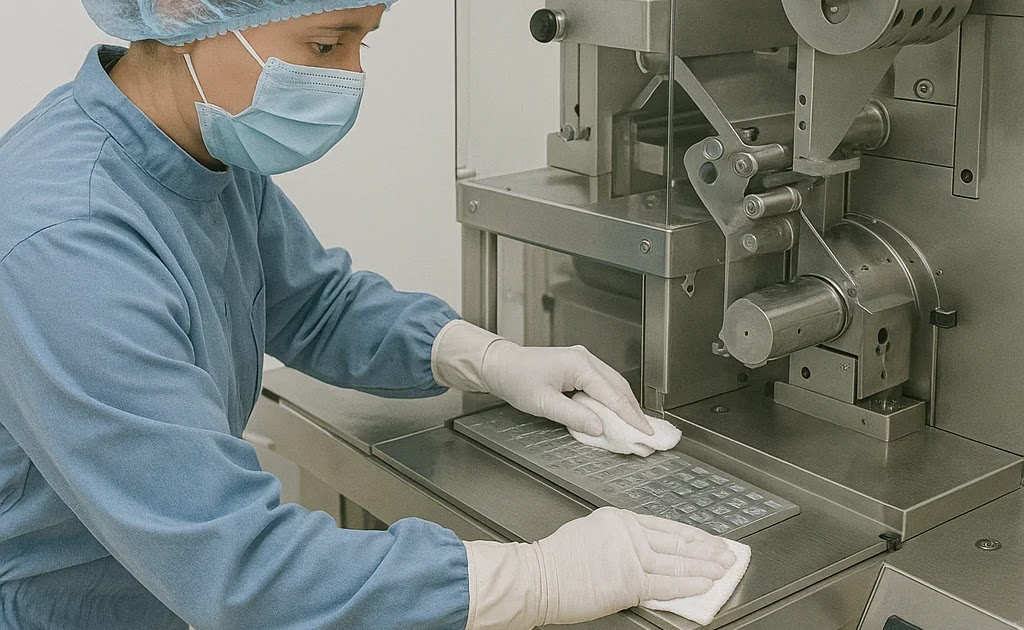
Daily cleaning is not optional anymore. It is required to clean the blister packaging equipment after each shift. The parts to be cleaned include various movable parts, and the lower anilox plate, forming plate, and punching knife.
Here’s a step-by-step guide on a cleaning method you should be using:
Step 1: Shut Down and Isolate the Machine
Power off completely, disconnect the air supply, and post warning signs before touching anything. Do not begin cleaning on a warm or running machine.
Step 2: Clear Product Residue from the Previous Run
Begin each shift by removing any debris or product residue from the previous production run. Use compressed air to blow loose powder and particles from cavities, channels, and tooling before wiping.
Step 3: Clean All Product Contact Areas
Use a lint-free soft cloth and approved cleaning agents such as 75% ethanol to thoroughly clean all parts that come into direct contact with the product. This includes the hopper, vibrating plate, guide rails, and discharge channel.
Also wipe down all movable components, including the anilox plate, forming plate, and punching knife.
Step 4: Inspect Sealing Temperature Settings
Before the next production run, verify sealing temperature against the product specification. A seal that runs too hot or too cold produces defective packs that may not be caught until further down the line.
Step 5: Check Alignment
Regularly check and adjust the alignment of forming tools, sealing plates, and cutting mechanisms. Pay particular attention to the synchronization of various machine elements, as even slight misalignment can lead to subpar packaging.
Step 6: Record Everything
All maintenance work must be recorded for traceability and analysis. Establish equipment operation logs to record daily parameters, malfunctions, and maintenance details, especially useful for industries with high compliance requirements.
Annual Overhaul
Once a year, conduct a comprehensive overhaul of the blister packaging machine, including the readjustment of any abnormal parts. This is also the point to review all maintenance records from the previous 12 months.
Identify any recurring failures and address their root cause rather than continuing to treat the symptom. With proper maintenance discipline, blister packaging machine service life can be extended well beyond 15 years.
Keep Your Blister Equipment Running Smoothly
By following this daily maintenance and cleaning method for blister equipment, you can run your production line for years. However, even a well-maintained machine can run into technical issues that go beyond routine upkeep.
When that happens, call Finetech.
We offer online technical support services available through multiple channels, including WhatsApp, email, Zoom, and mobile applications. Submit your issue and get a fast response from our specialists.
References:
Blister Packaging Machine Defects Troubleshooting and Checklist.