English
 Russian
 Turkish
 Spanish
 French
 German
 Japanese

If you’re reading a blister packaging machine spec sheet without understanding what the numbers mean, you’ll most likely end up with the wrong machine. To make sure you don’t make this mistake, here’s every technical parameter you need to watch out for.
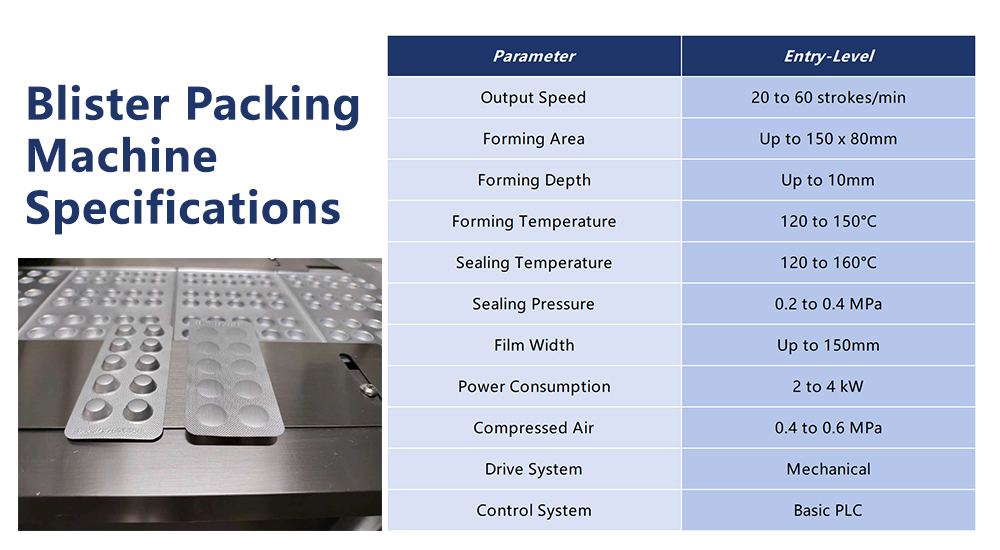
Technical Parameters of Blister Packaging Machine
The table below gives you a quick reference across all key parameters from entry-level to high-end machines.
| Parameter | Entry-Level | Mid-Range | High-End |
| Output Speed | 20 to 60 strokes/min | 60 to 150 strokes/min | 150 to 400+ strokes/min |
| Forming Area | Up to 150 x 80mm | Up to 260 x 130mm | Up to 320 x 160mm+ |
| Forming Depth | Up to 10mm | Up to 16mm | Up to 26mm |
| Forming Temperature | 120 to 150°C | 120 to 180°C | 120 to 200°C |
| Sealing Temperature | 120 to 160°C | 120 to 180°C | 120 to 200°C |
| Sealing Pressure | 0.2 to 0.4 MPa | 0.3 to 0.5 MPa | 0.4 to 0.6 MPa |
| Film Width | Up to 150mm | Up to 260mm | Up to 320mm+ |
| Power Consumption | 2 to 4 kW | 4 to 8 kW | 8 to 20 kW |
| Compressed Air | 0.4 to 0.6 MPa | 0.4 to 0.6 MPa | 0.4 to 0.6 MPa |
| Drive System | Mechanical | Mechanical / Servo | Servo |
| Control System | Basic PLC | PLC + HMI | PLC + HMI + SCADA |
Let’s discuss each of these key parameters of blister packaging machines in detail.
1. Output Speed and Production Capacity
We measure output speed in strokes per minute. One stroke produces one complete blister card. So, to calculate actual tablets per minute, multiply strokes per minute by the number of cavities in the mould.
For instance, a machine running 100 strokes per minute with a 10-cavity mould produces 1,000 tablets per minute, not 100.
Also, note that catalog speeds are measured under ideal lab conditions. Whereas real-world output in a GMP facility typically runs 15 to 30% lower due to changeovers, stops, and material variation.
2. Forming Area and Cavity Dimensions
The forming area defines the maximum blister card size the machine can produce in a single stroke. A larger forming area means more cavities per card and higher output per stroke.
Just remember, cavity dimensions must match your product size precisely. Standard machines support fixed tooling. Meanwhile, higher-tier machines offer quick-change tooling for faster product changeovers.
3. Forming Depth
Forming depth is the maximum depth of the blister cavity the machine can produce. Standard tablets and capsules typically require 6 to 12mm of forming depth.
Larger products, thick capsules, or irregular shapes may require up to 26mm. Cold-form ALU-ALU machines generally support greater forming depth than thermoforming PVC machines.
4. Forming Temperature and Sealing Temperature
Forming temperature softens the film for cavity creation. Sealing temperature bonds the lidding foil to the formed film. Both must be set precisely for your specific material.
PVC typically forms at 120 to 150°C. PVDC and cold-form ALU-ALU require different settings entirely. The sealing station temperature setpoint and the actual surface temperature differ by 8 to 15°C, depending on the heater design.
Always request measured surface temperatures from a Factory Acceptance Test support rather than relying on setpoint figures alone.
5. Sealing Pressure and Dwell Time
Sealing pressure and dwell time work together with sealing temperature to determine seal integrity. Pressure is measured in MPa or bar.
Dwell time, on the other hand, is measured in milliseconds and refers to how long the sealing plates hold contact. A spec sheet listing temperature alone without pressure range and dwell time is insufficient.
6. Film Width and Material Compatibility
Film width determines the maximum forming width the machine supports and directly affects how many cavities can be arranged across the card.
Confirm that your machine supports your specific film type, whether PVC, PVDC, ALU, or cold-form ALU-ALU laminates. Each one requires different temperature, pressure, and speed settings.
7. Power Consumption/Compressed Air
The standard compressed air requirement for most blister packaging machines is 0.4 to 0.6 MPa. In contrast, power consumption ranges from 2 kW on entry-level machines to over 20 kW on high-speed fully automatic systems.
Both figures are critical for facility planning, electrical supply sizing, and operational cost estimation.
Get the Right Blister Packaging Machine
If you would rather work with a manufacturer who already has all this covered, Finetech is the simple choice.
We supply GMP-compliant blister packaging machines across multiple types and configurations. Whether you need a standalone blister packaging machine or a complete production line, our team will configure the right solution for you.
If you think there is a fit, get in touch with our specialists today and let us take it from there!